BRSR Assurance vs Assessment: Why That’s the Wrong First Question
Regulatory Navigation
PS Team
October 1, 2026
Table of Contents
Assessment or assurance?
That is usually the first question ESG teams ask when BRSR Core lands on their desk.
It should be the second.
The question that comes earlier is:
Can you support the numbers you report?
Because whichever review route applies to your organisation, the reported information needs to be supported by a clear data trail.
If the evidence is scattered across spreadsheets, emails, bills and shared folders, choosing a review route will not solve the underlying problem.
So before getting into the difference between BRSR assessment and BRSR assurance, it is worth understanding what the process is really looking at.
It is not only the report. It is the data behind the report.
Let's break it down.
The Quick Answer
What is BRSR assessment?
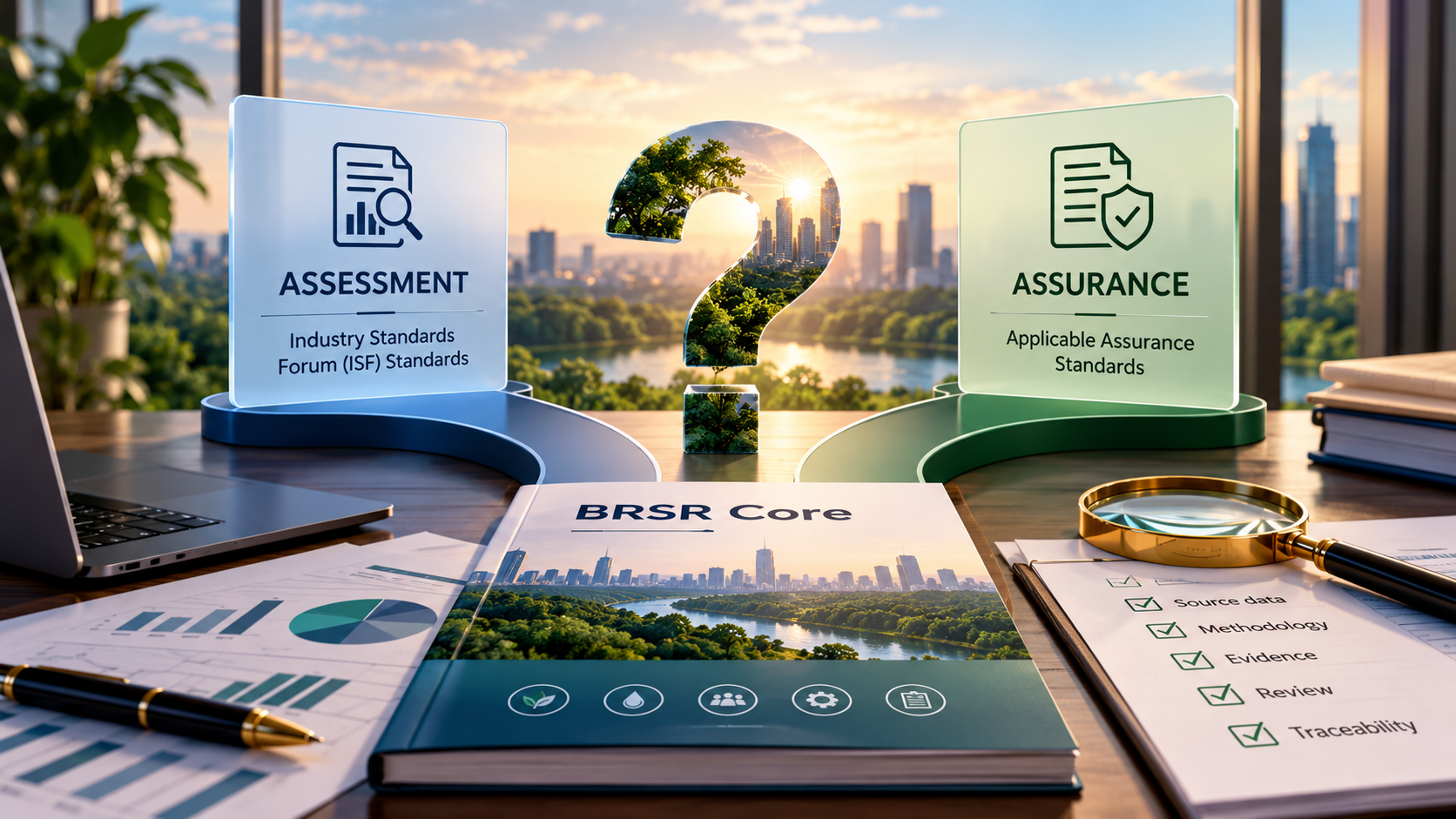
BRSR assessment is a third-party assessment of BRSR Core disclosures carried out according to standards developed by the Industry Standards Forum in consultation with SEBI.
What is BRSR assurance?
BRSR assurance is an assurance engagement over applicable BRSR Core disclosures using an applicable assurance standard. SEBI does not prescribe one specific assurance standard.
Can companies choose between assessment and assurance?
Yes.
Under the current framework, applicable listed entities have the option to undertake assessment or assurance of BRSR Core. SEBI introduced this flexibility through its March 28, 2025 circular.
What is the common requirement?
Regardless of the route, your ESG data needs to be:
Organised. Traceable. Supported by evidence.
That is where most of the preparation work sits.
First, What Is BRSR Core?
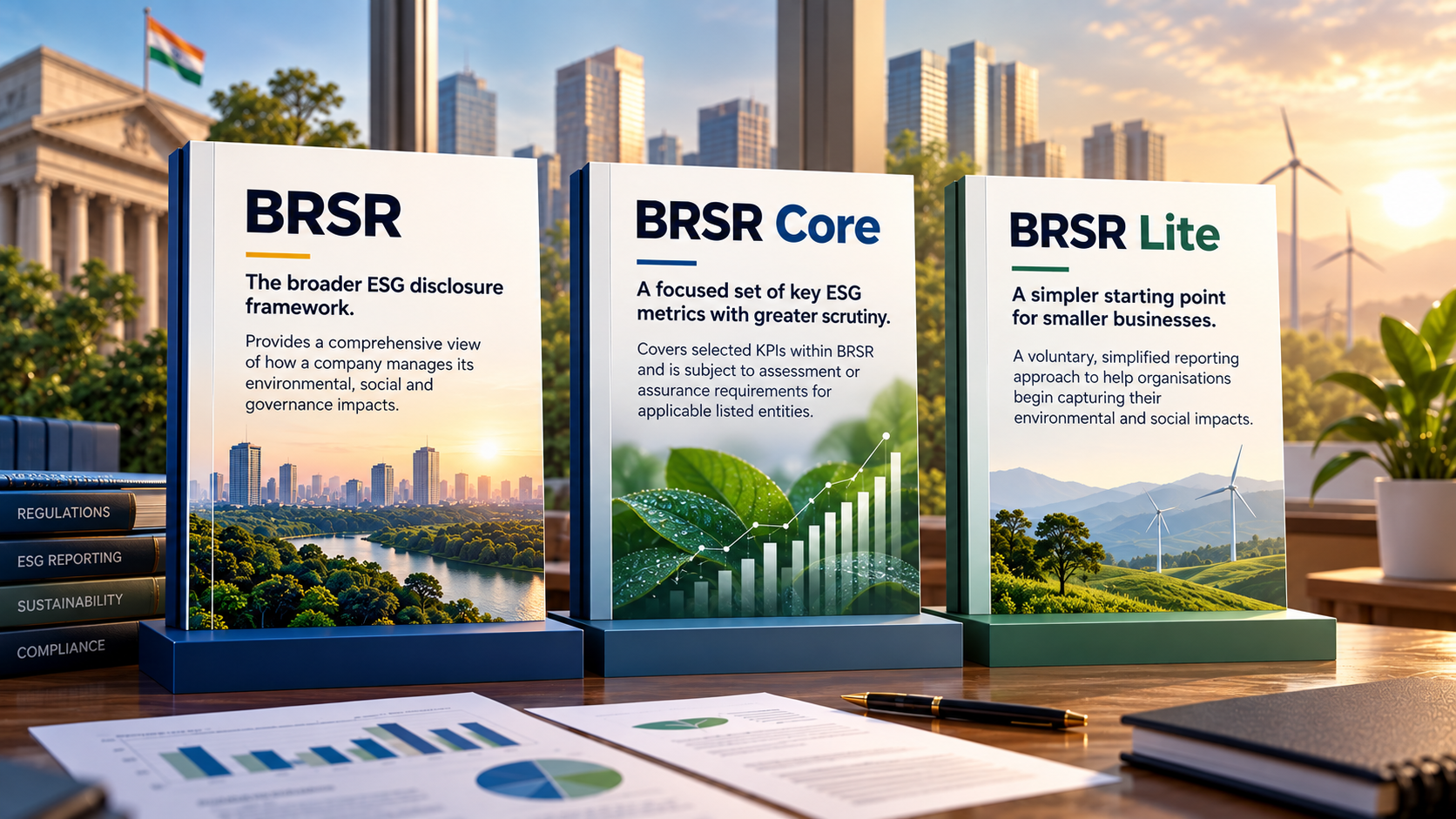
A focused set of ESG metrics within BRSR.
BRSR Core is not a replacement for BRSR.
It is a subset of BRSR, consisting of selected Key Performance Indicators and metrics across nine ESG attributes. SEBI introduced it to focus greater attention on important ESG metrics and their credibility.
The framework covers areas such as:
- Greenhouse gas emissions
- Water
- Energy
- Waste management
- Employee wellbeing and safety
- Gender diversity
- Inclusive development
- Fairness in engaging with customers and suppliers
- Openness of business
It also includes intensity ratios intended to improve comparability.
The important point is this:
BRSR Core is not only about what you report. It is also about the information behind what you report.
That is where assessment or assurance comes in.
Why the Route Is Secondary
The number is only the starting point.
Take a reported Scope 1 emissions figure.
The final number might look simple:
125,000 tCO₂e
This is an illustrative figure.
But that number is the final link in a longer chain:
Fuel consumption
↓
Source documents
↓
Activity data
↓
Emission factor
↓
Calculation
↓
Review
↓
Reported figure
An assessment or assurance process needs to consider the information supporting the reported disclosure.
That means your team needs more than the final number.
You need the whole trail behind it.
A clean data trail gives the reviewer something to work with.
A weak data trail creates questions, delays and additional effort.
Assessment vs Assurance: The Real Difference
Similar objective. Different frameworks.
The two terms are often used together, but they are not interchangeable.
BRSR Assessment
Assessment is a third-party assessment carried out according to standards developed by the Industry Standards Forum, in consultation with SEBI.
The Industry Standards Forum includes representatives from ASSOCHAM, CII and FICCI under the aegis of the stock exchanges. SEBI has published industry standards for implementation of BRSR Core reporting.
BRSR Assurance
Assurance is an assurance engagement over BRSR Core disclosures.
SEBI does not mandate one specific assurance standard. An assurance provider may use an appropriate globally accepted standard or relevant ICAI standard.
Examples include:
- ISAE 3000
- ISSA 5000
- ICAI SSAE 3000
- SAE 3410 for greenhouse gas statements
The assurance standard used should be disclosed.
In simple terms
Assessment follows the applicable ISF standards.
Assurance follows an applicable assurance standard selected by the provider.
The routes are different.
But both require the organisation to have reliable information and supporting evidence.
What Changed in 2025?
From assurance to assessment or assurance.
The original BRSR Core framework introduced by SEBI in July 2023 required reasonable assurance according to a phased glide path.
SEBI subsequently changed the framework.
On March 28, 2025, SEBI issued Circular SEBI/HO/CFD/CFD-PoD-1/P/CIR/2025/42.
The revised framework changed BRSR Core from an assurance-only approach to assessment or assurance. It also defined assessment as a third-party assessment undertaken according to standards developed by the Industry Standards Forum in consultation with SEBI.
The change was part of SEBI's broader measures to facilitate ease of doing business and reduce the cost and effort associated with sustainability reporting verification.
So if you are still working from older BRSR Core guidance that says “reasonable assurance” only, check the current framework.
The terminology and requirements have evolved.
FY 2026-27: Why This Matters
The BRSR Core glide path reaches the top 1,000.
SEBI introduced BRSR Core with phased applicability based on market capitalisation.
The glide path is:
FY 2023-24
Top 150 listed entities
FY 2024-25
Top 250 listed entities
FY 2025-26
Top 500 listed entities
FY 2026-27
Top 1,000 listed entities
FY 2026-27 is therefore an important reporting year.
If your organisation falls within the applicable top 1,000 listed entities by market capitalisation, BRSR Core assessment or assurance becomes part of the reporting requirement.
SEBI's framework also specifies how market capitalisation is determined for the relevant financial year.
So the first question is not:
“Assessment or assurance?”
It is:
“Does BRSR Core apply to us for this reporting year?”
Settle applicability first.
Then consider the review route.
What Does a Reviewer Actually Need to See?
The review starts long before the final report.
Whichever route you use, your organisation needs to be able to explain the information supporting its reported metrics.
Depending on the metric, that means being able to show:
Source data
Where did the information come from?
Methodology
How was the metric calculated?
Evidence
What documents support it?
Calculations
Were the formulas and relevant factors applied correctly?
Estimates
Were assumptions or estimates used?
Data ownership
Who prepared and reviewed the information?
Consistency
Was the same methodology applied across relevant facilities and reporting periods?
Traceability
Can the reported number be traced back to its source?
This cannot be assembled a few weeks before the reporting deadline.
It needs to exist as the data is collected.
The Real Problem Is Often the Data Trail
The final number is rarely the hard part.
Imagine an ESG team reporting electricity consumption across 70 facilities.
The total is available.
But the information behind it sits across:
- Electricity bills
- Excel files
- Emails
- Facility teams
- Procurement records
- Utility portals
- Shared folders
Then the request arrives:
“Please provide the source data and calculation supporting this number.”
Now the challenge is not calculating the figure.
It is finding and proving it.
That is where an unstructured ESG data process becomes difficult.
And it is where a structured process starts to create value.
Is Your ESG Data Ready for Review?
Before an assessment or assurance provider starts asking questions, ask your team five things.
1. Can every important BRSR Core number be traced to source data?
2. Are your calculation methodologies documented?
3. Are supporting documents stored and easy to retrieve?
4. Does every important metric have a clear owner?
5. Can you show who prepared, reviewed and approved the data?
If several answers are unclear, the problem might not be the final BRSR report.
It might be the data process behind it.
That is where preparation should begin.
What Should Your ESG Team Prepare?
Don't wait for reporting season.
There are five practical areas to put in place throughout the year.
1. Define data ownership
Every metric needs a clear owner.
That person should know:
- What data is required
- Where it comes from
- Who provides it
- Who reviews it
- Where the evidence is stored
2. Standardise methodologies
Document how important metrics are calculated.
For emissions, this could include:
- Activity data
- Emission factors
- Calculation methodology
- Organisational boundary
- Assumptions
- Conversion factors
3. Keep source evidence as you go
Do not wait for the reviewer to ask.
Store supporting documents when the data is collected.
4. Build a review trail
Your organisation should be able to show:
Prepared → Reviewed → Approved
This becomes particularly important when multiple facilities or departments contribute to one number.
5. Track data gaps
If information is missing, record the gap.
Do not allow missing information to quietly disappear inside a spreadsheet.
Who Can Perform BRSR Core Assessment or Assurance?
Expertise and independence matter.
SEBI takes a profession-agnostic approach to BRSR Core assessment and assurance.
The provider does not necessarily have to be a Chartered Accountant.
The board of the listed entity needs to ensure that the appointed provider has the necessary expertise to undertake the assessment or assurance. The framework also contains conflict-of-interest requirements.
For assurance specifically, SEBI's FAQ states that the internal auditor of the listed entity or its group entities cannot be appointed as the assurance provider.
The statutory auditor may be appointed as the assurance provider, subject to applicable competence and independence requirements.
So provider selection needs to consider two things:
Capability and Independence.
What About the Assurance Standard?
SEBI does not prescribe one specific assurance standard.
For the assurance route, SEBI's FAQ states that the Master Circular does not mandate or recommend one specific assurance standard.
Possible standards include:
- ISAE 3000
- ISSA 5000
- ICAI SSAE 3000
- SAE 3410 for greenhouse gas statements
The standard used should be disclosed.
For assessment, the third-party assessment follows the standards developed by the Industry Standards Forum in consultation with SEBI.
A Better Way to Think About BRSR Core
Instead of thinking:
“We need to get BRSR Core assessed or assured.”
Think:
“We need to make our BRSR Core data review-ready.”
That changes the preparation process.
You start asking:
- Can we trace every important number?
- Do we have the source documents?
- Are our calculations documented?
- Are relevant factors recorded?
- Are estimates clearly identified?
- Are data owners assigned?
- Are reviews documented?
- Can we respond quickly to information requests?
These questions matter regardless of which review route your organisation uses.
From Data to Disclosure
A practical BRSR Core workflow looks like this:
Collect
↓
Validate
↓
Calculate
↓
Document
↓
Review
↓
Assess or Assure
↓
Disclose
The external review is the later part of the process.
The preparation happens throughout the year.
What About Value Chain Reporting?
BRSR Core discussions also include value-chain disclosures.
SEBI revised the value-chain framework in March 2025.
For the top 250 listed entities, value-chain ESG disclosures are voluntary from FY 2025-26. The associated assessment or assurance is also voluntary from FY 2026-27.
SEBI defines the relevant value chain using upstream and downstream partners that individually account for 2% or more of the listed entity's purchases or sales by value. An entity can limit disclosure coverage to partners representing 75% of purchases and sales by value.
The practical point is simple:
Do not assume every supplier or customer is automatically in scope.
First establish the applicable value-chain requirements for the relevant reporting year.
Where Karbon by Planet Sustech Fits
BRSR readiness starts with organised ESG data.
An assessment or assurance process becomes easier to manage when the underlying ESG information is already structured.
Karbon helps organisations manage ESG data across facilities, departments and reporting requirements.
This includes:
- ESG data collection
- GHG emissions tracking
- Evidence management
- Data validation
- Review and approval workflows
- Reporting
- Data traceability
The objective is simple:
Know where the number came from.
Know how it was calculated.
Know who reviewed it.
Keep the evidence behind it.
With a structured ESG data platform, organisations can build the data and evidence trail before the BRSR reporting and review process begins.
Is Your BRSR Core Data Review-Ready?
If you are preparing for BRSR Core, start with these five questions:
1. Do we know which metrics apply to us?
2. Does every metric have a clear owner?
3. Can every important number be traced to source evidence?
4. Are our calculations and methodologies documented?
5. Can we produce the evidence quickly when requested?
If the answers are clear, you have a stronger foundation for the review process.
If they are not, that is where the work should begin.
Frequently Asked Questions
What is BRSR assessment?
BRSR assessment is a third-party assessment of BRSR Core disclosures undertaken according to standards developed by the Industry Standards Forum in consultation with SEBI.
What is BRSR assurance?
BRSR assurance is an assurance engagement over applicable BRSR Core disclosures using an applicable assurance standard. SEBI does not prescribe one specific assurance standard.
What is the difference between BRSR assessment and assurance?
Assessment follows the applicable standards developed by the Industry Standards Forum in consultation with SEBI.
Assurance follows an applicable assurance standard selected by the assurance provider and disclosed in the reporting.
Can companies choose between BRSR assessment and assurance?
Yes. SEBI's March 28, 2025 circular introduced the option for applicable listed entities to undertake either assessment or assurance of BRSR Core.
Who needs BRSR Core assessment or assurance in FY 2026-27?
The BRSR Core glide path reaches the top 1,000 listed entities by market capitalisation in FY 2026-27. Organisations should determine their applicability against SEBI's requirements for the relevant reporting year.
Does the BRSR Core provider need to be a Chartered Accountant?
No. The framework is profession agnostic. The board of the listed entity needs to ensure that the provider has the necessary sustainability expertise.
Can the internal auditor provide BRSR Core assurance?
No. SEBI's FAQ states that the internal auditor of the listed entity or its group entities cannot be appointed as the assurance provider for BRSR Core.
Can the statutory auditor provide BRSR Core assurance?
Yes. The statutory auditor of a listed entity can be appointed as the assurance provider, subject to applicable competence and independence requirements.
Which assurance standard should be used for BRSR Core?
SEBI does not prescribe one specific assurance standard. Examples include ISAE 3000, ISSA 5000, ICAI SSAE 3000 and SAE 3410 for greenhouse gas statements. The standard used should be disclosed.
When should companies start preparing for BRSR Core assessment or assurance?
Preparation should begin well before the reporting deadline.
Data ownership, calculation methodologies, supporting evidence and review processes should be established before the external review begins.
Conclusion
BRSR Core has changed how companies need to think about ESG reporting.
The question is no longer only:
“What number should we report?”
It is also:
“Can we explain where that number came from?”
Assessment or assurance comes later.
The real work starts earlier.
Reliable data. Clear methodology. Supporting evidence. Defined ownership. Documented review.
That is what makes BRSR Core reporting more review-ready.
Follow Planet Sustech for practical insights on ESG reporting, carbon accounting, regulatory developments and sustainability data.
Preparing for BRSR Core assessment or assurance? Talk to our ESG team about building a more structured data and evidence process.