BRSR vs BRSR Core vs BRSR Lite: What’s the Real Difference?
Compliance & Regulations
PS Team
September 28, 2026
Table of Contents
Three names. Three different purposes. One common source of confusion.
BRSR, BRSR Core and BRSR Lite are often discussed as if they are three versions of the same report.
They are not.
For an ESG or sustainability team, the important questions are simple:
- What is BRSR?
- What is BRSR Core?
- Where does BRSR Lite fit?
- Who needs to follow each one?
- What changes for your reporting team?
Let’s break it down without the regulatory jargon.
First, What Is BRSR?
Start with the full picture.
BRSR stands for Business Responsibility and Sustainability Report.
SEBI introduced BRSR to bring more structured and quantitative ESG disclosures into corporate reporting.
For the top 1,000 listed entities by market capitalisation, BRSR became mandatory from FY 2022-23. The framework focuses on standardised ESG information covering environmental, social and governance matters.
The objective is straightforward.
Companies should move beyond broad statements about sustainability and disclose measurable information that stakeholders can understand and compare.
That includes areas such as:
- Energy and emissions
- Water
- Waste
- Employees
- Human rights
- Consumers
- Communities
- Governance
- Business responsibility practices
BRSR also separates disclosures into Essential Indicators and Leadership Indicators, with Leadership Indicators being voluntary.
In simple terms:
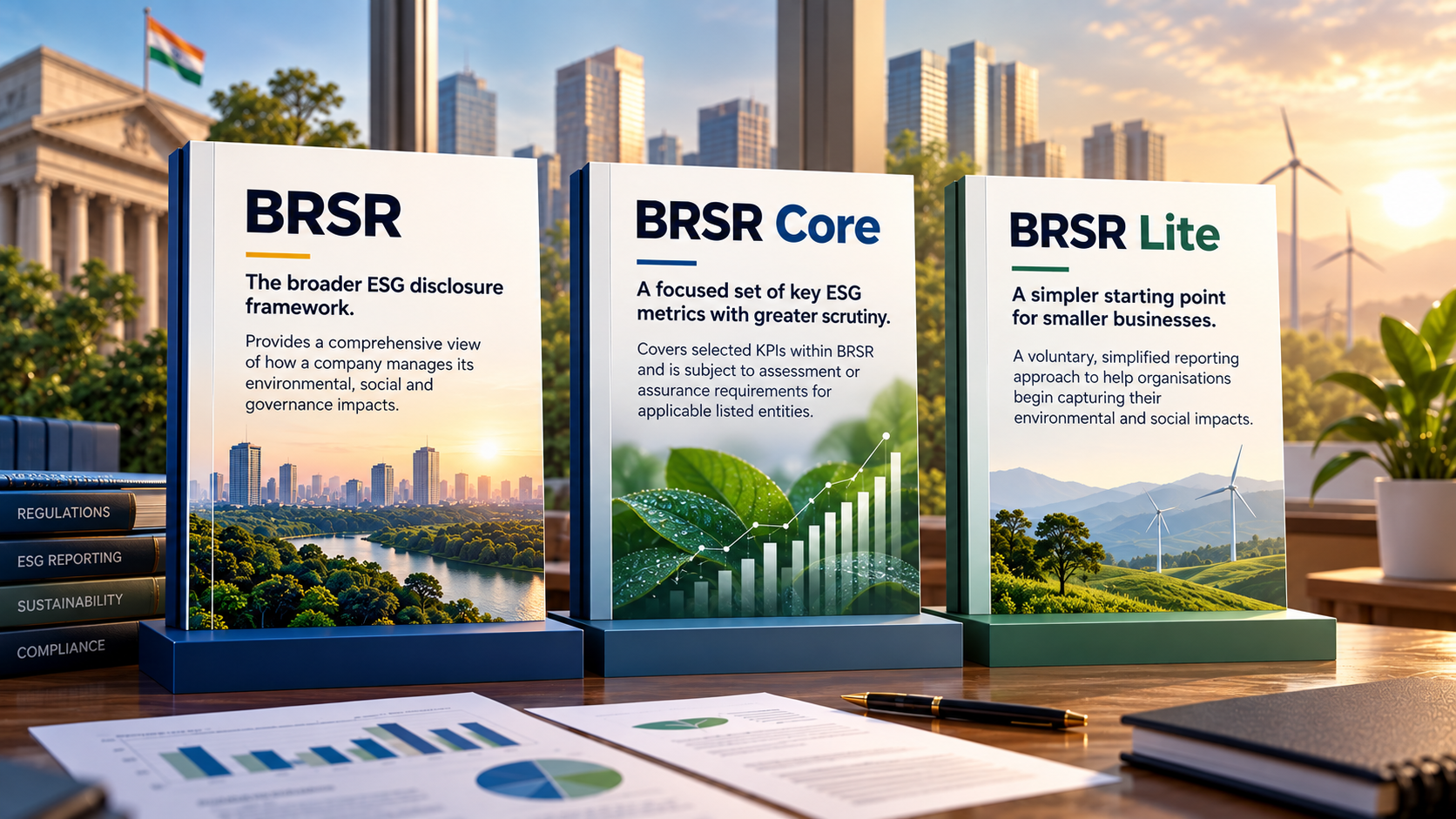
BRSR = the broader ESG disclosure framework.
It gives stakeholders a wider view of how a company manages its environmental, social and governance impacts.
Then Came BRSR Core
Less data. More scrutiny.
BRSR Core was introduced by SEBI in 2023.
It is not a replacement for BRSR.
It is a subset of BRSR, containing selected Key Performance Indicators and metrics across nine ESG attributes.
Think of it this way:
BRSR tells the broader story.
BRSR Core focuses on selected numbers that need greater credibility.
The BRSR Core framework includes metrics covering areas such as:
- Greenhouse gas emissions
- Water consumption
- Waste management
- Employee-related indicators
- Gender diversity
- Social impact
- Business openness and related indicators
It also includes specific intensity ratios to improve comparability across companies and sectors.
The important part is not only what you report.
It is also how confidently that information can be relied upon.
Who Needs BRSR Core?
This is where many companies get confused.
BRSR Core was introduced with a phased applicability based on market capitalisation.
The SEBI glide path was:
- FY 2023-24: Top 150 listed entities
- FY 2024-25: Top 250
- FY 2025-26: Top 500
- FY 2026-27: Top 1,000
As the framework reaches FY 2026-27, the BRSR Core requirements extend to the top 1,000 listed entities according to the prescribed applicability.
One important update is the terminology around verification.
SEBI's framework initially referred to reasonable assurance for BRSR Core. The framework subsequently moved to assessment or assurance, with assessment referring to third-party assessment under standards developed by the Industry Standards Forum in consultation with SEBI.
The practical takeaway
If BRSR applies to your organisation and BRSR Core applies based on the relevant market-capitalisation criteria, your ESG team needs to think beyond collecting numbers.
You need to think about:
Data → Methodology → Evidence → Review → Assessment or Assurance
So, Where Does BRSR Lite Fit?
A simpler starting point for smaller businesses.
This is where the terminology creates unnecessary confusion.
BRSR Lite is not another mandatory SEBI filing alongside BRSR and BRSR Core.
The BRSR Lite concept was developed as a simplified reporting format for smaller businesses, particularly smaller unlisted companies, to help them start capturing their environmental and social impacts without taking on the full reporting burden.
It was proposed on a voluntary basis.
The idea was practical.
Smaller businesses often do not have:
- Dedicated sustainability teams
- Mature ESG data systems
- Large reporting budgets
- Extensive reporting processes
- Separate teams for every ESG metric
A simplified format provides a starting point.
In simple terms:
BRSR Lite = a voluntary, simpler approach for organisations starting their ESG reporting journey.
It should not be presented as a third mandatory SEBI reporting requirement.
BRSR vs BRSR Core vs BRSR Lite
The simplest way to remember it
BRSR
The broader ESG disclosure.
BRSR Core
A focused set of important ESG metrics within BRSR, subject to assessment or assurance requirements for applicable listed entities.
BRSR Lite
A simplified, voluntary reporting approach designed to help smaller businesses begin capturing ESG information.
That is the basic difference.
The Common Mistake Companies Make
Don’t start with the format. Start with applicability.
A common question is:
“Should we prepare BRSR, BRSR Core or BRSR Lite?”
That is not the first question to ask.
Start with:
1. Are you a listed entity?
BRSR applicability depends on the SEBI framework and the relevant market-capitalisation criteria.
2. Does your organisation fall within the applicable BRSR Core category?
If yes, selected BRSR Core metrics require the prescribed assessment or assurance approach.
3. Are you a smaller or non-obligated business?
A simplified voluntary approach such as BRSR Lite can provide a structured starting point.
4. What does your existing ESG reporting already cover?
You might already collect much of the information required.
The challenge is often not creating more data.
It is organising the data you already have.
BRSR and BRSR Core Are Not Two Separate ESG Worlds
This distinction matters.
BRSR Core is a subset of BRSR.
SEBI's framework also provides cross-references between BRSR Core and the broader BRSR disclosures.
That means your ESG data process should not look like this:
BRSR data → separate BRSR Core data → separate assurance data
A better approach is:
One source of ESG data → structured calculations → evidence → review → reporting
The same underlying data should support the relevant reporting requirements.
For example, if your organisation reports GHG emissions, the underlying activity data, emission factors, calculations and supporting documents should be traceable.
That becomes important when someone asks:
“Where did this number come from?”
The Data Behind the Number Matters
Reporting is only as strong as the evidence behind it.
Take an emissions figure.
A reported number by itself tells you very little.
A stronger data trail looks like this:
Source document
↓
Activity data
↓
Emission factor
↓
Calculation
↓
Review
↓
Reported figure
This is where many ESG teams face operational challenges.
Data sits across:
- Excel files
- Electricity bills
- Fuel records
- Utility systems
- Procurement records
- HR systems
- Supplier responses
- Email attachments
- Shared folders
When reporting time arrives, the team has to bring everything together.
The bigger the organisation, the harder this becomes.
What About Value Chain Reporting?
BRSR discussions often extend beyond the company's own operations.
SEBI introduced value-chain ESG disclosures alongside BRSR Core. The framework has since been revised.
For the top 250 listed entities, value-chain ESG disclosures are voluntary from FY 2025-26. The framework also defines the relevant upstream and downstream partners using specified purchase and sales thresholds, with the ability to limit disclosure coverage to 75% by value.
This is important because companies should not assume that every supplier or customer needs to be brought into the same reporting exercise.
The first step is understanding which value-chain requirements apply to your organisation and for which reporting period.
What Should ESG Teams Prepare For?
Don’t wait until reporting season.
Whether you are preparing BRSR, BRSR Core or building your ESG reporting capability from scratch, the underlying preparation is similar.
Build a clear data structure
Know what data you need and where it comes from.
Assign ownership
Every important metric should have someone responsible for providing and reviewing the data.
Keep evidence
Store the source documents behind reported numbers.
Standardise calculations
Use defined methodologies and emission factors rather than rebuilding calculations every reporting cycle.
Track gaps
If information is missing, identify the gap early.
Maintain a review trail
Know who submitted, reviewed and approved important information.
Make data reusable
The same reliable ESG data should support multiple reporting requirements wherever possible.
What This Means for Your Organisation
The biggest difference between these frameworks is not simply the number of questions or metrics.
It is the level of structure and confidence required around the information.
BRSR pushes companies toward more structured ESG disclosure.
BRSR Core focuses attention on selected key metrics and their credibility.
BRSR Lite provides smaller businesses with a simpler starting point.
The common requirement underneath all three is good ESG data.
If the data is scattered, reporting becomes difficult.
If the data is structured, reporting becomes repeatable.
How Planet Sustech Fits In
ESG reporting should not depend on finding the right spreadsheet.
Planet Sustech helps organisations structure ESG data across their operations, collect information from different sources, manage reviews and approvals, and connect reported figures with their underlying data and evidence.
The goal is simple:
Capture the data once.
Keep the evidence.
Use reliable data across reporting needs.
With a structured ESG data platform such as Karbon, organisations can bring emissions, ESG metrics, reporting workflows and supporting evidence into a connected system rather than managing every reporting cycle through disconnected spreadsheets and folders.
A Simple Way to Remember
BRSR
The broader ESG disclosure.
BRSR Core
The focused metrics that need greater scrutiny.
BRSR Lite
The simpler starting point for smaller businesses.
Three names.
Different purposes.
One common foundation:
Reliable ESG data.
Frequently Asked Questions
Is BRSR mandatory in India?
BRSR is mandatory for the top 1,000 listed entities by market capitalisation from FY 2022-23. Other entities can also voluntarily disclose BRSR information.
Is BRSR Core mandatory?
BRSR Core has a phased applicability based on market capitalisation. The SEBI framework prescribed a glide path from the top 150 listed entities in FY 2023-24 to the top 1,000 in FY 2026-27.
Is BRSR Core a separate report?
No. BRSR Core is a subset of BRSR containing selected KPIs and metrics across nine ESG attributes.
What is BRSR Lite?
BRSR Lite is a simplified, voluntary reporting format developed to help smaller businesses capture their environmental and social impacts. It should not be treated as another mandatory SEBI filing alongside BRSR and BRSR Core.
Does BRSR Core require assurance?
The current framework provides for assessment or assurance of BRSR Core disclosures for applicable listed entities.
Does BRSR cover Scope 1, Scope 2 and Scope 3 emissions?
BRSR includes environmental disclosures covering greenhouse gas emissions, energy and other environmental indicators. The specific disclosure requirements should be checked against the applicable BRSR format for the relevant reporting year.
Do BRSR and BRSR Core require separate data collection?
They should not be treated as completely separate data exercises. BRSR Core is a subset of BRSR, so organisations should build a common underlying ESG data structure wherever possible.
Conclusion
BRSR, BRSR Core and BRSR Lite are often grouped together.
But they serve different purposes.
BRSR provides the broader ESG disclosure framework.
BRSR Core focuses on selected key ESG metrics for applicable listed entities, with assessment or assurance requirements.
BRSR Lite provides a simpler, voluntary starting point for smaller businesses.
The practical lesson is bigger than the terminology.
Good ESG reporting starts before the report.
It starts with reliable data, clear ownership, consistent calculations and evidence that supports every important number.
Follow Planet Sustech for practical insights on ESG reporting, carbon accounting, regulatory developments and sustainability data.
If your organisation is preparing for BRSR or BRSR Core and wants to build a more structured ESG data process, speak with our team.