Oil & Gas: A Flare Is Not a Boiler
Sector Reality
PS Team
September 21, 2026
Table of Contents
Flaring gets a lot of attention in Oil & Gas.
It is visible. It is measurable. It is often discussed in operational and environmental reporting.
But there is another part of the emissions picture that is much easier to overlook: what happens to the oil and gas after it is sold.
This is where the difference between a flare and a boiler becomes important.
Both involve combustion. But they serve very different purposes, and they represent very different parts of an emissions inventory.
Same combustion, different job
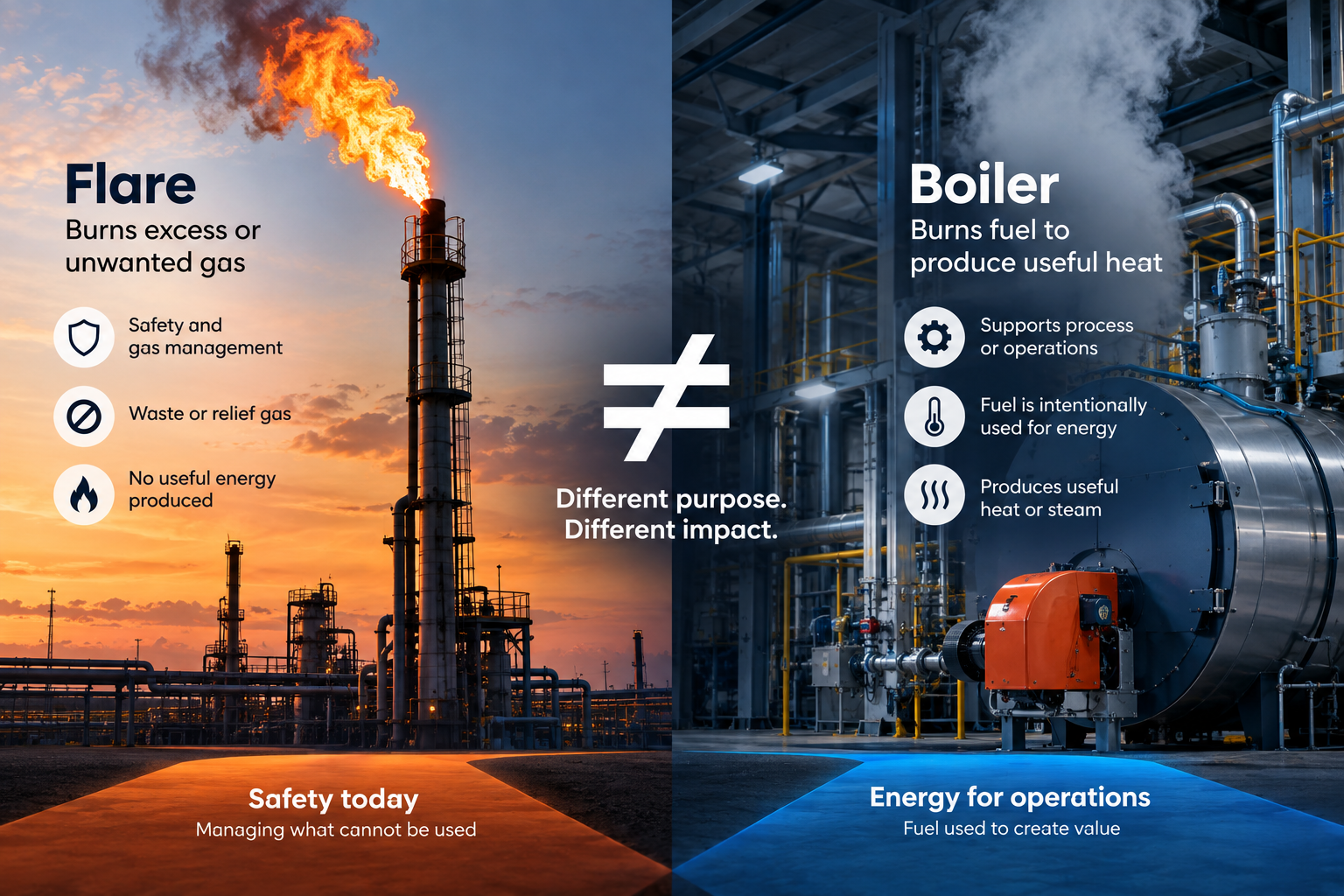
A flare and a boiler both involve combustion, but they serve different purposes.
Flare
A flare is primarily used to burn excess, waste, or relief gas.
Its typical role is gas management, safety, or disposal.
The key data to track includes the quantity of gas sent to the flare, its composition, and relevant operating data.
The key accounting question is:
“What gas was flared, and how was it accounted for?”
Boiler
A boiler burns fuel to produce useful heat or steam.
Its typical role is to support a process or provide utility services.
The key data to track includes the type and quantity of fuel consumed, along with relevant operating data.
The key accounting question is:
“What fuel was consumed, and where?”
Why the distinction matters
Both sources involve combustion, but they answer different operational and accounting questions.
A flare is about managing gas at the facility.
A boiler is about using fuel to produce useful energy.
Keeping these sources clearly separated helps your team collect the right activity data and apply the appropriate emissions accounting methodology.
The exact accounting treatment depends on the company's organizational and operational boundaries.
Under the GHG Protocol, Scope 1 covers direct emissions from sources owned or controlled by the reporting company.
So, where a flare is part of an owned or controlled operation, its direct combustion emissions fall within the company's Scope 1 inventory.
The emissions you cannot see
Now comes the bigger question.
What happens to the products after they leave your facility?
When customers use fuels sold by an oil and gas company, the resulting emissions are captured under Scope 3 Category 11, Use of Sold Products.
The GHG Protocol specifically provides a method for calculating emissions from fuels and feedstocks sold by a company. The calculation uses the quantity sold and the relevant combustion emission factor. It focuses on combustion emissions and excludes upstream emissions already accounted for elsewhere, helping avoid double counting.
For the Oil & Gas sector, this category can be substantial.
CDP's sector analysis found that, among 94 Oil & Gas companies responding to its 2021 climate change questionnaire on behalf of investors, Category 11 represented 91% of reported Scope 3 emissions and 81% of reported combined Scope 1, 2 and 3 emissions. CDP also notes that only slightly more than half of those companies had calculated Category 11 emissions.
The exact share varies by company, business model, products, and reporting boundary.
But the message is important.
The emissions from your own operations are only part of the story.
The use of the products you sell also needs to be understood.
Why the flare-versus-boiler distinction matters
Think about two different situations.
Your facility flares gas.
That is an operational emissions source within the relevant organizational boundary.
A customer later burns the oil or gas you sold in an engine, furnace, boiler, or other equipment.
That is part of the downstream emissions associated with your sold product.
Both involve combustion.
They are not the same activity.
And they should not be treated as though they answer the same reporting question.
Reducing flaring remains important.
But reducing flaring alone does not tell you how the full emissions profile of an upstream oil and gas business is changing.
What goes into a Category 11 calculation?
The basic calculation is straightforward.
For fuels and feedstocks, the GHG Protocol identifies two key inputs:
- Quantity of fuel or feedstock sold
- Relevant combustion emission factor
The calculation is essentially:
Quantity sold × combustion emission factor = emissions from use of sold fuel/feedstock
The difficult part is often the data behind those two inputs.
Ask yourself:
- Can you trace the quantity sold back to your sales records?
- Is the product type clearly identified?
- Can you show which emission factor was used?
- Is the source of the emission factor documented?
- Can another person reproduce the calculation?
The GHG Protocol also notes that combustion emissions can vary depending on factors such as technology and fuel mix, and recommends using emission factors that are representative of the fuel and situation being assessed.
So the final number is only as reliable as the data and methodology behind it.
Five questions to ask about your emissions data
Before you report your numbers, ask:
- Can you trace the activity data back to the original source?
- Is the emission factor documented with its source?
- Are the assumptions and exclusions recorded?
- Is the reporting boundary clearly defined?
- Has someone reviewed the calculation before it becomes part of the final report?
These checks apply beyond Category 11.
They are part of building ESG data that people can understand, review, reproduce, and defend.
Behind every number, there should be a trail
A flare is visible.
A boiler is visible.
The number in an ESG report is not.
Behind that number should be a clear trail:
Source data → Method → Calculation → Review → Report
This becomes especially important for large emissions categories.
If someone asks:
“Where did this number come from?”
Your team should be able to show the source data, methodology, assumptions, calculation, and review history.
Good ESG reporting starts with getting the underlying data right.
Where Planet Sustech fits
This is where ESG data management becomes important.
Planet Sustech helps organizations structure sustainability data, connect reported numbers to their underlying information, and build review and approval processes before the data reaches the final report.
The objective is simple:
When someone asks, “Where did this number come from?”, your team should have a clear answer.
Follow Planet Sustech for practical insights on carbon accounting, ESG data, reporting, and sector-specific sustainability challenges.
If your team is reviewing how emissions data is collected, checked, and reported, speak with our team.
FAQs
Is flaring a Scope 1 emission?
When a flare is part of a source owned or controlled by the reporting company, its direct combustion emissions fall within Scope 1. The GHG Protocol defines Scope 1 as direct emissions from sources owned or controlled by the reporting company.
Is a flare the same as a boiler?
No.
A flare is used to combust waste, excess, or relief gas, including for safety purposes. A boiler burns fuel to produce useful heat or steam. The exact purpose and operation of a flare depend on the facility and its gas management system.
What is Scope 3 Category 11?
Category 11 covers emissions from the use of products sold by a reporting company. For fuels and feedstocks, the GHG Protocol provides a calculation based on quantities sold and relevant combustion emission factors.
What data is needed for Category 11?
For fuels and feedstocks, the GHG Protocol identifies the total quantities sold and the relevant combustion emission factors as key inputs.
Why does the source of an emission factor matter?
Emission factors can vary depending on factors such as the fuel mix and technology. The GHG Protocol recommends using emission factors that are representative of the fuel and situation being assessed.
Sources and References
GHG Protocol, Corporate Value Chain (Scope 3) Accounting and Reporting Standard. GHG Protocol Scope 3 Standard
GHG Protocol, Technical Guidance for Calculating Scope 3 Emissions, Category 11: Use of Sold Products. GHG Protocol Category 11 Guidance
GHG Protocol, Calculation Tools FAQ. GHG Protocol Calculation Tools FAQ
CDP, Technical Note: Relevance of Scope 3 Categories by Sector, Oil & Gas. CDP Oil & Gas Scope 3 Technical Note
UK Environment Agency, Onshore Oil & Gas Sector Guidance, Flares at Onshore Oil & Gas Sites. Environment Agency Flare Guidance
US EPA, Chapter 1: Flares. US EPA Flares Technical Guidance