Is ISSB Mandatory for You Yet? A 2026 Jurisdiction Check
ESG Reporting & Regulations
PS Team
September 7, 2026
Table of Contents
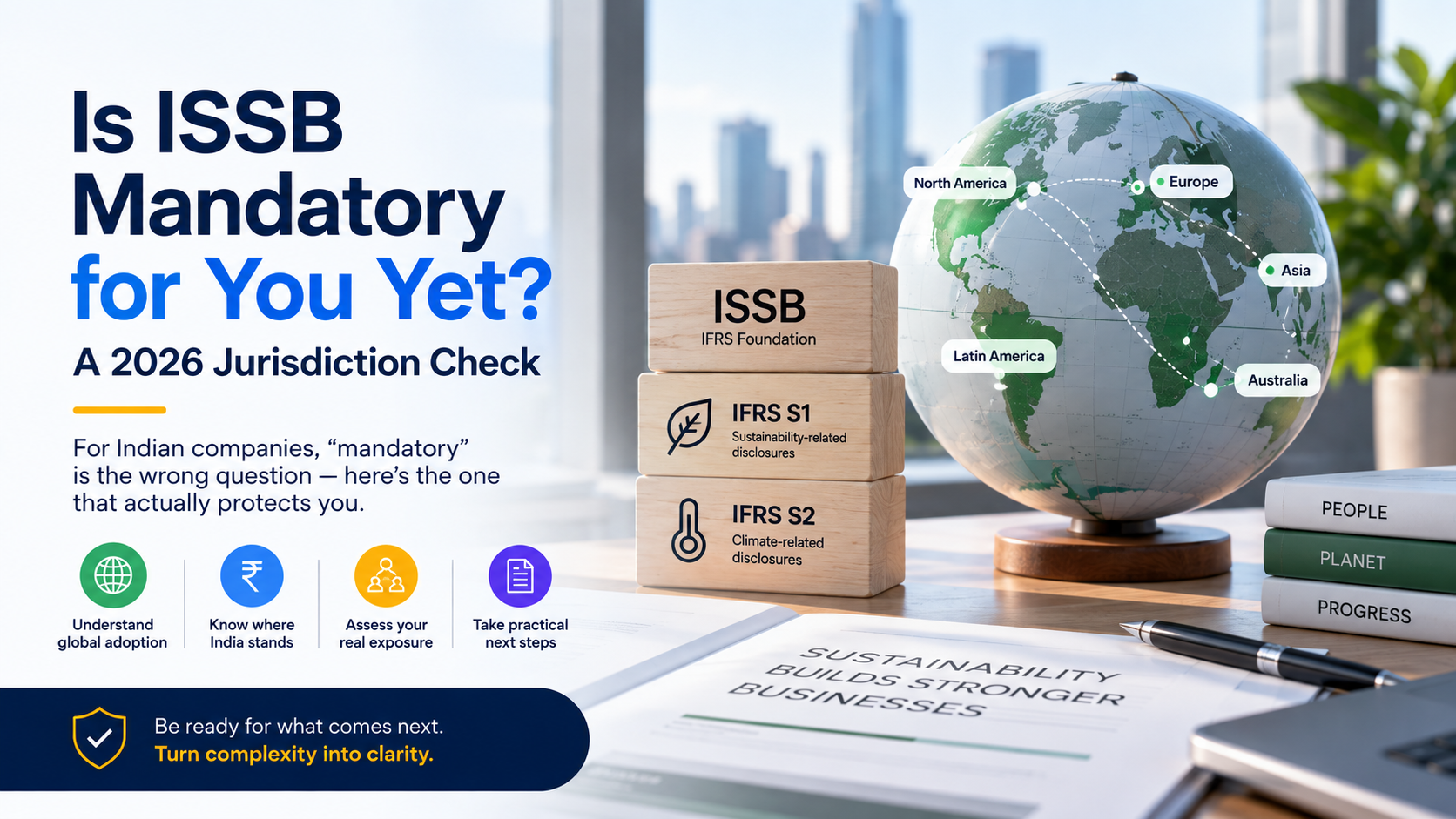
For Indian companies, “mandatory” is the wrong question. Here’s the one that actually matters.
Status checked September 2026. ISSB adoption is moving quickly, and requirements differ by country, company size and reporting year. Always confirm the latest local rules before making a compliance decision.
You might have no legal obligation to report under ISSB in India.
And still be asked for ISSB-ready data by your biggest customer next quarter.
That is the part many companies miss.
If you report in India, the short answer is straightforward:
No. ISSB is not currently a separate mandatory SEBI reporting requirement.
For applicable listed companies, BRSR remains the key domestic sustainability reporting framework.
But “not mandatory for me” does not mean “does not affect me.”
Your customers, investors, parent company or overseas operations may still require information aligned with ISSB.
So the better question is not:
“Is ISSB mandatory?”
It is:
“Does ISSB apply to my business, directly or indirectly?”
Let’s break it down.
First, what is ISSB?
ISSB stands for the International Sustainability Standards Board.
It operates under the IFRS Foundation, the organisation behind the IFRS accounting standards used in many countries.
In 2023, ISSB issued two standards:
- IFRS S1, covering general sustainability-related financial disclosures
- IFRS S2, covering climate-related disclosures
The goal is to give investors consistent information about sustainability and climate-related risks and opportunities that could affect a company’s business.
But there is one important point:
ISSB itself does not make reporting mandatory.
The IFRS Foundation is not a regulator.
Each country or market regulator decides whether and how ISSB standards become mandatory.
That is why there is no single global answer to:
“Is ISSB mandatory?”
You have to look at the rules that apply to your company.
What’s happening globally in 2026?
ISSB adoption is moving forward across multiple markets.
The IFRS Foundation’s jurisdictional profiles include markets such as Australia, Brazil, Chile, Japan, Malaysia, Mexico, Pakistan, the Philippines, Qatar and Singapore, among others.
But the requirements are not the same everywhere.
Some jurisdictions are introducing ISSB-based requirements.
Some are adopting climate requirements based on IFRS S2.
Some are allowing voluntary use.
Others are still developing their approach.
This is why simply saying “Country X has adopted ISSB” is not enough.
You still need to ask:
- Who does it apply to?
- When does it start?
- Is it mandatory or voluntary?
- Does it cover IFRS S1, IFRS S2 or both?
- Are there exemptions?
- Are there transition periods?
Do not rely on a simple list of ISSB countries. Check the actual requirement that applies to your company.
Where does India stand?
India has its own sustainability reporting framework.
For applicable listed companies, that is BRSR, the Business Responsibility and Sustainability Report.
SEBI introduced BRSR for the top 1,000 listed entities by market capitalisation from FY 2022-23.
SEBI later introduced BRSR Core, which focuses on a defined set of key ESG metrics.
The framework has continued to evolve, including changes relating to value-chain disclosures and assessment and assurance.
For example, value-chain ESG disclosures for the top 250 listed entities are voluntary from FY 2025-26.
The important point is simple:
ISSB is not currently a separate mandatory SEBI filing requirement for Indian companies.
Your BRSR obligations still depend on the SEBI requirements applicable to your company and reporting year.
But ISSB is still worth watching.
Why?
Because your business does not operate only within your local reporting framework.
Four ways ISSB can reach you anyway
This is where things get interesting.
You may not have a direct ISSB reporting obligation.
But ISSB-related requirements can still reach your business.
1. You operate in another country
Your company may have:
- An overseas subsidiary
- Operations in another jurisdiction
- A foreign listing
- A parent company outside India
That entity may be subject to ISSB or an ISSB-aligned requirement.
Your Indian BRSR does not automatically satisfy those requirements.
You need to check the rules that apply to the specific entity and jurisdiction.
2. Your customers ask for the data
This is one of the most practical ways ISSB-related requirements can reach you.
Imagine you supply a large multinational.
Its reporting requirements change.
Suddenly, its procurement or sustainability team starts asking you for:
- Scope 1 emissions
- Scope 2 emissions
- Scope 3 emissions
- Energy consumption
- Climate targets
- Climate risks
- Transition plans
You may have no legal ISSB obligation of your own.
But your customer needs your data to meet its reporting requirements.
The requirement has reached you through the supply chain.
You may not need to file ISSB. Your customer may still need ISSB-ready data from you.
3. Your investors expect comparable information
ISSB focuses on information that is useful to investors.
That means the focus is not simply on listing sustainability activities.
Investors want to understand:
- What sustainability risks does the company face?
- What opportunities does it see?
- How could these affect the business?
- How is management responding?
- What is changing over time?
IFRS S1 and IFRS S2 cover areas such as governance, strategy, risk management, and metrics and targets.
So even when ISSB is not mandatory, international investors may still ask for information aligned with it.
4. Your parent company needs the data
Consider a multinational group.
The Indian subsidiary follows BRSR.
The parent company is subject to ISSB-aligned reporting requirements.
The parent now needs information from the Indian subsidiary.
The Indian entity may not have to file ISSB.
But it still needs to provide the data.
This creates an important distinction:
The obligation to supply information can exist even when the obligation to file does not.
So do not ask only:
“What do I need to file?”
Also ask:
“What information does my group need from me?”
BRSR and ISSB are not the same thing
This is another common source of confusion.
BRSR is India's regulatory sustainability reporting framework.
ISSB is an international sustainability disclosure standard.
There is overlap between the two.
But they are not identical.
So don't assume:
“We already do BRSR, so we automatically meet ISSB.”
And don't assume:
“We need ISSB, so BRSR no longer matters.”
Depending on your situation, you may need to manage both.
The practical approach is to map the requirements.
Identify:
- What your BRSR process already covers
- What ISSB-related information is also covered
- What needs additional work
- What data is missing completely
That gives you a much clearer picture of your actual exposure.
What should you do today?
You do not need to build a second reporting system tomorrow.
Start with three simple checks.
Step 1: Check where you operate
List:
- Countries where your company operates
- Countries where your subsidiaries operate
- Countries where your parent company operates
- Stock exchanges where group entities are listed
Then check whether ISSB or ISSB-aligned requirements apply in those markets.
The IFRS Foundation's jurisdictional profiles are a useful starting point for this assessment.
Step 2: Check who is asking for your data
Look beyond regulators.
Ask:
- Are customers requesting climate data?
- Are investors asking for more detailed sustainability information?
- Does our parent company have ISSB-related reporting requirements?
- Are lenders asking for climate-related information?
- Are international partners asking for Scope 1, 2 or 3 data?
These requests can give you an early indication of where reporting requirements are heading.
Step 3: Check whether your data is ready
This is where many companies find the real problem.
You may already have the information.
But is it:
- Clearly defined?
- Consistently calculated?
- Owned by someone?
- Reviewed?
- Approved?
- Supported by evidence?
- Available for previous years?
- Traceable back to the source?
If not, you have a data-management problem, not an ISSB problem.
And fixing that foundation helps whether you eventually report under ISSB, BRSR or another framework.
Put your data gaps into three buckets
Once you understand your exposure, don't try to fix everything at once.
Put your data into three simple categories.
Already covered
Data you already collect and report.
Partially covered
Data exists, but the definition, calculation, evidence or process needs improvement.
Missing
Data you do not currently collect.
This gives you a practical roadmap.
Fix the biggest gaps first.
You don't need to build everything at once.
You need to know where the gaps are.
The biggest mistake is waiting for the deadline
Picture two companies receiving the same request from a global customer.
Company A
- Centralised ESG data
- Clear data owners
- Documented calculation methods
- Historical information
- Review and approval workflows
- Supporting evidence
Company B
- Data spread across spreadsheets
- Different teams using different methods
- Missing historical information
- No clear ownership
- Limited supporting evidence
Both companies receive the same request.
Company A responds quickly.
Company B starts collecting information from scratch.
And it does so under a deadline it did not set.
That is the real risk.
The goal is not to report ISSB before you are required to.
The goal is to avoid building your reporting process under pressure.
Where Karbon fits
The difference between Company A and Company B comes down to having a controlled ESG data foundation.
That is where Karbon fits.
Karbon helps centralise ESG data, assign ownership and manage configurable maker-checker-approver workflows.
It gives teams a structured way to manage:
- Data ownership
- Reviews and approvals
- Supporting evidence
- Historical records
- Audit trails
- ESG reporting workflows
So when a customer, investor or parent company asks for climate or sustainability data, you are not searching through inboxes and spreadsheets.
You have a controlled system behind the numbers.
You know:
Who entered the number.
Who reviewed it.
Who approved it.
What evidence supports it.
What changed.
That is the difference between responding to a reporting request and being caught off guard by one.
The bottom line for Indian companies
If you report under SEBI, BRSR remains your current domestic sustainability reporting framework.
ISSB is not currently a separate mandatory SEBI filing requirement.
But the global reporting environment is changing.
More jurisdictions are adopting, permitting or otherwise using ISSB Standards, and the exact requirements differ from one market to another.
Your ISSB exposure therefore depends on more than where your headquarters are.
It depends on:
- Where you operate
- Where your group operates
- Where you are listed
- Who your investors are
- Who your customers are
- What your business partners require
So don't ask only:
“Is ISSB mandatory for us?”
Ask:
“Where could ISSB reach us?”
That is the question worth answering in 2026.
Final Thought
ISSB is not a global switch that turns on for every company at the same time.
Each jurisdiction is taking its own approach.
For Indian companies, BRSR remains the key domestic reporting framework today.
But your business may still face ISSB-related data requirements through customers, investors, parent companies or overseas operations.
So know:
Where you are exposed.
What data you already have.
What is missing.
Then strengthen your data foundation before someone else sets the deadline.
You don't need to report ISSB before you're required to.
You do need to know whether it's coming to you.