Credit Ratings Correlate at 99%. ESG Ratings? 54%
ESG Software & Technology
PS Team
August 13, 2026
Table of Contents

And the difference often has less to do with how sustainable a company is than with how its ESG performance is measured.
Consider a company that has completed its BRSR and published its sustainability disclosures.
One ESG rating provider places it in the top quartile.
Another rates it as average.
A third gives it a significantly weaker score.
Same company. Same reporting year. Similar underlying disclosures. Three different results.
The first reaction is usually simple: someone must have got it wrong.
The research suggests something more complicated.
ESG ratings diverge because different providers measure ESG performance through different lenses. The result is a market where two credible rating providers can look at the same company and reach very different conclusions.
ESG raters aren't grading the same test
A credit rating has one job. It estimates one thing: will this company pay back what it owes?
ESG ratings have no single job like that.
One provider might place greater emphasis on environmental risks. Another might give more weight to governance. A third might use different indicators, different data sources or different methods for dealing with missing information.
They're not answering the same question — so of course they don't land on the same answer.
Researchers put real numbers to this in a study called Aggregate Confusion: The Divergence of ESG Ratings, published in the Review of Finance. They compared six major ESG raters.
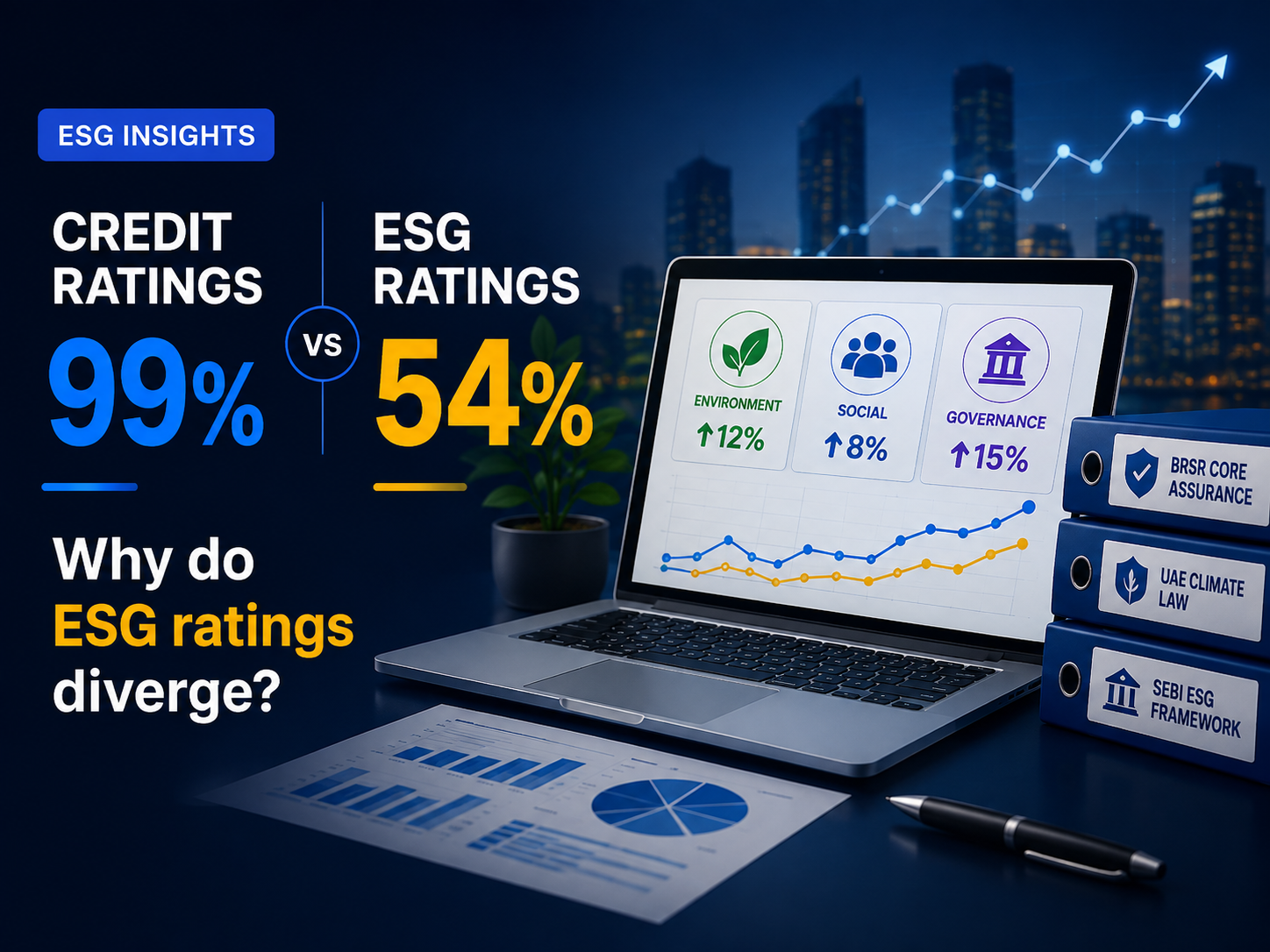
Credit rating agencies sit at about 0.99 — near-total agreement.
The six ESG raters averaged 0.54.
Put plainly: credit raters almost always agree. ESG raters agree about half the time.
Where does the difference come from?
The same study broke it into three sources.
- Measurement — the biggest one (~56%). Two raters look at the same issue, say emissions, but use different indicators, data, and assumptions. Same topic, different ruler.
- Scope (~38%). They're not even looking at the same set of issues. One counts a governance factor the other ignores completely.
- Weighting (~6%). Even when they measure the same things, they decide those things matter to different degrees.
Notice what that means.
ESG rating differences are not simply a reflection of differences in a company's sustainability performance. A significant portion comes from how that performance is measured and assessed.
There's a second, quieter problem
The same research identified what it calls a "rater effect", also known as a halo effect.
A company that receives a high score in one category is more likely to receive high scores across other categories from the same rating provider. he study found this effect explained 15% of the variation in category scores after controlling for the company and category being assessed.
For companies, this creates an important implication.
The quality and consistency of the information available to a rating provider matters across the assessment, not only for one individual metric.
When data is incomplete, inconsistent or difficult to verify, providers have more scope to rely on estimates, proxies and alternative data sources.
Why this is about to matter more in India
ESG ratings in India are getting formal, fast.
SEBI has established a regulatory framework for ESG Rating Providers and maintains a register of providers operating under that framework. SEBI's current Master Circular for ESG Rating Providers was issued on 11 July 2025.
SEBI is also continuing to review the regulatory framework for ESG Rating Providers. In February 2026, SEBI set up a working group to review the framework again.
At the same time, SEBI introduced flexibility for listed companies to undertake either assessment or assurance of BRSR Core disclosures.
This makes the quality of the underlying ESG data increasingly important.
As ESG disclosures, assessments, ratings and assurance become more connected, companies need to be able to explain where their numbers came from and how they were calculated.
You cannot fix their rating methodology. You can fix your data.
This is where many companies approach the problem incorrectly.
They receive several ESG scores and focus on improving the lowest one.
But the better question is:
"Why are different reviewers reaching different conclusions from our ESG information?"
You will never control how each provider builds its methodology. You can't. Let it go.
You can control whether your underlying data is:
- Consistent
- Traceable
- Complete
- Supported by evidence
- Calculated using documented methods
- Consistent across different disclosures
That is where companies have a practical opportunity to reduce uncertainty.
What "defensible ESG data" actually means
1. One source of truth
Your emissions, energy, water, waste, workforce and safety information should come from controlled data sources rather than multiple spreadsheets maintained by different teams.
The same underlying figure should be available to the sustainability team, finance team, assurance provider and reporting team.
2. A clear audit trail
Every material number should have an identifiable source.
If someone asks where an emissions figure came from, you should be able to trace it to the source activity data, emission factor, calculation and supporting evidence.
3. Consistency across disclosures
The figure reported in your BRSR should not differ from the figure in your annual report or the information provided during an ESG assessment without a documented reason.
When numbers change between disclosures, the explanation becomes part of the assessment.
4. Primary data wherever possible
Company-specific and source-supported data reduces the need for external estimates and proxies.
The objective is not to eliminate estimates entirely. Some estimates are unavoidable.
The objective is to know where estimates are being used, why they are being used and how they affect the reported result.
5. Documented methodology
A number without its calculation logic is difficult to defend.
Your ESG data should have a documented methodology covering boundaries, assumptions, emission factors, calculation methods and approvals.
This becomes particularly important when the same information is reviewed by different parties.
The real goal isn't a better score.
Different ESG rating providers will continue to use different methodologies.
Their scores will not become identical simply because a company improves its data management.
But it gives you something more useful than a good score: the ability to stand behind every number, no matter who's assessing you or how.
Instead of asking:
"How do we get a better ESG rating?"
The more useful question is:
"Can we defend every number behind our ESG performance?"
That is a question companies can answer.
Where Karbon fits
This is the exact gap Karbon by Planet Sustech was built to close.
Karbon provides a centralized system for collecting, calculating, tracking and reporting ESG data.
It helps organisations maintain:
- A single source of ESG data
- Traceability from reported figures to underlying information
- Supporting evidence for reported metrics
- Consistent calculations across reporting requirements
- Structured workflows for review and approval
- Data that can be reused across ESG disclosures and reporting frameworks
The goal is not to produce a particular ESG rating.
The goal is to make the underlying ESG record more consistent, traceable and defensible.
Because when different reviewers assess your company, you should be able to explain the numbers regardless of the methodology they use.
The takeaway
ESG rating differences do not automatically mean that one provider is right and another is wrong.
They reflect differences in measurement, scope and weighting.
Companies cannot control all three.
They can control the quality of the information being assessed.
The companies that are better prepared will not necessarily be the ones with the highest rating from every provider.
They will be the ones whose numbers are consistent across disclosures, supported by evidence and easy to trace back to their source.
Not a better story. A better record.
Which of the five would your organisation struggle with most today?