Nobody Announced That ESG Reporting Became a Finance Function
ESG Insights
PS Team
August 10, 2026
Table of Contents
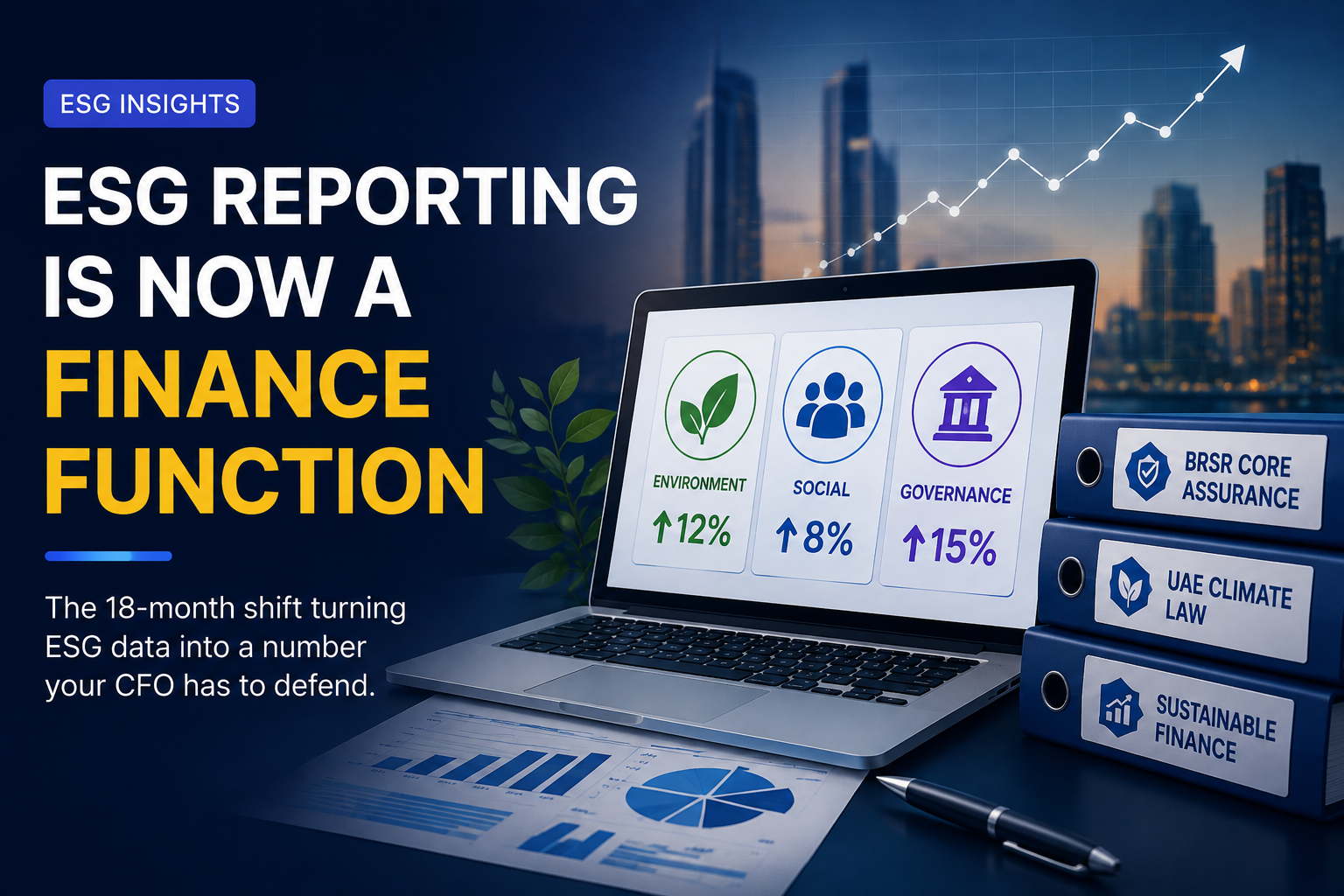
It happened anyway, deadline by deadline. Over the last 18 months, assurance requirements, climate regulation and sustainable finance have turned ESG data from a once-a-year CSR exercise into information your CFO needs to trust.
Two years ago, the sustainability report often sat with a small CSR or sustainability team.
It was usually a once-a-year exercise. Data was collected from different departments, consolidated into spreadsheets, reviewed internally and eventually turned into a report.
Finance might have reviewed the final numbers.
But ESG reporting was rarely treated with the same discipline as financial reporting.
That is changing.
ESG data now faces questions from assurance providers, regulators, investors and lenders.
Nobody announced that ESG reporting had become a finance function.
It happened deadline by deadline.
The first push: assurance, not just disclosure
For years, BRSR was primarily a disclosure exercise.
That changed with BRSR Core.
SEBI introduced BRSR Core as a defined set of KPIs across nine ESG attributes, with reasonable assurance requirements for listed companies. The applicability was designed as a phased glide path:
- FY2023-24: Top 150 listed entities by market capitalisation
- FY2024-25: Top 250
- FY2025-26: Top 500
- FY2026-27: Top 1,000
SEBI also specified data and reporting approaches within BRSR Core to facilitate the assurance process.
This changes the nature of the data.
If an emissions number, water figure or workforce metric needs to withstand independent assurance, knowing the final number is no longer enough.
You need to know:
- Where did the number come from?
- Who provided the source data?
- Which methodology was used?
- Which emission factor was applied?
- What assumptions were made?
- Who reviewed the calculation?
- Which version was ultimately reported?
That is the same basic discipline finance applies to financial information.
ESG data is moving in the same direction.
The second push: climate regulation became financially relevant
The UAE provides another example.
Federal Decree-Law No. 11 of 2024 on the Reduction of Climate Change Effects entered into force on 30 May 2025. The law establishes requirements around measuring, reporting and reducing greenhouse gas emissions for in-scope entities.
The first major compliance milestone was 30 May 2026.
That date has now passed.
The important point is what changed around the deadline.
Climate data moved from a voluntary sustainability exercise into a regulated process.
The law provides for fines of AED 50,000 to AED 2 million for certain violations, with penalties doubled for repeat violations within two years.
The law also requires emissions inventories and periodic reporting for designated sources, with record-keeping requirements forming part of the compliance framework.
This creates a different type of business risk.
A weak sustainability report might once have created a reputational issue.
Weak underlying emissions data can now create a compliance issue.
And compliance issues eventually reach finance.
They affect provisions, budgets, risk assessments, operational decisions and management attention.
The third push: ESG entered financing decisions
The strongest evidence of ESG becoming a finance issue is the growth of sustainable finance in markets where companies are raising capital.
The Middle East is a useful example.
S&P Global reported that sustainable bond issuance in the Middle East increased by about 3% in 2025, while global sustainable bond issuance declined by 21%. It expects Middle East sustainable bond issuance of $20 billion to $25 billion in 2026.
Sustainable sukuk also reached a record $11.4 billion in the Middle East in 2025, compared with $7.9 billion in 2024.
This does not mean ESG data automatically determines a company's interest rate.
It means something more important for finance teams.
When sustainability-linked loans, green bonds, transition finance or other labelled instruments are involved, sustainability data becomes part of the evidence used to demonstrate eligibility, track targets, report outcomes and support investor confidence.
The quality of that data therefore matters to the financing process.
A CFO who previously viewed the ESG report as a communications document now has a direct financial reason to care about how those numbers were produced.
ESG data now needs finance-grade controls
So what does “finance-grade ESG data” actually mean?
It means you should be able to take any material ESG number and trace it back to its source.
For example:
Your reported Scope 2 emissions should connect to:
Electricity consumption → source document → reporting period → facility → emission factor → calculation → reviewer → approved value → final report.
The same principle applies to water, waste, energy, workforce metrics and other material indicators.
You need:
- Clear data ownership
- Defined reporting boundaries
- Documented methodologies
- Source evidence
- Version control
- Review and approval workflows
- Consistent calculation methods
- An audit trail
This is where the difference between an ESG spreadsheet and an ESG reporting system becomes obvious.
A spreadsheet gives you a number.
A controlled reporting process gives you a number you can explain.
Why this caught companies off guard
The shift did not come through one global ESG regulation.
It came through different channels.
SEBI increased assurance expectations.
Climate regulation introduced enforceable emissions obligations.
Capital markets created new demand for credible sustainability information.
Each development looked manageable on its own.
Together, they changed the role of ESG data inside a company.
The sustainability team still owns much of the process.
But finance, risk, internal audit, legal, operations and senior management now have reasons to care about the underlying numbers.
ESG reporting is becoming cross-functional because ESG data is becoming business data.
What this means if your ESG report still lives with CSR
If your sustainability report still depends on one small team collecting data from dozens of spreadsheets, emails and disconnected files, the problem is not the sustainability team.
The problem is the process.
As reporting requirements become more rigorous, the questions become harder:
- Who owns this number?
- Where is the evidence?
- Why did it change from last year?
- Which emission factor was used?
- Who approved it?
- Can we reproduce the calculation?
- Can we give the same answer six months from now?
If answering those questions requires searching through emails and spreadsheets, your reporting process has become a business risk.
The solution is to bring finance-level controls into ESG reporting.
Not because ESG needs to become financial reporting.
Because the consequences of getting ESG data wrong increasingly resemble the consequences of getting other important business data wrong.
How Karbon by Planet Sustech helps
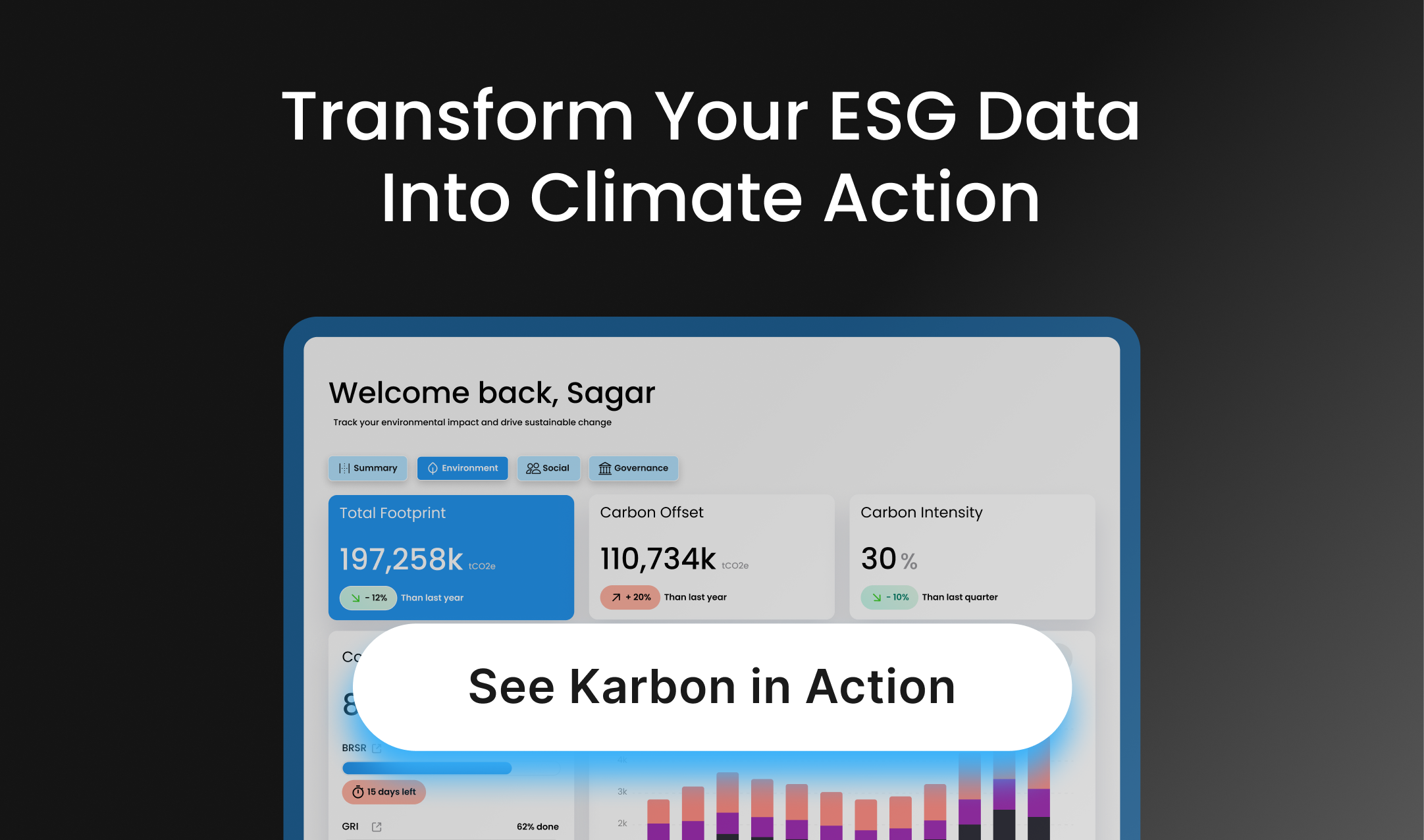
Karbon brings structure to the ESG data lifecycle.
It gives organizations a central environment to capture, calculate, review and report ESG data, with ownership, workflows and traceability built into the process.
Instead of treating ESG reporting as a once-a-year document exercise, teams can build a controlled data trail behind every reported figure.
That means your ESG data has:
- A defined source
- A responsible owner
- A calculation methodology
- Supporting evidence
- Review and approval
- A traceable reporting history
This becomes especially important when the same underlying data supports BRSR, assurance, climate compliance, internal reporting or sustainability disclosures.
The objective is simple.
Make your ESG numbers explainable before someone else asks you to explain them.
Final Thoughts
ESG reporting didn't become a finance function because someone announced it.
It became one because regulators, assurance providers, investors and lenders started asking finance-level questions about ESG data.
The shift is already underway.
Companies that continue treating ESG as a once-a-year CSR task will find the process increasingly difficult to defend.
Companies that build ownership, evidence, controls and traceability into their ESG data will be better prepared for the next reporting cycle, the next assurance review and the next financing conversation.
ESG reporting is no longer only about what your company says.
It is about whether you can prove the numbers behind it.