Scope 3 Emissions Explained: How to Measure and Manage What You Don't Control
Carbon Accounting
PS Team
August 26, 2026
Table of Contents
On average, a company's upstream supply-chain emissions can be 26 times higher than its combined Scope 1 and Scope 2 emissions.
That means you're often responsible for reporting a footprint you don't directly control, and for many companies, that footprint represents the largest part of their emissions.
Here's how that plays out.
Your factory has switched to cleaner energy. Your offices run on renewables. Your direct fuel consumption is measured, reported, and accounted for.
Then someone asks about Scope 3.
Suddenly, your carbon footprint includes the fuel burned by a logistics provider, the emissions from producing materials you purchase from suppliers, and the emissions generated when customers use your products.
You don't own those operations.
You don't control them.
And often, you don't have their emissions data.
Yet those emissions are part of your value-chain footprint and increasingly part of what companies need to understand and report.
That is what makes Scope 3 difficult.
The good news is that you don't need perfect Scope 3 data to get started. You need a consistent method, better data over time, and a clear record of how every number was calculated.
The goal isn't a flawless figure.
It's a defensible one.
The Short Version
If you take only five things from this article:
- Scope 3 covers indirect emissions across your value chain and is often much larger than your own operations.
- You don't need perfect data from every supplier on day one.
- Start with the categories and suppliers that matter most.
- Improve estimated data with better supplier and activity data over time.
- Keep a clear trail showing where every number came from and who reviewed it.
What Are Scope 3 Emissions?
The GHG Protocol divides corporate emissions into three scopes.
Scope 1 covers direct emissions from sources your company owns or controls, such as fuel burned in company-owned equipment or vehicles.
Scope 2 covers indirect emissions from the energy you purchase, including electricity, steam, heating, and cooling.
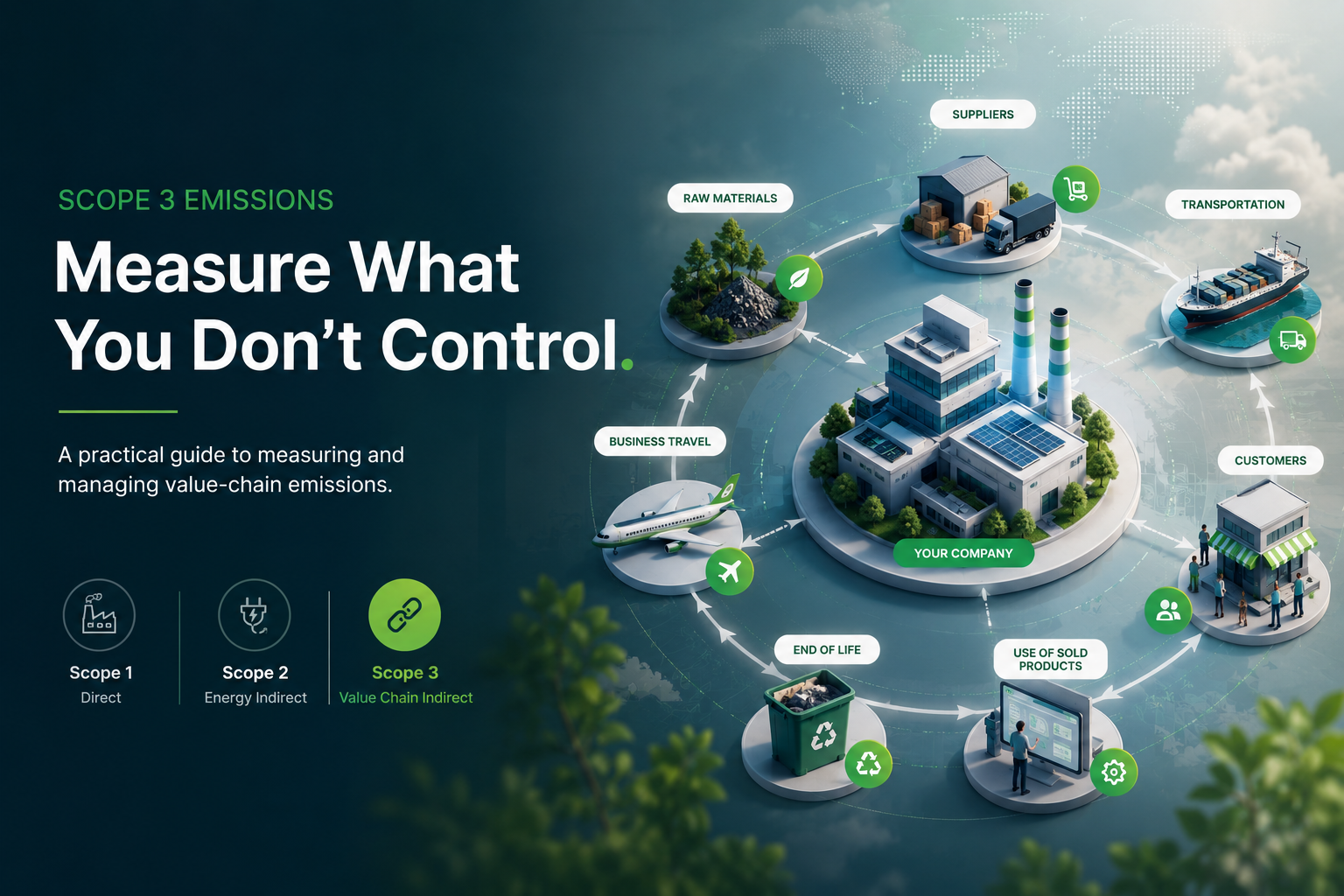
Scope 3 covers other indirect emissions across your value chain, both upstream and downstream.
The GHG Protocol divides Scope 3 into 15 categories covering areas such as:
- Purchased goods and services
- Capital goods
- Transportation and distribution
- Business travel
- Employee commuting
- Use of sold products
- End-of-life treatment
- Investments
A simple way to remember it:
Scope 1 = emissions from your operations
Scope 2 = emissions from the energy you buy
Scope 3 = emissions connected to your value chain
That last one is where most of the difficulty begins.
Why Scope 3 Matters
Scope 3 is often much larger than the emissions from a company's own operations.
A 2024 report from CDP and Boston Consulting Group, Scope 3 Upstream: Big Challenges, Simple Remedies, found that companies disclosing through CDP had supply-chain, or upstream Scope 3, emissions averaging 26 times their combined Scope 1 and Scope 2 emissions.
The analysis also found that companies were twice as likely to measure their operational emissions as their supply-chain emissions, while only 15% of disclosing companies had set a Scope 3 target.
The implication is important.
If you focus only on your factories, offices, vehicles, and purchased electricity, you could be managing only a small part of your total footprint.
A significant share of your emissions might sit with suppliers, logistics providers, customers, and other value-chain partners.
That makes Scope 3 a business data problem as much as a carbon accounting problem.
Why Is Scope 3 So Difficult?
Three problems come up again and again.
1. You Don't Control the Source
Your supplier controls its manufacturing process.
Your logistics provider controls its vehicles.
Your customer controls how your product is used.
You still need to account for the relevant emissions in your inventory.
This makes Scope 3 fundamentally different from measuring emissions from your own operations.
2. The Data Isn't Always There
One supplier might give you detailed emissions data.
Another might provide energy consumption.
A third might give you nothing more than an invoice.
As a result, a single Scope 3 inventory can contain different levels of data quality.
In many cases, companies start with estimates based on spend or activity and improve those estimates as better data becomes available.
That's normal.
The problem isn't starting with estimates.
The problem is not being able to explain them.
3. Better Data Can Change the Number
Suppose you initially estimate a category using spend-based data.
Later, a supplier provides product-specific emissions data.
Your reported Scope 3 figure might change.
That doesn't automatically mean the original calculation was wrong.
It means your data quality improved.
This is why consistency and documentation matter.
If your methodology changes, you should be able to explain:
- What changed
- Why it changed
- How it affected the result
Does Scope 3 Double Count Emissions?
Yes, across different companies, the same emissions can appear in more than one inventory.
Consider a steel manufacturer producing material for your company.
The emissions from its furnace are part of the steel manufacturer's Scope 1.
Those same emissions, from your perspective as the buyer, can also appear in your Scope 3.
Both companies report them because each is looking at the value chain from a different position.
This is expected under the GHG Protocol.
The important question for your company isn't who "owns" the emission.
It's whether you understand your:
- Reporting boundary
- Methodology
- Data sources
- Assumptions
- Reduction claims
There is also an important distinction between Scope 3 accounting and carbon-credit claims.
Overlap across corporate emissions inventories is expected.
Claiming the same emission reduction through a carbon credit more than once is not.
What Changed Under BRSR?
For Indian listed companies, SEBI changed its approach to value-chain ESG disclosure through its 28 March 2025 circular.
For the top 250 listed entities by market capitalisation, value-chain ESG disclosures are voluntary from FY 2025-26. The associated third-party assessment or assurance is also voluntary.
Where a listed entity chooses to disclose, SEBI's framework identifies upstream and downstream partners individually representing 2% or more of purchases or sales by value.
Companies can also limit disclosure to partners that together cover 75% of purchases and sales by value.
For companies, this provides a practical way to focus their efforts.
You don't have to start by chasing data from every supplier.
You can concentrate on the value-chain partners that have the greatest relevance to your purchases, sales, and emissions.
Regulatory requirements change, so confirm the latest SEBI requirements for your reporting year and company category before deciding what applies to your organisation.
How to Build Reliable Scope 3 Data
You don't need perfect data on day one.
You need a process that improves your data every reporting cycle.
Five steps can help.
1. Identify Your Material Categories
Don't spread your effort evenly across all 15 Scope 3 categories.
First, understand where your emissions are most likely to concentrate.
For many companies, this could include:
- Purchased goods and services
- Capital goods
- Transportation and distribution
- Business travel
- Use of sold products
- End-of-life treatment
The right priorities depend on your business model.
The objective is to identify where better data will make the biggest difference.
2. Prioritise the Suppliers That Matter Most
Don't start by sending a long ESG questionnaire to every supplier.
Begin with suppliers that represent a significant share of your purchases or have a significant emissions impact.
Ask for the information you actually need, such as:
- Product quantity
- Energy consumption
- Emissions data
- Emission factors used
- Reporting period
- Calculation methodology
Then expand the number of suppliers providing primary data over time.
3. Start With the Data You Have
Don't wait for perfect inputs.
Use appropriate estimates where primary data isn't available.
Then create a plan to improve data quality.
A typical progression looks like:
Estimated data → Activity data → Supplier-specific data
What matters is documenting which approach you used and where you used it.
4. Keep Your Methodology Consistent
A Scope 3 number becomes difficult to defend when the calculation method changes without explanation.
For each category, document:
- Data source
- Calculation method
- Emission factor
- Reporting period
- Assumptions
- Data quality
- Exclusions
If you change the methodology, document why.
When someone compares this year's number with last year's, you should be able to explain the difference.
5. Create an Audit Trail
This is where many Scope 3 processes fall short.
You should be able to answer:
Who entered the data?
What source did they use?
Who reviewed it?
What changes were made?
Who approved the final number?
What evidence supports the calculation?
A defensible Scope 3 inventory isn't defined by having a perfect number.
It's defined by being able to explain the number.
The Real Goal Isn't Perfect Scope 3 Data
Your first Scope 3 inventory probably won't be perfect.
That's fine.
What matters is whether it is:
- Consistent
- Explainable
- Traceable
- Reviewable
- Improving over time
A reasonable estimate with a documented methodology is more useful than a highly precise number nobody can explain.
Your goal should be to improve data quality each year.
Start with the biggest sources.
Deepen supplier engagement.
Replace estimates with primary data where possible.
Document your methodology.
Keep the evidence.
Where ESG Data Governance Fits In
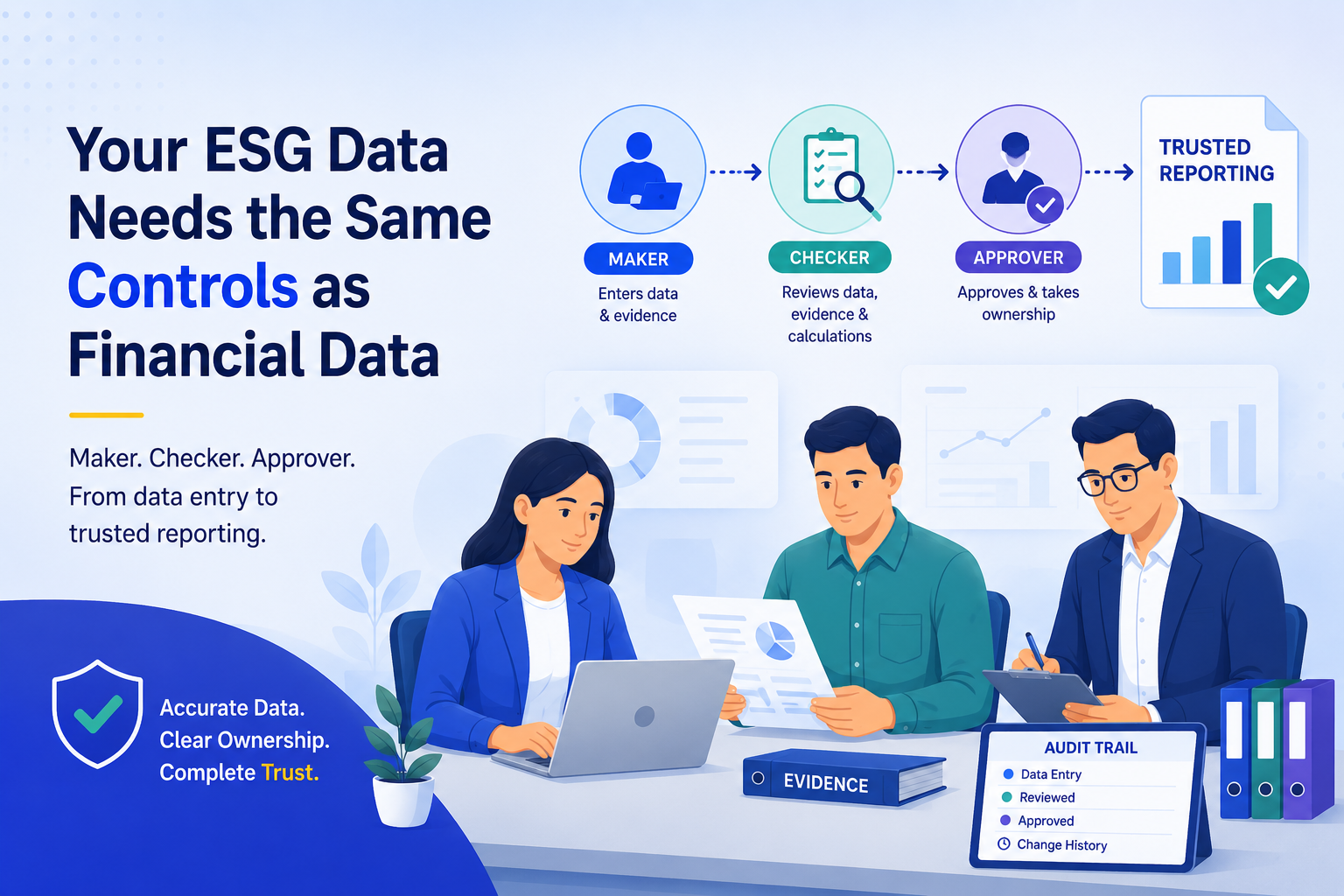
A Scope 3 calculation is rarely one person's work.
One person collects supplier information.
Another calculates the emissions.
Someone else reviews the calculation.
A final approver signs off on the reported figure.
If this chain of accountability isn't preserved, it becomes difficult to explain where the final number came from.
This is where Karbon fits.
Karbon provides a configurable maker-checker-approver workflow with up to ten levels, allowing ESG data to move through defined roles from entry to review to final approval.
Each figure has a clear owner and approval path.
For companies that need additional traceability, Karbon also offers a blockchain-backed audit trail as an add-on.
Governance doesn't make an estimate more accurate. No workflow can turn a spend-based estimate into primary data.
What governance does is make the number easier to explain, review, and defend.
That's what turns an uncertain Scope 3 figure into a defensible one.
What Should You Do Next?
If you're early in your Scope 3 journey, don't try to solve everything at once.
Start with five questions:
- Which Scope 3 categories are most material for our business?
- Which suppliers and value-chain partners contribute most to those categories?
- Where are we using estimates instead of primary data?
- Who is responsible for entering, reviewing, and approving each figure?
- Can we show the evidence behind every number we report?
Answer those questions and you have the foundation for a stronger Scope 3 process.
Scope 3 will always involve data from outside your organisation.
You don't need to control every emission source.
You need to control your process for measuring, reviewing, documenting, and improving the data.
That's how an uncertain Scope 3 number becomes a defensible one.
Frequently Asked Questions
What Are Scope 3 Emissions in Simple Terms?
Scope 3 covers indirect greenhouse gas emissions across a company's value chain that aren't included in Scope 1 or Scope 2.
This includes emissions linked to purchased goods, transportation, business travel, product use, product disposal, and other upstream and downstream activities.
The GHG Protocol divides Scope 3 into 15 categories.
Why Is Scope 3 Difficult to Measure?
Most Scope 3 emissions occur outside your direct operational control.
Suppliers and other value-chain partners might not have detailed emissions data, so companies often rely on estimates or secondary data.
Inventory quality improves as better activity and supplier-specific data becomes available.
Is Scope 3 Double Counting?
The same emissions can appear in different companies' inventories because each company accounts for its own value-chain emissions.
This is expected under the GHG Protocol's value-chain approach.
It is different from claiming the same carbon credit or offset more than once.
How Should a Company Start Measuring Scope 3?
Start by identifying the most material categories and prioritising the suppliers and activities with the greatest potential impact.
Use appropriate estimates where primary data is unavailable.
Then improve the data over time.
How Do You Make Scope 3 Data Defensible?
Document the source, methodology, emission factor, assumptions, reporting period, and data quality for each calculation.
Maintain a clear review and approval trail so you know who entered, checked, and approved each figure.
Are Scope 3 Value-Chain Disclosures Mandatory Under BRSR?
For the top 250 listed entities by market capitalisation, SEBI's March 2025 circular made value-chain ESG disclosures voluntary from FY 2025-26.
Associated assessment or assurance is also voluntary.
The framework identifies significant upstream and downstream partners using a 2% purchases-or-sales threshold and allows disclosure to be limited to partners covering 75% of purchases and sales by value.
Always check the latest SEBI requirements for your reporting year before making a compliance decision.