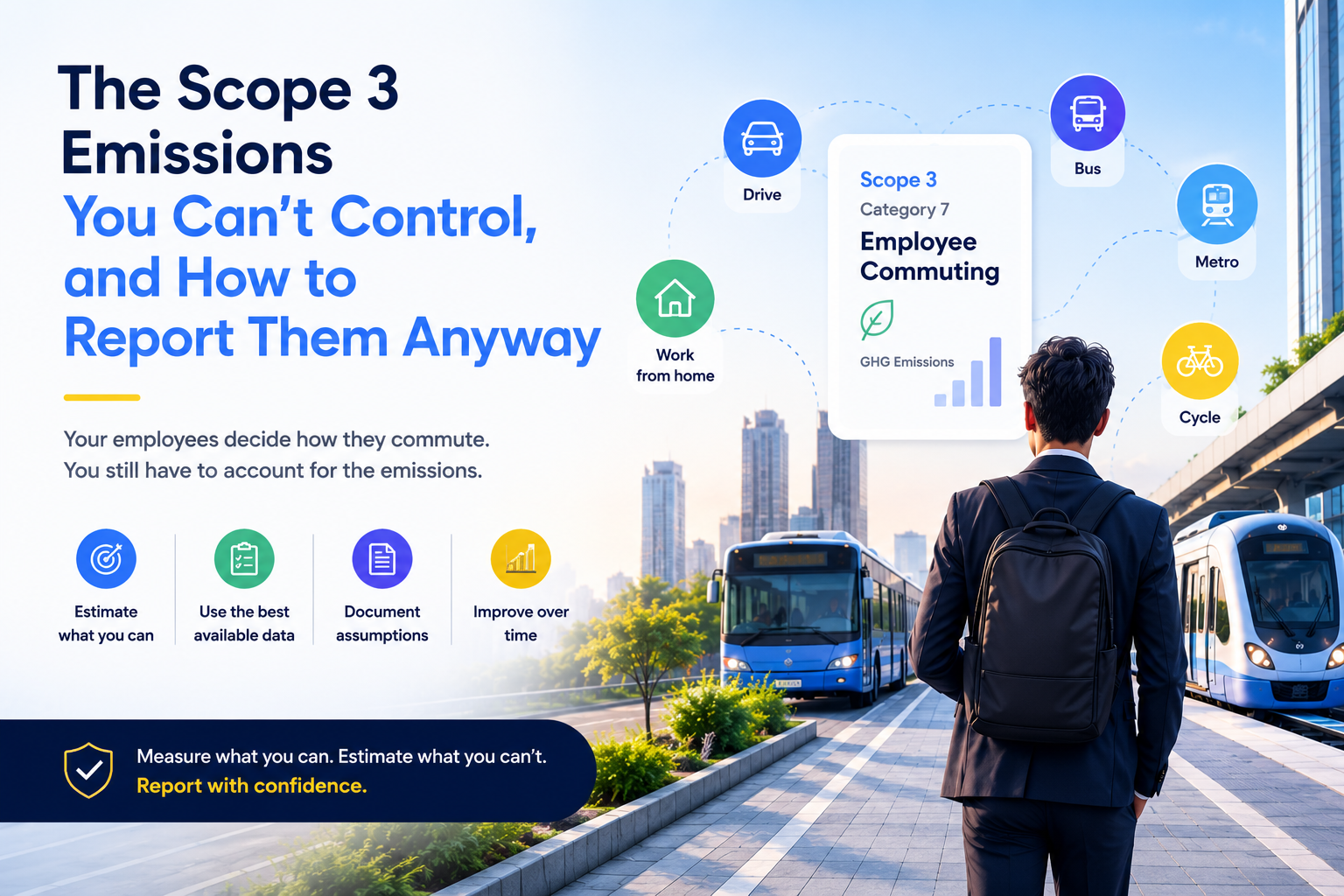
The Scope 3 Emissions You Can't Control, and How to Report Them Anyway
Scope 3 Emissions
PS Team
September 1, 2026
Table of Contents
Your employees decide how they commute. You still have to account for the emissions.
An employee wakes up in the morning.
They decide whether to drive, take the metro, use a bus, carpool or work from home.
They choose where they live.
They decide how far they are willing to travel.
They use their own vehicle.
They buy their own fuel.
Your company controls none of these decisions.
But there is a catch.
The emissions from their commute can still form part of your company's Scope 3 emissions.
And this creates a question that many companies struggle with:
How do you report emissions from something you don't control?
The answer is simpler than many people think.
You do not wait until you have perfect data.
You use the best information available. You make reasonable assumptions. You document those assumptions. Then you improve the data over time.
This is one of the realities of Scope 3 reporting.
You are often asked to account for emissions you do not directly control.
Employee commuting is one of the clearest examples.
Employee commuting is a real Scope 3 problem
Employee commuting falls under Scope 3, Category 7: Employee Commuting.
This includes emissions linked to employees travelling between their homes and their workplace using transportation that the company does not own or control.
That is what makes this category difficult.
Your company may know:
- How many employees it has
- Where its offices are
- How many days employees work
- How often employees work from home
But it may not know:
- How employees travel every day
- How far they travel
- Whether they drive alone or carpool
- What type of vehicle they use
- How frequently their commuting pattern changes
And even if you collect this information today, it can change tomorrow.
One employee moves closer to the office.
Another starts working from home twice a week.
Someone switches from driving to the metro.
Another starts carpooling.
Employee commuting data is constantly changing because employee behaviour changes.
That does not mean you should ignore the emissions. It means you need a practical way to estimate them.
The biggest misconception: "We don't control it, so we can't measure it"
This is one of the most common misunderstandings around Scope 3.
Companies often think about emissions in terms of ownership and control.
For example:
You own a factory.
You control the fuel used in the factory.
You can measure the emissions.
That logic works well for many Scope 1 and Scope 2 emissions.
Scope 3 is different.
The purpose is to understand emissions linked to activities across your value chain, even when those activities happen outside your direct operations.
So the question should not be:
Do we control these emissions?
The better question is:
What information do we have to estimate them?
This shift changes the entire approach.
You may not control how your employees commute.
But you can control how you collect data, how you make assumptions and how you calculate the emissions.
There is no meter for employee commuting
Imagine trying to measure electricity consumption.
You look at the meter or electricity bill.
The information already exists.
Employee commuting is different.
There is no single meter showing:
Total employee commuting emissions: 1,245 tCO₂e
Instead, companies need to build the estimate from available information.
For example:
- How many employees commute
- How often they travel to work
- How far they travel
- Which transport they use
The more representative your information is, the better your estimate is likely to be.
This brings us to the practical question.
So, how do companies report employee commuting emissions?
There is no single perfect method for every company.
The right approach depends on the information available.
Here are three practical approaches.
1. Ask your employees
The most direct approach is to conduct an employee commuting survey.
You can ask simple questions such as:
- How do you usually travel to work?
- Approximately how far is your commute?
- How many days do you usually travel to the office?
- Do you drive alone or carpool?
- How often do you work from home?
The company can then use this information to estimate the total commuting activity.
A simple example
Imagine an employee travels:
- 20 km from home to the office
- 20 km back home
- Five days a week
Their daily commute is 40 km.
Over a year, those kilometres start adding up.
Repeat that exercise across hundreds or thousands of employees, and the commuting emissions become significant.
Of course, companies do not need to manually calculate every employee's commute.
The important point is the data.
Once you understand the commuting patterns, you can apply the appropriate calculation method.
The advantage
The estimate reflects actual employee behaviour more closely.
The challenge
Employees need to respond.
And the information still depends on what they report.
That is why data coverage matters.
If only 10 percent of employees respond to a survey, you should understand and document the limitations before applying those results to the wider workforce.
2. Use available data and reasonable assumptions
What happens when you do not have survey data?
This is where many companies get stuck.
They assume:
"If we don't know exactly how everyone commutes, we can't report anything."
That is not a useful approach.
You can start with the information you already have.
For example:
- Number of employees
- Office locations
- Typical working days
- Remote working policies
- Broad employee location data
- Average commuting distances
- Regional transportation patterns
You can then make reasonable assumptions based on the available information.
The key word here is reasonable.
Do not invent numbers simply because a calculation requires one.
Use credible sources and document the assumptions you make.
For example:
"We did not collect individual commuting distances. We used an average commuting distance based on available employee location data and applied this consistently across the reporting population."
That is not perfect data.
But it is transparent.
And transparency is far better than presenting an assumption as if it were measured data.
3. Use a high-level estimate as a starting point
Some companies have very limited information.
In the early stages of Scope 3 reporting, they may need to use higher-level estimates or proxy information.
This can help create an initial view of the category.
But companies should understand the limitation.
An estimate is still an estimate.
This is especially important when numbers start moving through spreadsheets, review processes and management approvals.
A calculation can be reviewed multiple times.
That does not automatically improve the quality of the original data.
This is one of the most important principles in ESG reporting:
Good governance can make an estimate defensible. It cannot turn weak data into perfect data.
Both are important.
You need good data.
You also need a strong process around that data.
The danger of false precision
This is where Scope 3 reporting can become misleading.
A company produces a number:
1,247.38 tCO₂e
It looks precise.
There are two decimal places.
The spreadsheet works.
The calculation has been reviewed.
The number gets reported.
But how accurate is it?
If the calculation is based on an assumption about average commuting distance, transport modes or employee behaviour, those two decimal places do not make the estimate more accurate.
The calculation may be mathematically precise.
The underlying data may still be uncertain.
This does not mean companies should avoid estimating Scope 3 emissions.
It means they should be honest about what the number represents.
Do not confuse a detailed calculation with accurate data.
A simpler estimate based on transparent assumptions can be more useful than a highly detailed calculation built on weak information.
What you cannot control, and what you can
This is the key distinction.
You cannot control:
- Where every employee lives
- How they travel
- How far they commute
- Whether they drive, carpool or take public transport
- Changes in their daily travel habits
But you can control:
- Who is included in your calculation
- How you collect information
- Which assumptions you use
- How calculations are performed
- Which data sources are used
- How changes are documented
- Who reviews the information
- How the final number is approved
This is where companies should focus their effort.
You cannot control every emission source. You can control the quality of your reporting process.
What about employees who work from home?
Employee commuting is becoming harder to estimate because work patterns are changing.
Some employees work from the office every day.
Some work remotely.
Some follow a hybrid model.
That means the number of commuting days can vary significantly.
Companies should therefore avoid making one broad assumption that applies to everyone.
Instead, consider the actual working arrangements within the organisation.
For example:
- How many employees work fully from the office?
- How many work remotely?
- How many follow a hybrid arrangement?
- How many days do hybrid employees usually commute?
You do not need to create a complicated system.
But your approach should reflect the reality of your workforce as closely as practical.
And most importantly, use a consistent approach from one reporting period to the next.
What if you have no commuting data at all?
Start anyway.
Waiting for perfect Scope 3 data can delay reporting for years.
A better approach is to improve gradually.
Year 1: Establish a baseline
Use the best information available.
Document your assumptions.
Identify the biggest data gaps.
Year 2: Improve the data
Introduce an employee commuting survey.
Increase employee participation.
Compare actual responses with earlier assumptions.
Year 3: Improve consistency
Create a standard process for collecting and reviewing the data.
Track changes in commuting behaviour.
Over time: Build a stronger data process
The objective is not to achieve perfection in the first year.
The objective is to make the estimate more representative over time.
Scope 3 reporting is a journey from estimates towards better data.
A practical way to approach employee commuting emissions
If you are starting from scratch, keep the process simple.
Step 1: Define who you are measuring
Decide which employees fall within your reporting approach.
Be clear and consistent.
Step 2: Collect the best information available
Start with employee surveys where practical.
If that is not possible, identify reliable information you already have.
Step 3: Identify your assumptions
Write them down.
Do not leave assumptions inside someone's spreadsheet.
Step 4: Apply your calculation methodology consistently
Use the same approach across the reporting population where appropriate.
Document any exceptions.
Step 5: Review the results
Look for unusual results.
For example:
- A sudden large increase
- A sudden large decrease
- Missing employee groups
- Duplicate information
Investigate before reporting.
Step 6: Improve the process next year
Ask one simple question:
What would make this estimate better next year?
The answer might be:
- More employee responses
- Better location data
- More accurate commuting distances
- Better information about transport modes
Small improvements can significantly strengthen the reporting process over time.
Before reducing emissions, you need to understand them
Companies often move quickly towards solutions.
They introduce:
- Carpooling programmes
- Public transport incentives
- Flexible working
- Work-from-home policies
- Electric vehicle initiatives
These actions may help reduce commuting-related emissions.
But there is a basic question that should come first.
What are your current emissions?
Without a credible baseline, it becomes difficult to answer:
- Where are the biggest sources of emissions?
- Are employees changing how they commute?
- Are your initiatives having an impact?
- Did emissions fall because of actual changes or because your calculation method changed?
You do not need perfect information to begin.
You need a reasonable baseline and a process to improve it.
The real lesson from employee commuting emissions
Employee commuting highlights one of the biggest challenges in Scope 3 reporting.
Many emissions are connected to your organisation without being directly controlled by your organisation.
You cannot tell every employee where to live.
You cannot decide how they travel.
You cannot monitor every kilometre they commute.
And you do not need to.
Your responsibility is to build the best possible estimate using the information available.
That means:
- Measure what you can
- Estimate what you cannot directly measure
- Make reasonable assumptions
- Document those assumptions
- Be clear about data limitations
- Review the methodology
- Improve the data over time
The goal is not to create a perfect number.
The goal is to create a number that your organisation understands and can explain.
Because when someone asks:
"Where did this Scope 3 number come from?"
Your team should have a clear answer.
Final Thought
The hardest Scope 3 emissions are often not the ones with the largest calculations.
They are the ones where you have the least control and the least data.
Employee commuting is one of those categories.
But a lack of control is not a reason to avoid reporting.
It is a reason to build a better estimation process.
You cannot control how your employees commute.
You can control how well you account for it.
Ready to make Scope 3 reporting more manageable?
Scope 3 reporting often involves incomplete data, changing assumptions and emissions sources outside your direct control.
Planet Sustech helps organisations structure ESG data collection, manage calculation methodologies, document assumptions and create stronger reporting processes.
Explore how Planet Sustech can help you build a more structured approach to ESG and Scope 3 reporting.