
Which Decarbonization Levers Save Money vs Cost Money?
Which decarbonization measures save money, require investment or add costs? Compare energy efficiency, renewable energy, electrification and low-carbon technologies.
 PS Team20 min read
The International Energy Agency (IEA) analysed more than 300 industrial energy-management case studies across 40 countries. The analysis found average energy savings of 11% in the first years of implementation. Some companies achieved savings of 30% or more, with many of the measures requiring little or no investment.
Source: IEA, Industrial Facilities Could Save Billions by Implementing Energy Management, 1 July 2025.
So why do so many decarbonization discussions start with green hydrogen, carbon capture and low-carbon materials?
These technologies have an important role to play. But some require significant investment or carry higher production costs than conventional alternatives.
Meanwhile, opportunities such as fixing compressed-air leaks, improving equipment performance and recovering waste heat often receive less attention.
These measures address energy and resource waste. They also offer opportunities to reduce operating costs alongside emissions.
The reality is that not every decarbonization measure has the same financial impact.
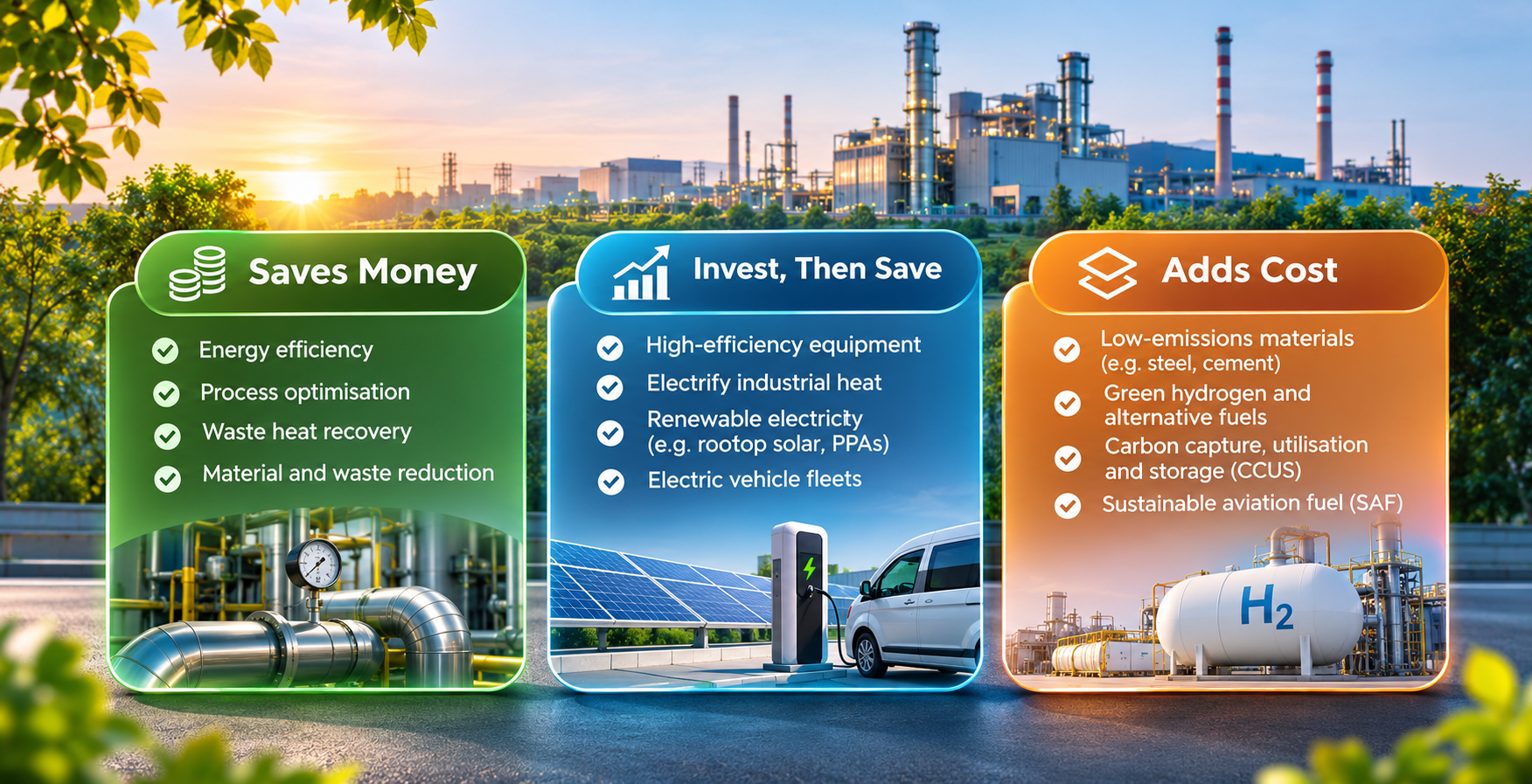
- Some measures reduce emissions and save money.
- Some require an initial investment but deliver savings over time.
- Others reduce emissions but currently cost more than conventional alternatives.
This guide explains these three groups, how to compare their costs and how to build a practical decarbonization roadmap.
1. Three types of decarbonization investments
Think of decarbonization as a portfolio of projects rather than one large expense.
Most initiatives fall into three groups.
1. Measures that save money
These reduce unnecessary energy, fuel or material consumption.
Examples:
- Improving energy efficiency.
- Optimising production processes.
- Recovering waste heat.
- Reducing material waste.
- Improving vehicle and route efficiency.
Business benefit: Potentially lower electricity, fuel and material bills.
Sources:
2. Measures that require investment but deliver savings
These require an initial investment in equipment, technology or infrastructure. The financial benefit comes from lower operating costs over time.
Examples:
- Replacing inefficient equipment.
- Electrifying suitable industrial heating processes.
- Installing rooftop solar.
- Switching to electric vehicles.
- Upgrading industrial heating and cooling systems.
Business benefit: Potentially lower operating costs over the equipment's useful life. The actual return depends on investment costs, energy prices and operating conditions.
Sources:
- US Department of Energy, Motor Systems
- IEA, Renewables for Industry, 2025
- IEA, Electric Vehicles: Total Cost of Ownership Tool
3. Measures that can add costs
Some low-carbon technologies and materials currently cost more than conventional alternatives. Others need substantial infrastructure or further development.
Examples:
- Low-emissions steel and cement.
- Renewable and low-carbon hydrogen.
- Carbon capture systems.
- Sustainable aviation fuel.
- Carbon credits.
Business benefit: Depending on the project, these measures can support emissions targets, customer requirements and the transition to lower-emissions production.
Sources:
- IEA, Demand and Supply Measures for the Steel and Cement Transition, 2025
- IEA, Breakthrough Agenda Report 2025: Hydrogen
The distinction is important.
If you present every decarbonization project as a cost-saving opportunity, you risk losing credibility when the financial results do not match expectations.
If you treat every project as an additional cost, you might overlook opportunities that reduce both emissions and operating expenses.
2. Decarbonization measures that save money
Start with opportunities that address inefficiencies in your existing operations.
A. Energy efficiency and process optimisation
Many facilities have opportunities to reduce energy consumption through better equipment management and operating practices.
Common areas to review include:
- Compressed-air leaks.
- Equipment running when it is not needed.
- Poorly maintained motors and pumps.
- Inefficient heating and cooling systems.
- Poor temperature and pressure controls.
- Production schedules that leave equipment running unnecessarily.
For example, a manufacturing facility could repair compressed-air leaks, improve equipment maintenance, adjust production schedules and install variable-speed drives where operating loads change.
The US Department of Energy's compressed-air guide explains how leaks waste energy and increase compressor operating time. Its Operations and Maintenance Best Practices Guide also provides a worked example of the electricity and cost savings from repairing air leaks.
Sources:
- US Department of Energy, Improving Compressed Air System Performance
- US Department of Energy, Operations and Maintenance Best Practices Guide
The IEA's analysis of more than 300 industrial case studies found average energy savings of 11% in the first years of energy-management implementation. Some companies achieved 30% or more. Many of the measures involved low or no cost.
Source: IEA, Industrial Facilities Could Save Billions by Implementing Energy Management.
Financial impact: Lower energy consumption and potentially lower energy bills.
Emissions impact: Lower Scope 1 emissions when fuel consumption falls and lower Scope 2 emissions when purchased electricity consumption falls.
B. Recovering waste heat
Industrial facilities release heat through exhaust gases, cooling water, hot equipment surfaces and heated products.
Some of this heat can be recovered and reused.
Examples include:
- Using waste heat to preheat process water.
- Recovering heat from exhaust gases.
- Reusing heat in another production process.
- Improving steam and condensate recovery.
The IEA also recommends recovering and using waste heat, improving insulation and strengthening process controls before investing in industrial heat electrification.
Source: IEA, Renewables for Industry, 2025, Executive Summary.
Financial impact: Requires suitable equipment and installation. The savings depend on how much usable heat the facility recovers and reuses.
Emissions impact: Reduces fuel or electricity demand, depending on the energy source being replaced.
C. Reducing material waste
Decarbonization is not only about using less energy. It is also about using materials more efficiently.
Consider a company manufacturing steel components, automotive parts or packaging.
If it reduces rejected products, improves material usage and reuses production scrap, it needs to purchase fewer raw materials.
Other opportunities include:
- Reducing production defects.
- Improving material yield.
- Reusing manufacturing scrap.
- Reducing packaging.
- Improving product design.
- Increasing material recovery and recycling.
The GHG Protocol's Scope 3 Standard identifies emissions from purchased goods and services as part of Category 1. Its guidance covers emissions from producing purchased goods and services, including materials and components.
Sources:
- GHG Protocol, Corporate Value Chain (Scope 3) Standard
- GHG Protocol, Category 1: Purchased Goods and Services
Financial impact: Using fewer materials can reduce procurement and waste handling requirements. Actual savings depend on material prices and production processes.
Emissions impact: Reducing purchased material quantities can reduce associated upstream Scope 3 emissions.
D. Improving fleet and route efficiency
Businesses with delivery fleets and regular transportation operations need to monitor fuel use and vehicle utilisation.
Potential areas for improvement include:
- Planning delivery routes.
- Reducing empty vehicle trips.
- Improving vehicle loading.
- Maintaining vehicles regularly.
- Avoiding unnecessary journeys.
- Monitoring fuel consumption.
For a logistics company, reducing fuel consumption per delivery can lower operating costs and direct fuel-related emissions.
For its customers, emissions from third-party transportation services are generally part of Scope 3.
Source: GHG Protocol, Corporate Value Chain (Scope 3) Standard, Categories 4 and 9.
Financial impact: Potentially lower fuel and maintenance expenditure.
Emissions impact: Lower Scope 1 emissions for the fleet operator and lower Scope 3 transportation emissions for customers, depending on the activity.
3. Measures that require investment but deliver savings over time
The next group involves replacing existing equipment or changing how energy is generated and consumed.
These projects require an initial investment. Their financial value depends on the savings they generate over their operating life.
A. Replacing inefficient equipment
Older motors, pumps, compressors, boilers and refrigeration systems might consume more energy than suitable modern alternatives.
Replacing them with efficient equipment is one way to reduce energy consumption.
For example, a manufacturing facility might replace an inefficient motor with a high-efficiency model and install a variable-speed drive where the equipment operates under changing loads.
The US Department of Energy identifies motor efficiency, motor selection and variable-speed drives as important industrial energy-efficiency opportunities.
Sources:
- US Department of Energy, Motor Systems
- US Department of Energy, Improving Motor and Drive System Performance
The investment should include more than the equipment purchase price. Installation, engineering and production downtime also affect the total cost.
Financial impact: Initial investment followed by potential energy savings.
Emissions impact: Lower Scope 2 emissions from reduced electricity consumption. Scope 1 emissions might also fall when combustion equipment is replaced.
B. Switching industrial heating to electricity
Many industrial processes use coal, natural gas or diesel to generate heat.
Where technically suitable, companies can replace some of these systems with electric alternatives.
Examples include:
- Industrial heat pumps.
- Electric boilers.
- Electric resistance heating.
The IEA's 2025 report on industrial renewables identifies commercially available electric technologies for low-temperature industrial heat and steam. It also explains that energy efficiency and waste heat recovery help reduce heat demand before electrification.
Source: IEA, Renewables for Industry, 2025.
However, electrification has financial and infrastructure challenges.
Financial impact: Requires investment. Savings depend on electricity and fuel prices, equipment efficiency and process requirements.
Emissions impact: Reduces direct Scope 1 fuel combustion but increases purchased electricity consumption under Scope 2. The overall emissions impact depends on the electricity supply.
C. Switching to renewable electricity
Companies looking to change their electricity supply have several options.
These include:
- Rooftop solar.
- Captive renewable energy projects.
- Renewable electricity contracts.
- Power purchase agreements (PPAs).
- Renewable energy certificates and other eligible contractual instruments.
Each option has a different financial structure.
For example, rooftop solar requires an initial investment. A power purchase agreement allows a company to purchase electricity under agreed contract terms without owning the generating asset.
The actual financial outcome depends on the project, electricity tariffs, financing, contract terms and local regulations. These factors need to be assessed for each location.
There is also an important emissions accounting requirement.
The GHG Protocol Scope 2 Guidance provides rules for accounting for purchased electricity and contractual instruments such as renewable energy certificates. It sets out eight quality criteria for contractual instruments used in the market-based method.
Source: GHG Protocol, Scope 2 Guidance.
Financial impact: Depends on the procurement model and contract terms.
Emissions impact: Renewable electricity instruments that meet the applicable accounting requirements can affect reported market-based Scope 2 emissions.
D. Switching company fleets to electric vehicles
Companies with large vehicle fleets are evaluating electric vehicles as an alternative to petrol and diesel vehicles.
The financial case depends on several factors:
- Vehicle purchase price.
- Annual distance travelled.
- Electricity and fuel prices.
- Charging infrastructure.
- Vehicle utilisation.
- Maintenance costs.
- Financing.
The IEA's Total Cost of Ownership tool compares the costs of owning and operating conventional and electric vehicles. It includes purchase, fuel or charging, maintenance and financing costs.
Source: IEA, Electric Vehicles: Total Cost of Ownership Tool.
This is important because a lower running cost does not automatically mean a lower total cost of ownership. The initial vehicle price and financing also matter.
Financial impact: Depends on the purchase price, financing and operating savings.
Emissions impact: Reduces direct Scope 1 fuel emissions. Electricity used for charging contributes to Scope 2 emissions.
4. Measures that can add costs
Some low-carbon technologies and materials currently cost more than conventional alternatives. Others require significant infrastructure or are still developing.
These measures still have a role in a company's decarbonization plan. However, their financial justification needs to be clear.
A. Buying low-emissions materials
Companies in steel, cement, aluminium, automotive and construction are looking at ways to reduce emissions associated with the materials they purchase.
Options include:
- Near-zero-emissions steel.
- Lower-emissions cement.
- Recycled aluminium.
- Alternative construction materials.
The IEA's 2025 report on steel and cement found that early offerings of near-zero-emissions steel and cement carry production cost premiums. The estimated premium varies by technology and region.
Source: IEA, Demand and Supply Measures for the Steel and Cement Transition, 2025.
For cement specifically, the IEA estimates that production costs at early commercial plants producing near-zero-emissions cement using carbon capture are 75% to 150% higher than conventional plants, depending on the region.
Source: IEA, Breakthrough Agenda Report 2025: Cement and Concrete.
These are technology- and region-specific estimates. They should not be treated as a universal premium for every low-carbon material.
Financial impact: Some near-zero-emissions materials carry higher production costs than conventional alternatives.
Emissions impact: Lower upstream Scope 3 emissions where the purchased material has lower verified emissions.
B. Green hydrogen and alternative fuels
Low-emissions hydrogen is being explored for industrial applications where reducing fossil fuel use is difficult.
Potential applications include:
- Iron and steel production.
- Certain chemical production processes.
- Industrial processes requiring high-temperature heat.
However, its financial competitiveness remains a challenge.
The IEA's 2025 Breakthrough Agenda Report states that renewable and low-carbon hydrogen remains more expensive than hydrogen produced from unabated fossil fuels. It also notes that the cost gap has increased due to slower deployment, inflation and lower fossil fuel prices.
Source: IEA, Breakthrough Agenda Report 2025: Hydrogen.
The total project cost also depends on production equipment, electricity supply, storage, transport and infrastructure.
Financial impact: The cost depends on the production pathway, location and infrastructure. The IEA reports a cost premium for renewable and low-carbon hydrogen compared with unabated fossil hydrogen.
Emissions impact: The emissions benefit depends on the hydrogen production pathway and what fuel or process it replaces.
C. Carbon capture, utilisation and storage
Some industrial processes release CO₂ that is difficult to eliminate through energy efficiency or fuel switching.
Carbon capture, utilisation and storage (CCUS) is one option for addressing these emissions.
It involves capturing CO₂ from industrial processes or energy facilities. The captured CO₂ can then be transported for use or injected into suitable geological formations for storage.
Source: IEA, Carbon Capture, Utilisation and Storage.
However, the cost varies significantly by the source of CO₂, capture technology, transport distance and storage conditions.
The IEA's analysis of carbon capture costs gives different cost ranges for concentrated industrial CO₂ streams and more dilute streams. This demonstrates why there is no single cost figure for all CCUS projects.
Source: IEA, Is Carbon Capture Too Expensive?.
Financial impact: Requires investment and operating expenditure. Costs vary significantly by project.
Emissions impact: Can reduce CO₂ released into the atmosphere, depending on capture performance, energy requirements and the storage or utilisation pathway.
D. Sustainable aviation fuel
Sustainable aviation fuel (SAF) is being considered as an alternative to conventional aviation fuel.
Its lifecycle emissions depend on the feedstock, production process, transportation and other stages of the fuel supply chain.
The International Civil Aviation Organization (ICAO) has developed a lifecycle methodology for calculating emissions from sustainable and lower-carbon aviation fuels.
Source: ICAO, Life Cycle Emissions of Aviation Fuels.
SAF production costs also vary by feedstock, technology and facility scale. ICAO provides cost estimates and production assumptions through its SAF Rules of Thumb resource. It specifically cautions that these estimates are not precise prices and vary with regional conditions.
Source: ICAO, SAF Rules of Thumb.
Financial impact: Requires a project- and pathway-specific cost assessment. Do not assume a single price premium for all SAF.
Emissions impact: Depends on the lifecycle emissions of the fuel pathway.
E. Carbon credits and removals
Some organisations purchase carbon credits to support climate action.
These credits represent emissions reductions or removals from projects outside the organisation's own value chain.
However, there is an important distinction.
Carbon credits should not be treated as a substitute for reducing your organisation's own emissions.
The Science Based Targets initiative states that carbon credits must not be counted as emission reductions towards progress against a company's near-term or long-term science-based targets.
Source: Science Based Targets initiative, Frequently Asked Questions.
Before purchasing credits, organisations should assess:
- Whether the emissions reduction or removal is additional.
- Whether the climate benefit is permanent.
- Whether the emissions reduction is properly quantified.
- Whether double counting has been avoided.
- Whether the project has been independently verified.
These principles are included in the Integrity Council for the Voluntary Carbon Market's Core Carbon Principles.
Source: ICVCM, Core Carbon Principles.
Financial impact: Creates an additional expenditure.
Emissions impact: Supports mitigation or removals outside the organisation's value chain. It should not be presented as a reduction in the organisation's own gross emissions inventory.
5. How do you compare the cost of reducing emissions?
How do you compare the cost of fixing compressed-air leaks with the cost of switching to green hydrogen?
You need a common way to measure the financial impact.
This is where the concept of abatement cost becomes useful.
Abatement cost measures the additional cost of avoiding one tonne of greenhouse gas emissions compared with a defined baseline.
The World Bank explains the calculation using the investment cost and the difference in operating costs, divided by the emissions avoided.
Source: World Bank, What You Need to Know About Abatement Costs and Decarbonization.
A simplified formula is:
Abatement Cost per tonne of CO₂e = Net Cost of the Project ÷ Tonnes of CO₂e Avoided
For a multi-year project, the investment and operating costs should be assessed over a consistent period. The analysis should account for the asset's useful life and the assumptions used.
What does the result mean?
Negative abatement cost
The project saves money while reducing emissions.
Example: An energy efficiency project reduces electricity consumption and lowers annual electricity bills.
Zero or near-zero abatement cost
The financial savings are roughly equal to the cost of implementing the project.
Positive abatement cost
The company spends additional money for every tonne of emissions avoided.
Example: Purchasing a lower-emissions material at a higher price than its conventional alternative.
Projects can then be compared by their cost per tonne of CO₂e avoided and the total emissions reduction they deliver.
This comparison is often shown through a Marginal Abatement Cost Curve (MACC).
However, the World Bank warns against using abatement cost curves in isolation. Technologies and investments interact. A decision to electrify heating, for example, also depends on the emissions and cost of the electricity supply.
Source: World Bank, Abatement Costs and Decarbonization.
A low-cost project is not automatically the best long-term choice. Some higher-cost interventions are important for achieving deeper emissions reductions.
6. Five questions to ask before approving a decarbonization project
Choosing projects based only on emissions reduction might lead to unnecessary spending.
Choosing projects based only on financial payback might delay important long-term investments.
Evaluate both.
1. How much will the project reduce emissions?
Estimate the expected reduction in tonnes of CO₂e. Identify which emissions sources the project affects.
2. What is the total investment?
Include equipment, installation, engineering, infrastructure, financing and possible production downtime.
3. How much will the company save each year?
Calculate expected changes in:
Electricity consumption.
- Fuel consumption.
- Material purchases.
- Water consumption.
- Maintenance costs.
- Waste treatment and disposal costs.
4. How long will it take to recover the investment?
Calculate the payback period and assess the project's financial return over its useful life.
5. What other business benefits will it deliver?
Consider energy security, regulatory requirements, customer expectations and supply-chain resilience.
These are evaluation questions for your organisation. Their answers need to come from your own operational and financial data.
7. Build a decarbonization roadmap, not just a list of projects
Once you understand the financial and emissions impact of different measures, group them into a phased plan.
Phase 1: Start with savings
Focus on measures that reduce energy and resource waste.
Examples:
- Energy audits.
- Process optimisation.
- Equipment maintenance.
- Compressed-air leak detection.
- Material and waste reduction.
- Transportation and route optimisation.
Phase 2: Invest in efficiency and cleaner energy
Evaluate projects that require investment.
Examples:
- High-efficiency equipment.
- Waste heat recovery.
- Industrial heat pumps.
- Rooftop solar.
- Renewable electricity procurement.
- Electric vehicle fleets.
Phase 3: Address difficult-to-reduce emissions
Evaluate technologies and materials that require longer investment periods and project-specific assessments.
Examples:
- Low-emissions materials.
- Alternative fuels.
- Green hydrogen.
- Carbon capture.
- Emerging low-carbon technologies.
The sequence will differ by industry.
A steel manufacturer, hotel group, logistics company and technology business will have different emissions sources and investment priorities.
The important point is to connect every project to a measurable emissions reduction and a clear business outcome.
8. Where Karbon by Planet Sustech fits
You cannot identify the best decarbonization opportunities without understanding where your emissions and energy consumption come from.
Before approving an investment, organisations need to know:
- Which facilities contribute the most emissions.
- Which activities consume the most energy and fuel.
- Where material and resource consumption is highest.
- How emissions change over time.
- Whether existing reduction initiatives are delivering results.
Karbon by Planet Sustech helps organisations manage this information through a structured ESG data management platform.
With Karbon, teams can:
- Establish an emissions baseline.
- Track Scope 1, Scope 2 and Scope 3 emissions.
- Monitor emissions by facility and activity.
- Consolidate data from multiple locations.
- Identify missing information and reporting gaps.
- Monitor emissions trends.
- Track progress against reduction targets.
- Maintain supporting information for review.
This gives organisations a clearer picture of their emissions and a stronger basis for deciding where to invest.
The takeaway
Decarbonization does not have to mean spending more money on every initiative.
Some measures, such as energy efficiency, process optimisation and waste reduction, offer opportunities to lower both emissions and operating costs.
Others require investment but might deliver savings over time.
Some technologies and low-carbon alternatives still involve additional costs. These need to be evaluated against customer requirements, regulations and long-term business priorities.
The right strategy is not to choose the cheapest project or the biggest emissions reduction in isolation.
It is to understand the emissions impact, investment required, operating savings and long-term value of every initiative.
Start with the data. Find the savings. Build a roadmap you can measure.
Planning your decarbonization roadmap?
Planet Sustech helps organisations measure emissions, identify reduction opportunities and track progress through structured ESG data management.
Frequently Asked Questions
1. Does decarbonization always increase business costs?
No. Energy efficiency, process optimisation and waste reduction offer opportunities to reduce both emissions and operating costs. Other measures require upfront investment or involve higher operating costs. The actual result depends on the project.
2. How much can energy management save?
The IEA analysed more than 300 industrial energy-management case studies across 40 countries. It found average energy savings of 11% in the first years of implementation. Some companies achieved 30% or more, with many measures involving low or no cost.
Source: IEA, Industrial Facilities Could Save Billions by Implementing Energy Management.
3. Which decarbonization measures offer the fastest financial returns?
There is no universal ranking. The return depends on existing equipment, energy prices, operating hours and implementation costs. Compressed-air leak repairs and process optimisation are examples worth assessing.
Source: US Department of Energy, Improving Compressed Air System Performance.
4. What is a negative abatement cost?
A negative abatement cost means a project saves money while reducing emissions compared with the baseline. The World Bank explains this using the example of an energy-efficient heat pump that reduces emissions and operating costs.
Source: World Bank, Abatement Costs and Decarbonization.
5. What is a Marginal Abatement Cost Curve (MACC)?
A MACC compares emissions reduction options based on their cost per tonne of CO₂e avoided and the amount of emissions they can reduce. It helps organisations compare different projects. However, it should not be used in isolation because technologies and investments can affect one another.
Source: World Bank, Abatement Costs and Decarbonization.
6. Is renewable energy always cheaper than grid electricity?
No universal cost comparison applies. The financial outcome depends on location, tariffs, project costs, financing and contract terms. Organisations should assess each option using their own electricity consumption and commercial arrangements.
For emissions reporting, refer to the GHG Protocol Scope 2 Guidance.
7. Does electrifying industrial heat always reduce emissions?
Not automatically. Electrification reduces on-site fossil fuel use but increases electricity consumption. The overall emissions impact depends on the electricity supply and the efficiency of the new equipment.
Source: IEA, Renewables for Industry, 2025.
8. Do carbon credits reduce an organisation's reported emissions?
Carbon credits should not be counted as reductions towards progress against a company's science-based targets. They should not replace reductions in the organisation's own operations and value chain.
Source: Science Based Targets initiative, Frequently Asked Questions.
9. How should companies prioritise decarbonization investments?
Evaluate each project based on emissions reduction, investment requirements, operating savings, payback period, implementation feasibility and long-term business value. Use your own operational and financial data to assess each project.
- Decarbonization
- Carbon Reduction
- Energy Efficiency
- Net Zero
- Marginal Abatement Cost
- Industrial Sustainability
- Carbon Accounting
- Renewable Energy
- ESG Strategy
Want to go further?
Talk to Our ESG TeamKeep reading
All articles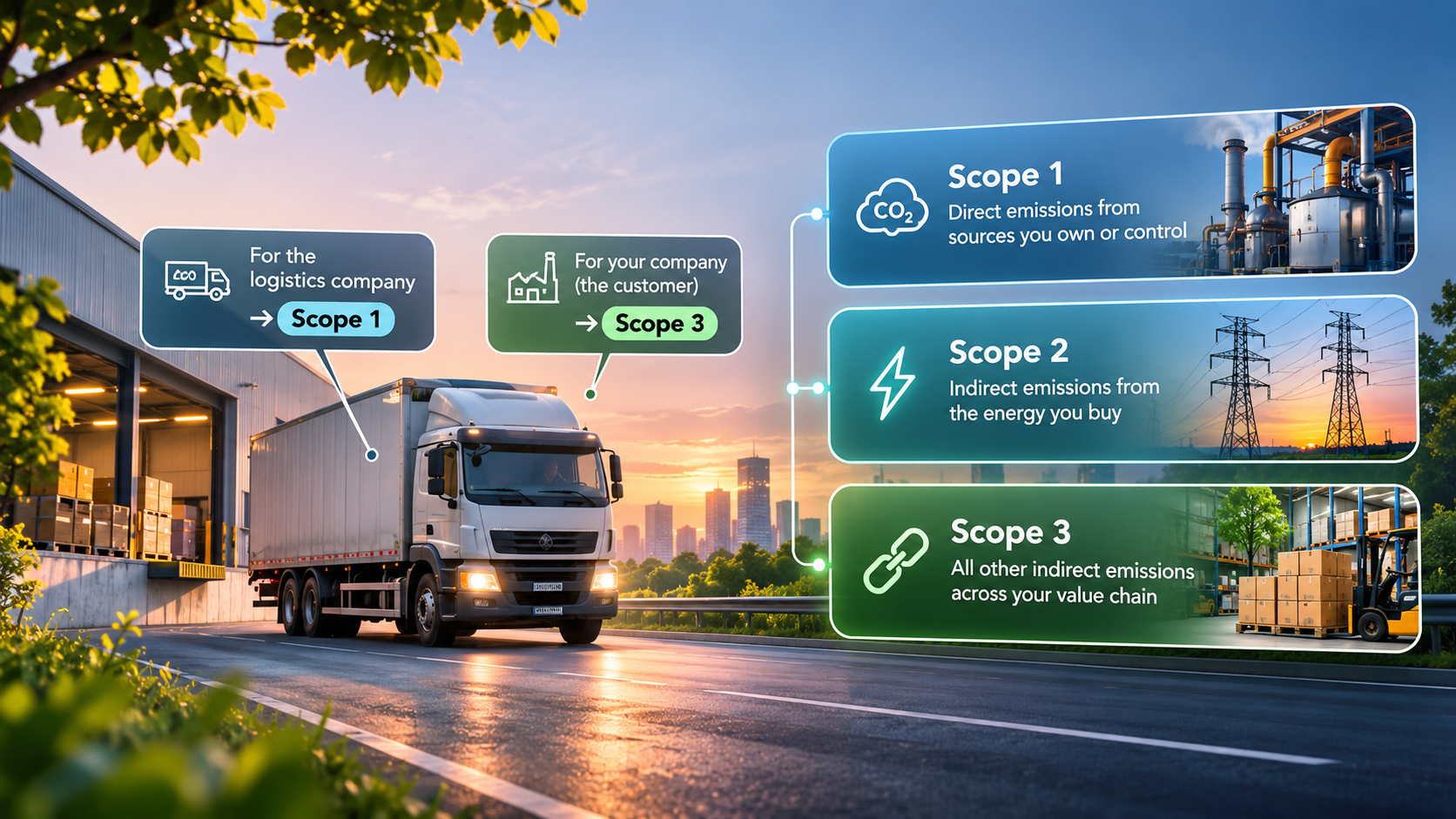 Regulatory NavigationNov 2, 2026 · 13 min read
Scope 1 vs Scope 2 vs Scope 3: The One Rule That Explains the Difference
Understand Scope 1, Scope 2 and Scope 3 emissions with simple business examples. Learn the differences, 15 Scope 3 categories, calculation basics and how to build a reliable GHG inventory
 Regulatory NavigationOct 21, 2026 · 10 min read
Your Financial Audit Is Done. Your ESG Numbers Still Aren't Covered.
A financial audit doesn't automatically cover ESG disclosures. Learn how sustainability assurance differs, what BRSR Core requires, and how to build an evidence trail.
 Financial ServicesOct 8, 2026 · 9 min read
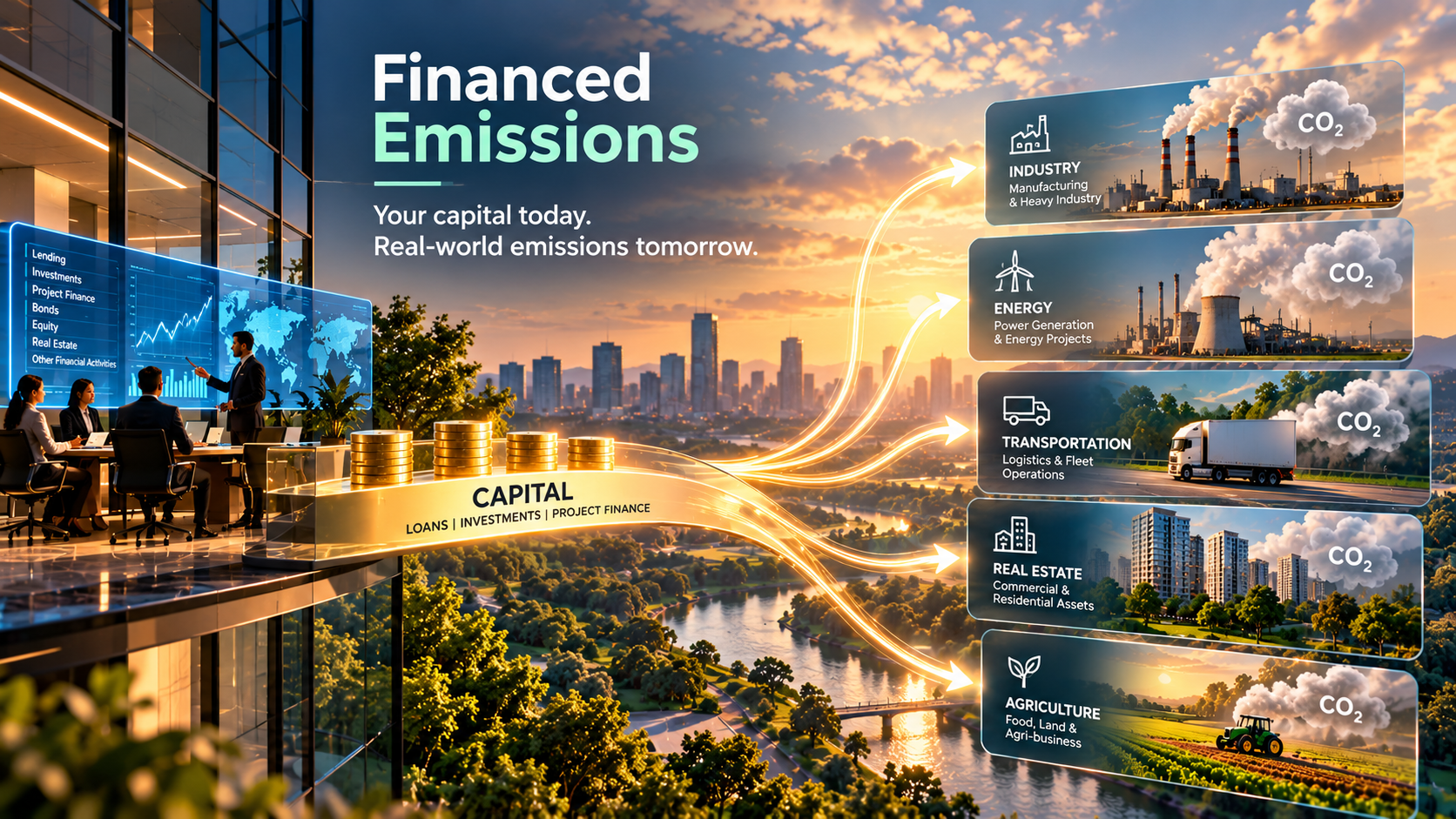
Financial Services: Your Emissions Live on Someone Else's Balance Sheet
Financed emissions were over 700x direct emissions in a CDP analysis. Learn how PCAF and Scope 3 Category 15 help financial institutions measure portfolio emissions.