America Just Abandoned Mandatory Climate Disclosure. India Didn't.
Compliance & Regulations
PS Team
May 15, 2026
Table of Contents
On May 4, 2026, the U.S. Securities and Exchange Commission sent a proposed rule to the White House: "Rescission of Climate-Related Disclosure Rules." Four days later, the SEC told the Eighth Circuit Court of Appeals it wouldn't defend those rules in court — and that it planned to rescind them entirely.
The world's largest capital market just walked away from mandatory climate disclosure.
Meanwhile, India's market regulator SEBI hasn't blinked. It mandates ESG reporting for the top 1,000 listed companies, requires phased external assurance of key disclosures, and is expanding reporting obligations to include suppliers and customers. India's framework didn't flinch. It tightened.
This isn't just a regulatory footnote. For Indian companies that compete for international capital, the ground just shifted — and most people haven't noticed yet.
What the SEC Actually Did
The Biden-era climate disclosure rules were adopted in March 2024 under then-SEC Chair Gary Gensler. They would have required US public companies to disclose climate-related risks, governance processes, financial impacts from severe weather, and Scope 1 and Scope 2 emissions. The rules never actually took effect — litigation paused them almost immediately after adoption.
Under the Trump administration, the SEC withdrew its legal defence in March 2025. When the Eighth Circuit ordered the agency to either defend the rules or formally rescind them, the SEC chose to rescind. Chair Paul Atkins directed staff to prepare the withdrawal, with the agency stating it wants to return to a "materiality-focused approach to securities regulation."
The practical result: the US now has no federal mandatory climate disclosure requirement for public companies. California's state-level law covering large companies remains technically in force but faces its own legal pressure. Federal policy is actively pushing back on state-level climate regulation too.
The direction is clear. The US is out.
What India Built Instead
Compare that to what India's disclosure architecture looks like right now.
BRSR is mandatory for the top 1,000 listed companies by market capitalisation. It covers environmental, social, and governance indicators across nine national principles — environmental stewardship, employee well-being, stakeholder engagement, human rights, and governance. This isn't a checkbox exercise. It's a structured, enforceable framework.
BRSR Core — a subset of high-impact metrics — goes a step further. It requires external assessment or third-party assurance. That requirement became mandatory for the top 500 listed entities from FY 2025-26, and expands to the full top 1,000 from FY 2026-27.
On top of that, value chain disclosures are being phased in. Companies will need to report on suppliers and customers who account for 2% or more of their total procurement or sales. Voluntary reporting is already expected in FY 2025-26. Mandatory assessment or assurance follows from FY 2026-27.
India has built a phased, assurance-backed ESG disclosure system. It is now, by any reasonable measure, the most comprehensive mandatory ESG framework in any major non-EU economy.
Why This Matters More Than You Think
The instinct is to treat this as geopolitical trivia — America steps back, India steps up. But the practical consequences for Indian companies are more immediate than that.
Global investors haven't abandoned ESG. Morgan Stanley's April 2026 Sustainable Signals survey of 2,250 individual investors across North America, Europe, and Asia Pacific found that 92% are interested in sustainable investing — up from 88% the previous year. In Asia Pacific specifically, that number is 93%. Two-thirds plan to increase their sustainable investment allocations over the next year.
Investor appetite for ESG data didn't follow the SEC's lead. It went the other direction.
The SEC's retreat creates a data vacuum — and Indian companies can fill it. With no federal US mandate, American companies will produce less standardised climate data over time, not more. Indian listed companies producing assured BRSR Core disclosures are generating exactly the kind of structured, comparable ESG data that global investors, rating agencies, and index providers need. An Indian company with third-party-assessed BRSR data is now, by default, more ESG-transparent than most US-listed peers. That's a competitive advantage in capital allocation decisions that simply didn't exist two weeks ago.
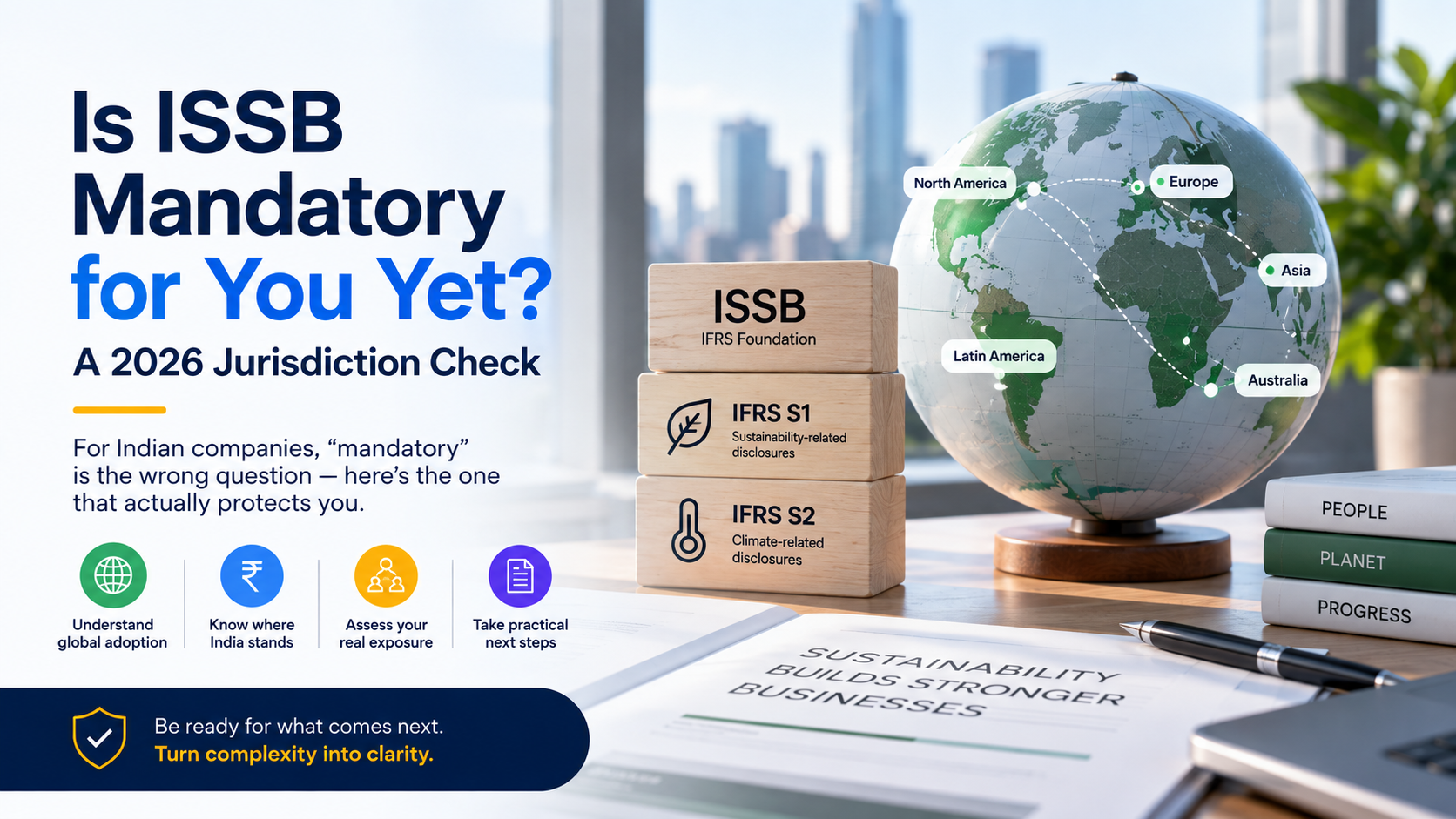
The ESG "backlash" is a US story, not a global one. The political pushback against ESG is driven by domestic American politics. The EU is advancing its own disclosure framework with revised standards under active consultation. Twenty-one jurisdictions had adopted ISSB standards as of January 2026. India's Carbon Credit Trading Scheme commenced compliance operations covering approximately 490 industrial entities from FY 2025-26. Outside the US, the direction of travel is uniformly toward more disclosure, not less.
Three Shifts to Watch Over the Next 12-18 Months
ESG rating agencies will recalibrate. Agencies like MSCI, Sustainalytics, and S&P Global rate companies across jurisdictions. With less data coming from US-listed companies, available and verified data carries more weight. Indian companies with comprehensive BRSR filings could see their relative ESG data footprint improve — not necessarily because their performance changed, but because the comparison set got worse.
Foreign institutional investors will follow disclosure quality. Institutional investors managing assets under EU regulations still need ESG data on portfolio companies globally. When a US-listed company can't provide standardised climate data and an Indian-listed company can, the capital allocation math becomes simpler. BRSR is quietly becoming a capital market advantage.
India's regulatory credibility gains international standing. SEBI maintaining and strengthening its ESG framework while the SEC retreats sends a clear signal to standard-setters, credit agencies, and multilateral institutions. India isn't following the West on ESG. It's leading.
The Companies That Built the Infrastructure Early Win
This isn't about celebrating regulatory divergence for its own sake. It's about recognising that Indian companies with strong ESG disclosure infrastructure now sit in a structurally better position for global capital flows — and that advantage will grow as the US regulatory vacuum persists.
Karbon by Planet Sustech is the ESG platform that makes this advantage operational. From carbon footprint calculation and Scope 1 through Scope 3 emission accounting to BRSR-aligned reporting with the audit trail that assessment and assurance demands, Karbon gives Indian companies the infrastructure to produce the disclosure quality that global investors are actively seeking.
The SEC just told US companies they don't have to report on climate. The investors allocating capital to India didn't get that memo.
Book a Karbon demo and turn India's ESG leadership into your company's competitive advantage.
Frequently Asked Questions
What did the SEC actually do with climate disclosure rules?
On May 4, 2026, the SEC submitted a proposal to formally rescind the Biden-era climate disclosure rules. On May 8, 2026, it told a federal appeals court it would not defend those rules. The US now has no federal mandatory climate disclosure requirement for public companies.
How does India's BRSR compare to what the US had?
The US rules, had they taken effect, would have required Scope 1 and 2 emissions disclosures and climate risk reporting. India's BRSR goes further — covering a broader set of ESG indicators, requiring third-party assurance on core metrics, and extending to value chain partners. BRSR is also mandatory and actively enforced by SEBI.
Does this affect how global investors view Indian companies?
It can, positively. Investors still need ESG data for portfolio decisions and regulatory compliance. As US companies produce less standardised ESG data, Indian companies with assured BRSR disclosures become comparatively more attractive to global capital allocators.
What is BRSR Core and who does it apply to?
BRSR Core is a set of high-impact ESG metrics within the broader BRSR framework. External assessment or third-party assurance of BRSR Core is mandatory for the top 500 listed entities from FY 2025-26, expanding to the top 1,000 from FY 2026-27.
What are value chain disclosures under BRSR?
Under SEBI's framework, companies are expected to report on suppliers and customers who account for 2% or more of total procurement or sales. Voluntary reporting applies in FY 2025-26, with mandatory assessment or assurance from FY 2026-27.
Is the ESG backlash a global trend?
No. The backlash is largely a US domestic political phenomenon. The EU, UK, Japan, Australia, and 21 other jurisdictions are either maintaining or expanding ESG and climate disclosure requirements. India's framework is strengthening, not retreating.