India's Listed Companies Are Sitting on a Massive Scope 3 Emissions Gap — Here's Where It's Hiding
Reporting
PS Team
April 29, 2026
Table of Contents
Here's a number most Indian boardrooms aren't talking about.
According to PwC India's April 2024 analysis of FY23 BRSR filings, only 51% of India's top 100 listed companies — the Nifty 50 and Next 50 — disclosed any Scope 3 emissions data. And of those that did, the most commonly reported categories were business travel and employee commuting. These together represent a tiny fraction of a company's actual value chain emissions.
Here's why that matters right now. Industry estimates suggest that Scope 3 typically accounts for 70 to 90% of a company's total carbon footprint. So what most companies are disclosing is, in effect, the smallest slice of their actual emissions picture.
Now layer on the GHG Protocol's proposed 95% minimum boundary rule — part of the Phase 1 Scope 3 Standard revisions published in March 2026 — and the gap between what Indian companies currently report and what the updated standard would require isn't a minor shortfall. It's a systemic undercount. And as carbon pricing mechanisms come online, that undercount is starting to carry a real financial cost.
This article maps exactly where that hidden exposure sits — by sector — and why acting now matters more than waiting for the rules to be finalised.
The Numbers Behind the Gap
The PwC India report found that while 34% of the top 100 companies had reduced their Scope 1 emissions and 29% had reduced Scope 2, Scope 3 remained largely uncharted territory.
Among companies that did disclose Scope 3, most covered just one or two of the fifteen standard categories — almost always Category 6 (business travel) and Category 7 (employee commuting). The categories that typically dominate Scope 3 — purchased goods and services (Category 1), use of sold products (Category 11), and investments and financed emissions (Category 15) — were either missing entirely or reported using rough spend-based estimates with no methodology attached.
Under current BRSR rules, this is technically acceptable. Scope 3 has been voluntary for most listed companies, and even BRSR Core covers only selected Scope 3 categories without requiring full GHG Protocol compliance across all fifteen.
But that's changing, driven by three developments converging at once.
What's Changing — and Why It Matters
Development 1: The 95% Rule Redefines What "Complete" Means
The GHG Protocol's proposed Phase 1 revisions — supported by 87% of its Technical Working Group — would require companies to account for at least 95% of their total required Scope 3 emissions. The remaining 5% of exclusions would need to be quantitatively validated each year, not just mentioned qualitatively.
This is a significant shift. Today, many companies exclude high-impact categories with a note like "data not available" or "not currently material." Under the proposed rule, every exclusion would need to be measured and demonstrated to fall within that 5% cap.
It's worth noting that this is still a draft standard, not a finalised requirement. But given that 87% of the Technical Working Group supported it, the direction is clear. Companies that start building measurement infrastructure now will be ahead when the standard is finalised.
Development 2: Carbon Pricing Is Putting a Real Number on the Gap
India's Carbon Credit Trading Scheme is now underway, with approximately 490 industrial units across seven sectors operating under legally binding emissions intensity targets for FY2025-26. Carbon credit trading is expected to begin by mid-2026. Meanwhile, the EU's Carbon Border Adjustment Mechanism entered its definitive financial phase on January 1, 2026, directly pricing the carbon embedded in Indian exports of steel, aluminium, cement, and fertilisers — at approximately €65–80 per tonne of CO2 equivalent.
To illustrate what unreported Scope 3 exposure could mean in practice: consider a large Indian conglomerate with ₹50,000 crore in annual procurement that currently reports zero Category 1 (purchased goods and services) emissions. If that procurement generates an estimated 2 to 5 million tonnes of CO2 equivalent — a conservative range for diversified manufacturing — the unaccounted environmental cost at a shadow price of ₹1,000 to 2,000 per tonne would be somewhere between ₹200 crore and ₹1,000 crore. These are illustrative figures, not a specific company's numbers. But the arithmetic shows how quickly unreported emissions translate into financial exposure once carbon is priced.
Development 3: ISSB Is Making Scope 3 an Investor Issue
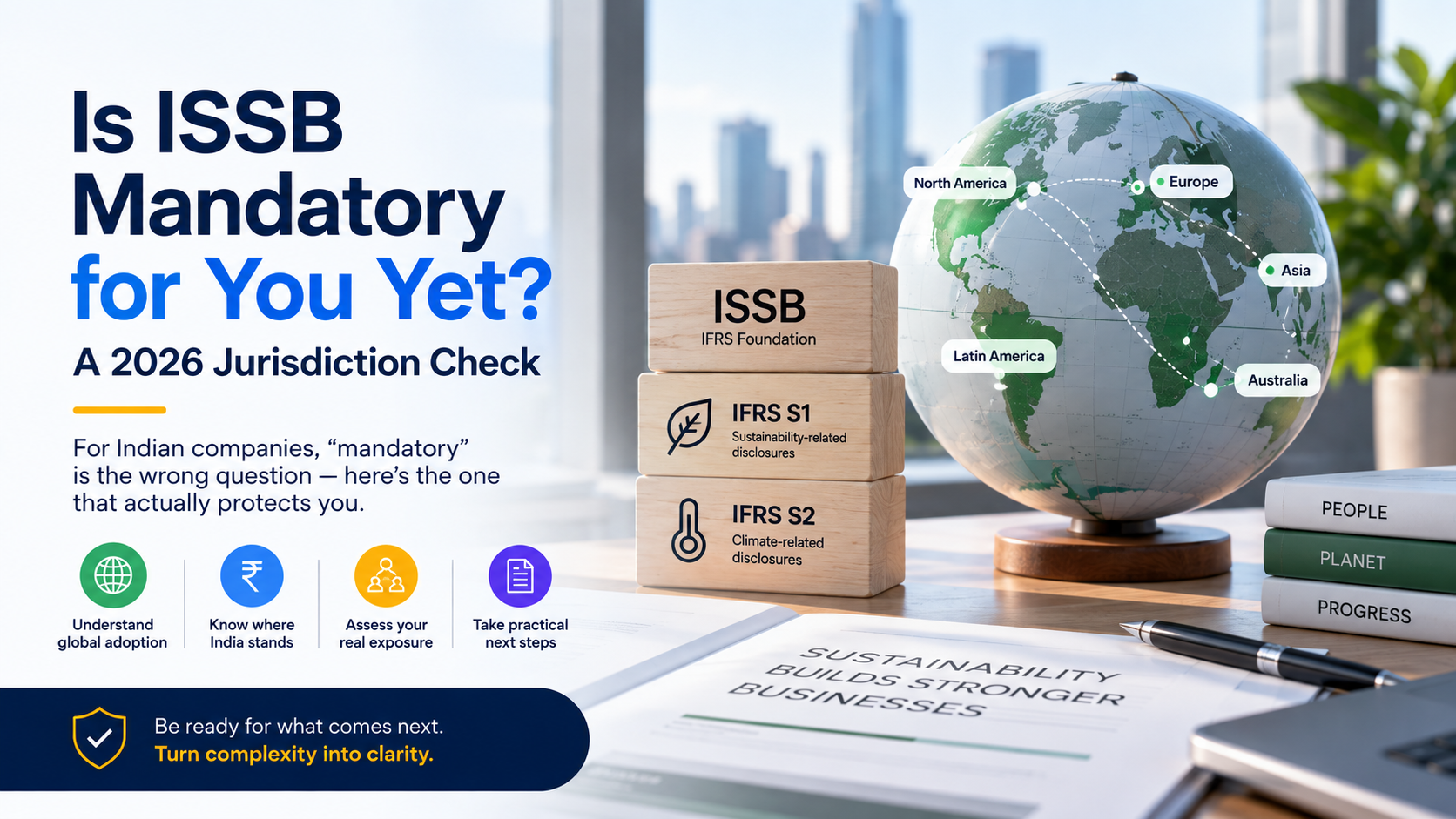
As of January 2026, 21 jurisdictions globally had adopted ISSB standards on a voluntary or mandatory basis. IFRS S2 requires disclosure of all material Scope 3 emissions. India hasn't formally adopted ISSB standards yet — but BRSR already references GRI, SASB, and TCFD, and SEBI has signalled ongoing alignment with international disclosure expectations. For Indian companies with foreign institutional investors, global supply chain relationships, or dual listings, the Scope 3 gap is increasingly an investment-grade information gap, not just a compliance one.
Where the Liability Is Hiding: Sector by Sector
Banking, Financial Services & Insurance
This is where the largest unreported exposure likely sits. Financed emissions — Category 15 — can represent hundreds of times a bank's direct operational footprint. Research from organisations including CDP and PCAF has found financed emissions to be many multiples of direct emissions for financial institutions, with some estimates suggesting ratios well above 700 times direct operations, though figures vary significantly by institution type and portfolio.
The GHG Protocol's Phase 1 draft is also restructuring this area: Category 15 is being narrowed to true financed emissions, while insurance underwriting and other facilitated emissions move to a new Category 16. Most Indian banks and NBFCs currently report zero financed emissions in their BRSR filings. That position is increasingly difficult to sustain.
IT Services
India's IT sector generally reports well on Scope 1 and 2 — office energy, data centre consumption. But Category 1 (purchased goods and services), Category 2 (capital goods), Category 11 (use of sold products including client-side digital infrastructure), and Category 13 (downstream leased assets) are rarely quantified. For companies whose core business is enabling client operations, the downstream Scope 3 footprint is often where the real emissions picture lives.
FMCG and Consumer Goods
Agricultural supply chains, packaging, logistics, product use-phase emissions, and end-of-life disposal — spanning Categories 1, 4, 9, 11, and 12 — are almost entirely absent from current BRSR filings in this sector. For a company distributing millions of packaged consumer products, use-phase and end-of-life emissions can dwarf manufacturing emissions.
Oil, Gas and Energy
These companies often report Scope 1 and 2 rigorously. But Category 11 — use of sold products, which includes the combustion of fuels sold to customers — is typically the single largest emissions category for any fossil fuel company. It can exceed all other scopes combined. Under the proposed 95% boundary rule, this cannot be excluded.
Metals and Mining
Downstream processing creates significant unreported Scope 3 volumes, particularly under Category 10 (processing of sold products). Iron ore and aluminium producers whose materials are converted by customers into high-emission finished goods carry substantial downstream exposure that rarely shows up in current filings.
Frequently Asked Questions
Why do most Indian companies only report business travel and commuting as Scope 3?
These two categories — business travel (Category 6) and employee commuting (Category 7) — tend to be the easiest to measure. Data is already available through expense systems and HR records. The categories that actually dominate most companies' Scope 3 footprints — like purchased goods, product use-phase, and financed emissions — require supply chain engagement, activity-based data collection, and specialised calculation methodologies that many companies haven't built yet.
Is the GHG Protocol's 95% rule already mandatory?
Not yet. The 95% minimum boundary rule is part of the Phase 1 revisions to the GHG Protocol Scope 3 Standard, published in draft form in March 2026. It had support from 87% of the Technical Working Group, but it remains a draft pending finalisation. However, the regulatory direction is clear, and companies building measurement infrastructure now will be significantly better positioned.
What does the EU CBAM mean for Indian exporters specifically?
The Carbon Border Adjustment Mechanism entered its definitive financial phase on January 1, 2026. Indian companies exporting steel, aluminium, cement, fertilisers, electricity, or hydrogen to the EU will need to pay for the carbon embedded in those exports — priced at the EU carbon market rate, currently around €65–80 per tonne of CO2 equivalent. The first certificate surrender deadline is September 30, 2027.
How does Karbon help with Scope 3 measurement?
Karbon collects activity data across your value chain — from suppliers, logistics partners, and product use data — and applies GHG Protocol-aligned calculation methodologies to produce verified Scope 3 disclosures. It integrates with ERP systems, supports third-party assurance workflows, and generates outputs aligned to global reporting requirements.
The Window for Quiet Preparation Is Closing
The 95% rule is still a draft. BRSR value chain disclosures remain voluntary for FY 2025-26. India hasn't adopted ISSB. These are real facts — but they point to a preparation window, not a reason for inaction. Every framework is moving in the same direction: more categories measured, less estimation accepted, stronger assurance required.
SEBI's December 2024 circular confirmed that assessment and assurance of BRSR Core KPIs become mandatory from FY 2026-27. The trajectory is set. Companies that map their full Scope 3 inventory now — before the rules make it mandatory — won't just be compliant. They'll own the narrative when the numbers become public. Companies that wait will be building measurement systems under regulatory pressure, without the historical baseline that makes those systems credible.
Karbon Finds What's Hidden — and Makes It Audit-Ready
Karbon by PlanetSustech is built for exactly this gap. From Category 1 purchased goods through the proposed new Category 16 facilitated emissions, Karbon's calculation engine maps your full emissions inventory across all Scope 3 categories. It flags what's unreported, quantifies your exposure, and generates audit ready disclosures — with the audit trail that assurance providers need.
The unreported liability doesn't go away because you haven't measured it. It just compounds.