ESG for SMEs in India: Where to Start Without a Dedicated Sustainability Team
Getting Started
PS Team
April 14, 2026
Table of Contents
What You Need to Know
You didn't start your business to become a carbon accounting expert. But here's what's happening right now:
Your biggest customer just asked for your Scope 1 and Scope 2 emissions data. Your bank application has an ESG section you've never seen before. That export order to Europe? They want your environmental metrics first.
The reality: ESG isn't just for big companies anymore. It's reaching Indian SMEs faster than anyone expected—not because of regulations, but because your customers, banks, and buyers need your sustainability data.
The challenge: You don't have a Chief Sustainability Officer, a dedicated team, or a massive budget.
The good news: You don't need any of that to get started. You just need to know where to begin.
Why ESG Matters to Your SME Right Now
Let's cut through the corporate sustainability jargon and talk about what actually affects your business.
Your Biggest Customers Are Asking
When SEBI mandated BRSR Core for India's top 250 companies, it included value chain reporting. That means:
Your corporate client—the one giving you 30% of your revenue—now needs:
- Your emissions data
- Your water usage numbers
- Your workforce metrics
- Your environmental practices
Why? Because they have to report it as part of their own compliance.
What this means for you: If you can't provide this data, they'll find a supplier who can. This isn't a future problem. It's happening now.
Industries feeling pressure first:
- Automotive component manufacturers
- FMCG suppliers
- Pharmaceutical vendors
- IT services providers
- Textile and garment exporters
- Chemical suppliers
Banks Are Pricing ESG Into Loans
RBI's framework on climate-related financial risks is changing how banks evaluate SME loans.
Green financing products offering better terms:
- SIDBI's sustainability-linked loans (lower interest rates)
- SBI's green credit lines (preferential terms)
- Export-Import Bank's sustainable finance
- NBFCs with ESG-linked lending
The advantage: SMEs that can produce verified carbon footprints and basic environmental disclosures get better loan terms. It's not just about being environmentally responsible—it's about being financially attractive.
Real impact: 0.5-1% lower interest rates can save an SME with ₹5 crore in borrowing around ₹2.5-5 lakhs annually.
Export Markets Are Setting ESG Prerequisites
If you export to Europe or supply companies that do, ESG compliance is becoming mandatory.
What's coming:
- EU's Carbon Border Adjustment Mechanism (CBAM)
- Corporate Sustainability Due Diligence Directive (CSDDD)
- Buyer-specific ESG requirements from multinational corporations
Industries most affected:
- Textiles and apparel
- Chemicals and plastics
- Metals and metal products
- Auto components
- Electronics manufacturing
The bottom line: Indian SMEs that can't measure and report their environmental footprint will lose European market access entirely.
The Mistake Most SMEs Make
Google "ESG for SMEs" and you'll find advice like:
- "Develop a comprehensive sustainability strategy"
- "Conduct a full materiality assessment"
- "Build a cross-functional ESG committee"
The problem: That advice assumes you have resources you don't have.
If you're juggling operations, cash flow, customer delivery, and everything else that comes with running an SME, "comprehensive sustainability strategies" end up on the "we'll get to it someday" list.
The better approach: Start with what your stakeholders are actually asking for right now—not what a consultant thinks you should do.
For most Indian SMEs, that means three things:
- Your carbon footprint
- Your basic environmental metrics
- Your ability to report them in a format customers recognize
Everything else can follow. But without these three, you're already falling behind.
The Four-Step ESG Entry Point for SMEs
You don't need a sustainability degree or a massive budget. Here's how to actually get started.
Step 1: Measure Your Energy and Emissions Baseline
You don't need an environmental engineer. The data you need is already in your business.
What you need to collect:
- Electricity bills (monthly consumption in kWh)
- Diesel purchases for generators (liters)
- LPG or PNG consumption (if applicable)
- Petrol/diesel for company vehicles (liters)
- Any coal, furnace oil, or other fuels used
Why this matters: This data lets you calculate Scope 1 and Scope 2 emissions—the foundation of any ESG disclosure.
Scope 1 (Direct emissions):
- Fuel burned in generators
- Company vehicles
- On-site boilers or furnaces
- Refrigerant leaks (if you track)
Scope 2 (Electricity emissions):
- Power purchased from the grid
- Emissions calculated using India's Central Electricity Authority factors
How to calculate: Use standardized emission factors. For India:
- Central Electricity Authority (CEA) publishes grid factors
- IPCC provides fuel combustion factors
- These are publicly available—you don't need to guess
Time required: If your records are organized, baseline calculation takes 2-4 hours with the right tool.
How Karbon helps: Upload your bills and consumption data. Karbon automatically applies the correct India-specific emission factors and calculates your footprint. No manual calculations. No spreadsheet formulas.
Step 2: Identify the Five Metrics Your Buyers Care About Most
Don't try to report on everything. Focus on what your customers actually need.
Here's what to do: Call your top 3 customers' procurement or sustainability teams and ask directly: "What ESG data will you need from us this year?"
In most cases, the answer converges around:
- GHG Emissions (tCO2e)
- Scope 1 and Scope 2 required
- Scope 3 increasingly requested
- Energy Intensity
- Energy consumption per unit of production
- Or per unit of revenue
- Water Consumption
- Total water withdrawal (cubic meters)
- Water intensity metrics
- Waste Management
- Total waste generated (tonnes)
- Waste recycled vs. sent to landfill
- Hazardous waste handling (if applicable)
- Workforce Safety
- Lost Time Injury Frequency Rate (LTIFR)
- Safety training hours
- Any fatalities (target: zero)
Why this matters: Knowing the exact ask prevents you from building reporting infrastructure for 50 indicators when 5 will keep your commercial relationships intact.
Pro tip: If customers haven't asked yet, they will. Get ahead by asking first—it positions you as proactive, not reactive.
Step 3: Digitize Before You Optimize
The biggest SME mistake isn't failing to reduce emissions—it's failing to systematically track what they generate.
Where your data lives now (probably):
- Electricity bills in email or paper files
- Fuel receipts in accounting folders
- Waste records in maintenance logs
- Water bills scattered across departments
- Production data in a different system entirely
The problem: You cannot improve what you cannot see. You cannot report what you cannot trace.
What digitization means: Move everything into one system where you can:
- Track data consistently month over month
- Compare year over year performance
- Generate reports without manual compilation
- Maintain audit trails
- Spot trends and anomalies
What this doesn't mean: You don't need expensive enterprise software or complex implementations.
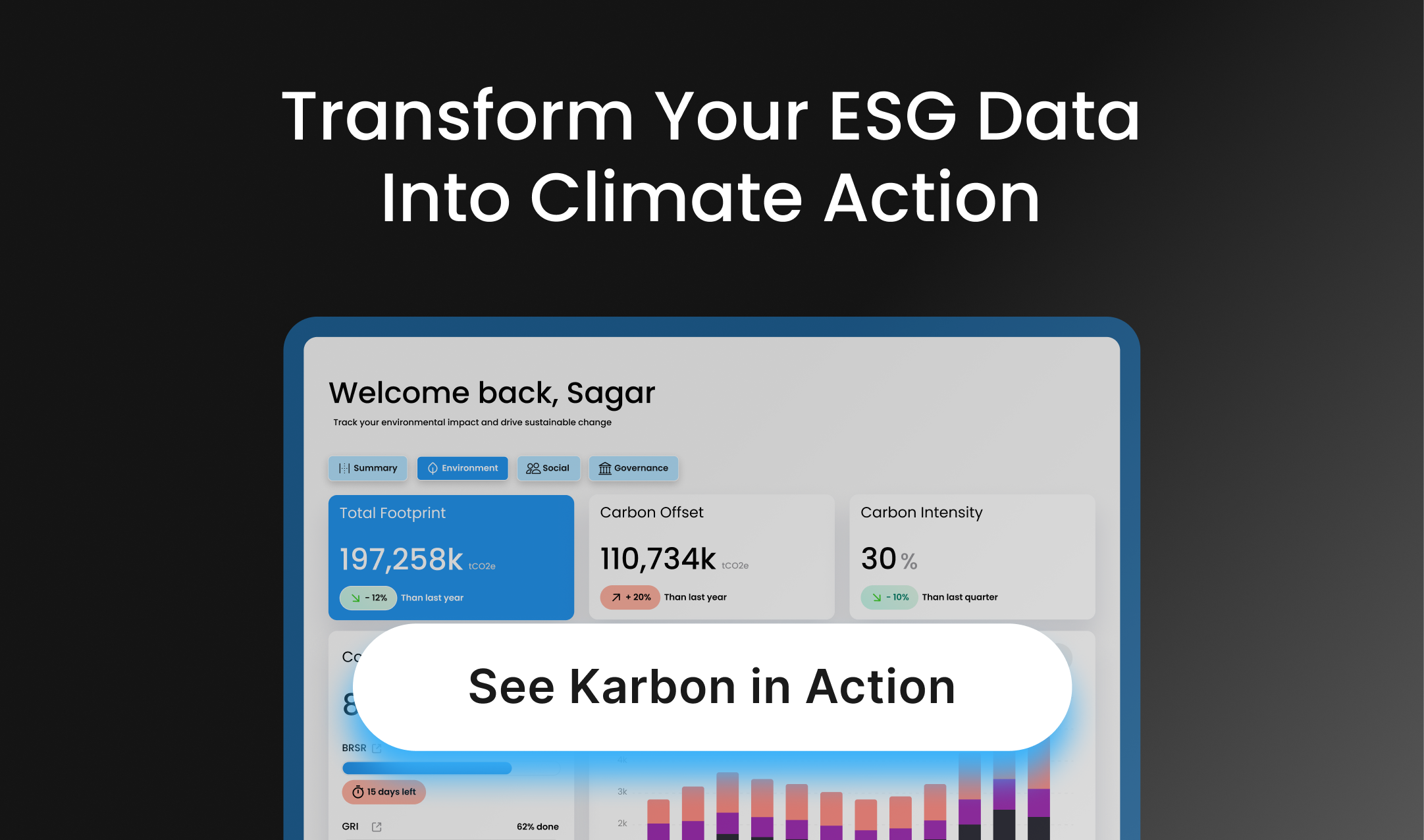
How Karbon helps: Central dashboard for all your ESG data. Upload utility bills, enter consumption figures, track metrics over time. Everything in one place with automatic calculations and audit trails built in.
Step 4: Generate Reports That Match Your Stakeholders' Frameworks
Your data means nothing if it arrives in a format your customer's sustainability team can't use.
What doesn't work:
- PDF attachments with your own formatting
- Excel files with custom calculations
- Emails with numbers in the body text
- Self-created templates
What does work: Reports aligned with recognized frameworks:
- BRSR (Business Responsibility and Sustainability Reporting) - for Indian customers
- GRI (Global Reporting Initiative) - for international buyers
- CDP (Carbon Disclosure Project) - for specific customer requirements
- Custom formats that match your buyer's specific templates
Why this matters: Your buyer needs to plug your data into their own BRSR or GRI disclosures. If your format doesn't match, they'll either reject it or spend time reformatting (which makes you a difficult supplier).
What buyers want:
- Structured data with clear methodologies
- Emission factors documented
- Calculation approaches specified
- Assurance-ready documentation
- Digital format they can integrate
How Karbon helps: One-click report generation in BRSR, GRI, and custom formats. Reports include methodology documentation, emission factors used, and audit trails—everything your customer needs to include your data in their assured reports.
Common SME ESG Questions
Q: How much does it cost to start measuring ESG metrics?
Starting with basic emissions tracking: minimal cost if you use the right platform. Karbon's SME packages start at affordable monthly subscriptions—think of it like accounting software, not a consulting project.Fraction of consultant costs, with ongoing capability
Q: Do we really need to do this if we're not mandated by law?
Legal requirement? Not yet for most SMEs. Commercial requirement? Already here.
If you supply large companies, export to regulated markets, or need competitive financing, ESG isn't optional—it's operational.
Q: How long does it take to calculate a carbon footprint?
With organized records and the right platform: 2-4 hours for initial setup, then 30 minutes monthly for updates.
Without a platform: 2-3 days of manual work each reporting cycle, plus high error risk.
Q: What if we don't have all the data?
Start with what you have. Most SMEs can get 70-80% accuracy with:
- Electricity bills
- Major fuel purchases
- Basic production data
Perfect data isn't the requirement. Documented, improving data is.
Q: Can we do this without hiring anyone?
Yes. That's the whole point of this guide.
Modern ESG platforms like Karbon are designed for teams without sustainability specialists. Your finance person, operations manager, or even the business owner can manage it—usually in less time than monthly accounting.
Q: What's the ROI on ESG for SMEs?
Tangible returns:
- Retain major customers (avoid revenue loss)
- Win new contracts (ESG-conscious buyers)
- Better loan terms (0.5-1% lower rates)
- Export market access (EU, US buyers)
Typical payback: 3-6 months through retained business and better financing terms.
Q: Will our customers actually ask for this data?
If you supply listed companies: They're asking now or will within 6 months.
If you export to Europe: CBAM requires it starting 2026.
If you need bank financing: Green products already require it.
The question isn't "if" but "when."
Q: How does Karbon compare to hiring a consultant?
Consultant approach:
- One-time assessment Cost
- Ongoing reporting: Cost per cycle
- You own nothing when they leave
Karbon approach:
- Monthly subscription (affordable for SMEs)
- Continuous tracking and reporting
- You build in-house capability
- Scales with your business
The Competitive Advantage Nobody Talks About
Here's what gets lost in the compliance conversation:
The SMEs that move early on ESG aren't just satisfying current clients. They're becoming preferred suppliers for every large company building sustainability into procurement decisions.
Think about it: In a market where most SMEs cannot produce a basic carbon footprint on request, the one that can doesn't just retain business—it wins new business that competitors aren't even being considered for.
Real scenarios playing out now:
Scenario 1: The Preferred Supplier Two SMEs bid for a ₹2 crore annual contract with a large FMCG company. Both have competitive pricing and quality. One can provide ESG data. The other can't. Guess who wins.
Scenario 2: The Export Opportunity A European buyer is qualifying Indian suppliers. ESG compliance is non-negotiable. SMEs without verified environmental data don't make the shortlist—regardless of price or quality.
Scenario 3: The Financing Edge Two manufacturers apply for ₹3 crore working capital. One has basic ESG metrics. The other doesn't. The first gets 0.75% lower interest rate, saving ₹22,500 annually.
The pattern: ESG readiness is becoming a commercial differentiator at the SME level faster than most founders realize.
First-mover advantage: Right now, SME ESG capability is rare. The gap between "can provide data" and "cannot provide data" is huge. That gap is your opportunity—but it's narrowing as more SMEs get onboard.
The Bottom Line for Indian SMEs
Here's what we know for certain:
ESG is no longer optional for SMEs. Your customers need your data. Your banks are pricing it. Your export markets require it.
You don't need a sustainability team. You need systematic tracking, correct calculations, and proper reporting. That's a platform problem, not a hiring problem.
Starting is easier than you think. If you have utility bills and fuel records, you have 80% of what you need. The rest is applying the right emission factors—something Karbon does automatically.
The commercial advantage is real. SMEs with ESG capability are winning contracts, getting better financing, and accessing markets that others can't. That advantage exists because most SMEs haven't started yet.
Waiting makes it harder, not easier. Your customers are asking now. The SMEs moving first are building relationships and capabilities. The ones waiting are explaining why they can't provide basic data.
The cost of inaction exceeds the cost of action. Losing one major contract because you can't provide ESG data costs more than years of ESG platform subscriptions.
You Don't Need a Sustainability Team. You Need the Right Platform.
This is precisely the gap Karbon was built to close.
Developed by PlanetSustech specifically for SMEs, Karbon gives you the same carbon accounting, emission calculation, and ESG reporting capabilities that large enterprises use—without requiring a dedicated sustainability team to run it.
What Karbon Does For SMEs:
Simple Data Input:
- Upload utility bills and consumption records
- Enter monthly data in minutes
- No complex forms or technical jargon
Automatic Calculations:
- India-specific emission factors built in
- Scope 1, 2, and 3 calculations automated
- Intensity metrics calculated automatically
- No manual formulas or spreadsheets
Customer-Ready Reports:
- BRSR-aligned formats for Indian customers
- GRI reports for international buyers
- Custom templates matching your buyer's requirements
- One-click generation with full methodology documentation
Audit-Ready Documentation:
- Complete data lineage and timestamps
- Emission factors and sources documented
- Calculation methodologies transparent
- Supporting documents organized and linked
Integration with SME Systems:
- Imports data from existing accounting systems
- No duplicate data entry
- Custom integrations available
Affordable for SMEs:
- Subscription pricing (not consulting fees)
- Scales with your business size
Built for Non-Experts:
- No sustainability degree required
- Guided workflows with clear instructions
- Contextual help throughout
- Minimal training needed
Your largest client is going to ask for your ESG data this year. The only question is whether you'll be ready.
Ready to Get ESG-Ready Without Hiring Anyone?
Your customers are asking for ESG data now. Don't lose contracts because you're not ready.
Start with a Karbon demo and see how quickly your SME can go from zero ESG infrastructure to audit-ready disclosure—without hiring a single sustainability specialist.