Supply Chain ESG: How to Collect Sustainability Data from Vendors and Suppliers
Supply Chain & Vendors
PS Team
April 10, 2026
Table of Contents
What You Need to Know
Getting ESG data from your suppliers is the hardest part of sustainability reporting. Period.
You can measure your own office electricity in a day. You can track your company vehicles in a week. But getting accurate emissions data from 200 suppliers across different countries? That's where most sustainability programs fall apart.
Here's the problem: Over 80% of your carbon footprint comes from your supply chain. Yet when reporting season hits, you're still chasing vendors over email, piecing together incompatible spreadsheets, and filling gaps with industry averages that auditors increasingly reject.
The reality: This isn't just a reporting headache. It's an infrastructure problem that needs a systematic solution.
Why This Matters More Than Ever
Think your supplier data issues are just your problem? Think again.
Regulators Are Watching:
- SEBI's BRSR Core requires verified supply chain data
- EU's CSRD extends reporting to your entire value chain
- SEC climate rules demand Scope 3 transparency
- Penalties for incomplete or unverified data are real
Investors Are Asking:
- ESG ratings now scrutinize supply chain data quality
- "Estimated" data gets flagged and downgraded
- Investment decisions depend on verified environmental claims
Customers Care:
- B2B buyers prioritize suppliers with transparent ESG data
- RFPs increasingly require supply chain emissions disclosure
- Corporate customers conduct supplier sustainability audits
Your Reputation Depends On It:
- Greenwashing accusations often stem from poor supply chain data
- Media and activists target companies with weak vendor oversight
- Competitors with better data will win the sustainability story
Bottom line: Your sustainability report is only as credible as your weakest supply chain data point.
Why Supplier ESG Data Collection Fails
Before we fix the process, let's understand why it breaks. Three fundamental issues sabotage most collection efforts.
Problem 1: Suppliers Have No Reason to Care
Your Tier 1 supplier is running a business. Unless ESG performance directly impacts their commercial relationship with you—procurement decisions, contract renewals, payment terms—why would they invest time measuring emissions or tracking water usage?
Sending a 40-question sustainability survey to a supplier who sees zero consequence for ignoring it isn't a strategy. It's wishful thinking.
The reality: If sustainability data doesn't affect business outcomes, it gets deprioritized. Always.
Problem 2: Suppliers Have Different Capabilities
Your large chemical manufacturer might have a dedicated sustainability team producing GHG Protocol-compliant emissions inventories. Your small components supplier in a Tier 2 city? Definitely doesn't.
When you apply the same data collection approach across suppliers with vastly different capabilities, you get:
- High-quality data from the few who already measure everything
- Noise, guesses, or silence from everyone else
The reality: One-size-fits-all questionnaires don't work across a diverse supply base.
Problem 3: Everyone Measures Differently
One supplier reports emissions in tonnes of CO2. Another includes all six Kyoto gases as CO2 equivalent. A third gives you energy consumption data and expects you to figure out the emissions.
Without standardized calculation methods and reporting templates, the data you collect can't be meaningfully compared, aggregated, or verified.
The reality: Data inconsistency makes your final numbers unreliable and unauditable.
A Framework That Actually Works
Effective supplier ESG data collection isn't about sending better surveys. It's about building a system that accounts for commercial realities, technical constraints, and operational differences across your supply base.
Here's how to do it right.
Step 1: Map Your Supply Chain First
Before requesting a single data point, you need clarity on your supply chain structure.
Key questions to answer:
- Which suppliers are material from an ESG perspective?
- Where does the highest emissions intensity sit?
- Which categories carry the greatest environmental or social risk?
- Raw materials?
- Contract manufacturing?
- Logistics and transportation?
- Packaging?
This mapping exercise determines who you collect from, what you collect, and at what level of detail.
Why this matters: Without mapping, you either collect too much data from low-impact suppliers or too little from high-impact ones. Both waste resources and hurt data quality.
How Karbon helps: Karbon's supply chain mapping module visualizes your vendor network by emissions intensity, spend, and risk category—so you know exactly where to focus.
Step 2: Segment Suppliers by Capability and Impact
Not every supplier needs to provide the same level of data. Smart segmentation looks like this:
Tier 1: Strategic Suppliers (Top 20-30 by impact)
- Represent 60-70% of your procurement spend
- Demand supplier-specific emission factors
- Require detailed energy consumption breakdowns
- Need verified environmental data with documentation
Tier 2: Significant Suppliers (Next 50-100)
- Moderate environmental impact
- Request activity-based data where possible
- Accept hybrid approaches (some primary data + modeled estimates)
- Focus on major emission categories only
Tier 3: Long Tail (Remaining suppliers)
- Lower individual impact but collectively significant
- Use spend-based estimation methods
- Collect basic operational data
- Apply industry-average emission factors
Why this matters: The GHG Protocol's Scope 3 guidance explicitly supports this tiered approach. Document which methodology applies to which segment, and auditors will accept it.
How Karbon helps: Karbon automatically segments your supplier base and applies the appropriate calculation methodology for each tier—no manual categorization needed.
Step 3: Standardize What You're Asking For
Every data request should specify exactly:
What is being measured (electricity consumption, natural gas use, diesel for transportation)
The reporting boundary (which facilities, which operations)
The time period (calendar year, fiscal year, specific quarters)
Unit of measurement (kWh, cubic meters, liters, tonnes)
Calculation methodology (which emission factors to use)
Supporting documentation required (utility bills, shipping manifests, certificates)
Ambiguity in your request guarantees inconsistency in responses.
What this looks like in practice:
- Bad request: "Please provide your carbon emissions data."
- Good request: "Please provide total electricity consumption in kWh for the XYZ manufacturing facility for fiscal year 2025 (April 1, 2025 - March 31, 2026). Include utility bills as supporting documentation. We will calculate emissions using IEA grid emission factors for your region.
How Karbon helps: Karbon provides pre-built, standardized templates for every data request type. Suppliers see clear instructions, dropdown menus for units, and guided workflows—dramatically improving response quality.
Step 4: Embed Collection Into Procurement Workflows
ESG data collection can't live as a standalone annual exercise run by the sustainability team. It needs to be woven into how you manage suppliers day-to-day.
Integration points that work:
Supplier Onboarding:
- ESG data requirements in vendor registration
- Baseline emissions assessment as part of qualification
- Sustainability expectations in contracts
Periodic Business Reviews:
- Quarterly or semi-annual ESG performance check-ins
- Track improvement against targets
- Link ESG metrics to supplier scorecards
Contract Management:
- Include data provision clauses in agreements
- Set consequences for non-compliance
- Build in incentives for high-quality data
Why this matters: When sustainability data sits alongside quality, cost, and delivery metrics in your procurement system, it becomes part of normal supplier management—not something you bolt on during reporting season.
How Karbon helps: Karbon integrates with major procurement and ERP systems so ESG data flows automatically into existing workflows.
Step 5: Build Verification Into the Process
Waiting until disclosure time to check data accuracy is too late. Build validation into the collection stage.
Automated checks that catch errors early:
- Range checks (is this number physically possible?)
- Year-over-year variance flags (why did emissions jump 300%?)
- Cross-referencing (does reported energy match production volumes?)
- Unit validation (did they accidentally report MWh as kWh?)
- Completeness checks (are all required fields filled?)
Why this matters: Catching errors during collection—not after—reduces manual review time and gives suppliers the chance to correct mistakes before they cascade into your final reports.
How Karbon helps: Karbon's built-in validation engine runs multiple automated checks on every supplier submission. Suppliers get instant feedback, and you get clean data from the start.
Common Supplier Engagement Challenges (And Solutions)
Challenge 1: "Our supplier won't respond"
Why it happens: No consequences for ignoring you.
Solutions:
- Tie data provision to contract renewals
- Include sustainability performance in supplier scorecards
- Make it a procurement qualification criterion
- Offer incentives: preferred supplier status, faster payments, longer contracts
How Karbon helps: Automated reminder workflows with escalation paths. Non-responsive suppliers get flagged in your procurement dashboard.
Challenge 2: "The data we get is garbage"
Why it happens: Suppliers don't understand what you're asking for or how to measure it.
Solutions:
- Provide simple, guided templates with examples
- Offer calculation tools (emission factor libraries, converters)
- Create supplier training resources or webinars
- Assign a point of contact for questions
How Karbon helps: Supplier portals with step-by-step guidance, built-in calculators, and contextual help reduce confusion and improve data quality.
Challenge 3: "We have too many suppliers to manage this"
Why it happens: Trying to collect primary data from everyone.
Solutions:
- Use the tiered approach (focus on high-impact suppliers)
- Automate data collection and validation
- Accept modeled estimates for long tail
- Outsource to supplier engagement platforms
How Karbon helps: Karbon scales from 10 to 10,000 suppliers. Automated workflows, bulk uploads, and smart segmentation make managing hundreds of vendors feasible.
Challenge 4: "Suppliers submit data in different formats"
Why it happens: No standardized templates.
Solutions:
- Mandate specific formats (provide templates)
- Use structured data collection portals (not email)
- Reject non-conforming submissions
- Build format conversion tools
How Karbon helps: All suppliers use the same portal with standardized data entry fields. No more Excel files in 47 different formats.
Challenge 5: "How do we know if the data is accurate?"
Why it happens: No verification process.
Solutions:
- Request supporting documentation (utility bills, invoices)
- Conduct spot audits or site visits
- Cross-reference against industry benchmarks
- Use third-party verification for key suppliers
How Karbon helps: Karbon's audit trail captures every data submission, revision, and approval with timestamps and supporting documents—creating a chain of custody that satisfies auditors.
Your Questions Answered
Q: How many suppliers should we collect data from?
Start with your top 20-30 suppliers by emissions impact (usually correlates with spend). This typically covers 60-70% of your supply chain footprint. Expand coverage gradually as your program matures.
Q: What if suppliers refuse to provide data?
First, understand why. Often it's capability issues, not unwillingness. Provide tools, training, and support. For persistent non-compliance, consider commercial consequences—data provision clauses in contracts, supplier scorecard impacts, or alternative sourcing.
Q: Can we use industry averages instead of supplier-specific data?
For initial baselines and low-impact suppliers, yes. But frameworks like GHG Protocol and SEBI BRSR increasingly require primary data from significant suppliers. Plan to transition from estimated to measured data over 2-3 years.
Q: How often should we collect supplier data?
For strategic suppliers: quarterly or semi-annually. For most suppliers: annually. Align with your reporting cycle and supplier contract review schedules.
Q: What emission factors should we use?
Use the most region-specific, recent factors available. Sources include: IEA (electricity), DEFRA/BEIS (UK), EPA (US), CEA (India), supplier-specific factors where available. Karbon's emission factor library includes 50,000+ factors and updates automatically.
Q: How do we handle Scope 3 Category 1 (Purchased Goods and Services)?
Start with spend-based calculations using EEIO (Environmentally Extended Input-Output) factors. Gradually replace with supplier-specific data for high-impact purchases. Karbon automates both approaches and tracks your coverage ratio.
Q: What if suppliers don't know their emissions?
Provide them with calculation tools or simple data requests (energy bills, fuel consumption). Many suppliers can provide activity data even if they haven't calculated emissions. Your platform should handle the conversion.
Q: How do we get buy-in from procurement teams?
Show the business case: regulatory compliance, customer requirements, risk management, cost optimization opportunities. Integrate ESG into existing supplier management processes rather than creating parallel workflows.
Q: How long does it take to implement a supplier data collection system?
With Karbon: 4-8 weeks from kickoff to first data collection. This includes supplier segmentation, template configuration, portal setup, and initial supplier onboarding. Full program maturity takes 6-12 months.
The Bottom Line on Supply Chain ESG
Here's what we know for certain:
The problem is only getting bigger. More regulations, more investor scrutiny, more customer requirements. Supply chain ESG transparency is becoming table stakes.
Manual processes don't scale. Email, spreadsheets, and heroic efforts by your sustainability team break down when you're managing 100+ suppliers.
Data quality matters more than coverage. Better to have verified data from 50 high-impact suppliers than estimated data from 500.
Technology solves structural problems. The right platform turns an impossible manual process into a manageable automated workflow.
Starting is better than perfect. Begin with your top suppliers, build processes, expand coverage over time. Waiting for the "perfect" moment means falling further behind.
Companies that get supply chain ESG right aren't working harder—they're working with better infrastructure.
Your Supply Chain Data Problem Has a Name. The Solution Does Too.
Collecting ESG data from hundreds of suppliers across tiers, geographies, and capability levels is exactly the kind of problem that breaks when you throw people and spreadsheets at it—and holds together when you build the right system.
Karbon by PlanetSustech is an ESG platform engineered for this complexity.
Ready to Fix Your Supply Chain Data Problem?
Stop chasing suppliers over email. Start building the infrastructure that makes supply chain ESG manageable.
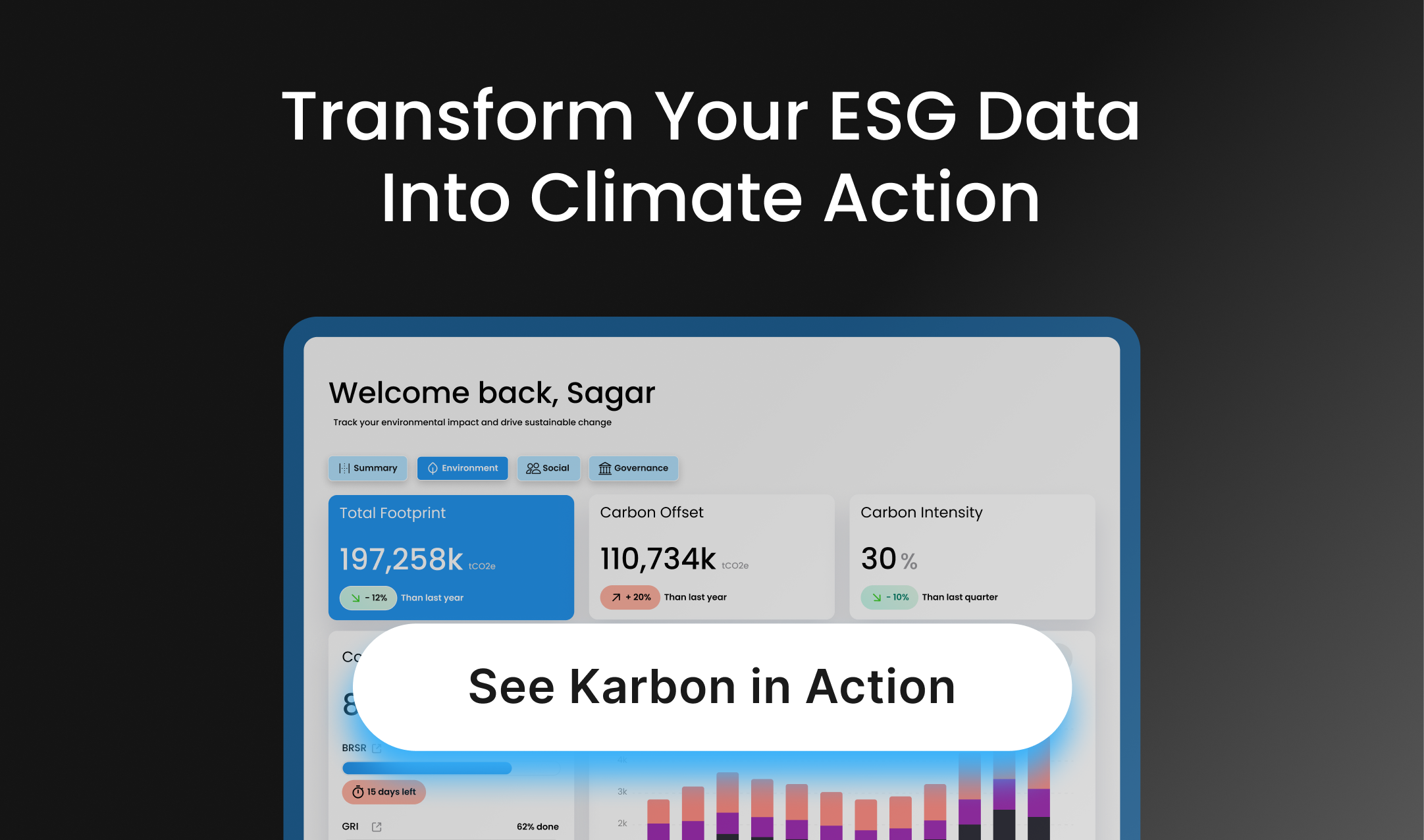
See Karbon in action and discover how PlanetSustech can transform your most fragmented data challenge into your most defensible disclosure.