UAE Federal Decree-Law No. 11 of 2024: What Every Business in the UAE Needs to Know
Compliance & Regulations
PS Team
June 10, 2026
Table of Contents
The UAE's Climate Law Is in Force. Here's What It Actually Requires.
For years, sustainability commitments in the UAE were largely voluntary. Companies could publish ESG reports and set climate targets — but there was no legal obligation to do so.
That changed in 2025.
Federal Decree-Law No. (11) of 2024 on the Reduction of Climate Change Effects entered into force nine months after its publication on 28 August 2024. It creates a legal framework for greenhouse gas management, emissions reporting, and climate action across the UAE — including free zones.
Why Was This Law Introduced?
Article 2 of the decree sets out five objectives:
- Managing emissions across the UAE to contribute to international climate efforts and achieve climate neutrality
- Strengthening the capacity of ecosystems, economic sectors, and society to adapt to climate impacts
- Supporting innovation, research, clean technology, and international cooperation
- Improving climate data sharing at the national level
- Aligning national plans with global sustainability standards and strengthening the UAE's position in global competitiveness
The law also aligns the UAE's actions with its Nationally Determined Contributions under the Paris Agreement — which are formally referenced in Article 12.
Who Does It Apply To?
Article 3 is direct: the law applies to all "sources" in the UAE, including free zones.
Article 1 defines "sources" as public and private legal persons, as well as individual enterprises, whose operations or activities result in the release of greenhouse gases.
One important nuance: Article 6, which sets out the core measurement and reporting obligations, applies specifically to "sources determined by the Ministry and the competent authority." This means the Ministry will designate which entities are subject to formal MRV obligations. If your business has not yet been formally designated, monitoring the Ministry's implementing resolutions closely matters — because designation will carry immediate legal obligations.
What Does the Law Actually Require?
Reduce your emissions
Article 4 requires sources to contribute to reducing their emissions toward climate neutrality. The law lists eight permissible means:
- Improving energy efficiency
- Using clean energy
- Enhancing and protecting natural carbon sinks
- Carbon Capture, Use and Storage (CCUS)
- Using alternatives to saturated fluorocarbons
- Carbon offsetting
- Implementing integrated waste management
- Any other technology or means determined by the Ministry or competent authority
The Ministry can issue resolutions setting the specific controls and standards for each of these.
Measure, report, and verify
Article 6 sets out three core obligations for designated sources:
- First, measure your emissions regularly, prepare an emissions inventory, and submit periodic reports to the standards the Ministry or competent authority specifies.
- Second, submit data on your current emissions-related activities, your current reduction measures, your planned future reduction measures, and the expected results — in the forms approved by the Ministry.
- Third, maintain records of your measured emission quantities for five years from the date of each analysis, and allow authorised Ministry and competent authority officials to access those records.
The Ministry will also build an electronic system for emissions measurement and data submission, linked to systems used by local authorities.
Annual sector-level targets
Article 5 gives the Cabinet — on the Ministry's proposal — the authority to set annual emission reduction targets for all sectors. Targets will be reviewed and updated periodically, and competent authorities must develop sector-specific plans to achieve them.
Adaptation planning
Article 7 requires competent authorities — the local government bodies — to develop and implement adaptation plans across the sectors of infrastructure, energy, environment, health, insurance, and others the Ministry determines.
These plans must cover: assessment of climate-related risks, measures for responding to those risks, early warning systems, and reporting of economic and non-economic losses from climate impacts to the Ministry.
Note: under the decree text, the direct obligation for adaptation planning sits with competent authorities, not businesses. However, businesses in these sectors should expect to provide data and cooperate with the relevant authority's plan.
Incentives: Carbon Credits and Emissions Trading
Article 10 directs the Ministry and competent authority to incentivise sources to adopt new technologies and reduce emissions. The incentive mechanisms the decree names include: facilitating carbon offsetting activities, emissions trading, and adopting shadow prices of carbon.
Article 10(3) states that the Ministry shall establish and manage the National Carbon Credit Registry — a national record tracking carbon emissions, carbon credits, and credit retirement.
The specific rules governing how credits are earned, traded, or retired are not detailed in the decree itself — they will be set through implementing resolutions.
What Happens If You Don't Comply?
Article 15 sets the penalty for violations of the Article 6(1) reporting and measurement obligations: a fine of no less than AED 50,000 and no more than AED 2,000,000.
Article 16: if the same violation is repeated within two years of a final conviction, the penalty is doubled.
Article 17 notes that further administrative penalties — and the mechanism for handling complaints — will be specified through a Cabinet resolution.
How Long Do You Have?
Article 18 gives sources one year from the date of entry into force to bring their status into compliance with the decree and implementing resolutions. The Cabinet can extend this period on the Minister's proposal.
Given that implementing resolutions will fill in the detailed operational requirements — which sources are designated, what the reporting standards are, how the electronic system works — businesses should treat that one-year window as the time to build the foundations, not wait for every detail before acting.
How Planet Sustech and Karbon Can Help
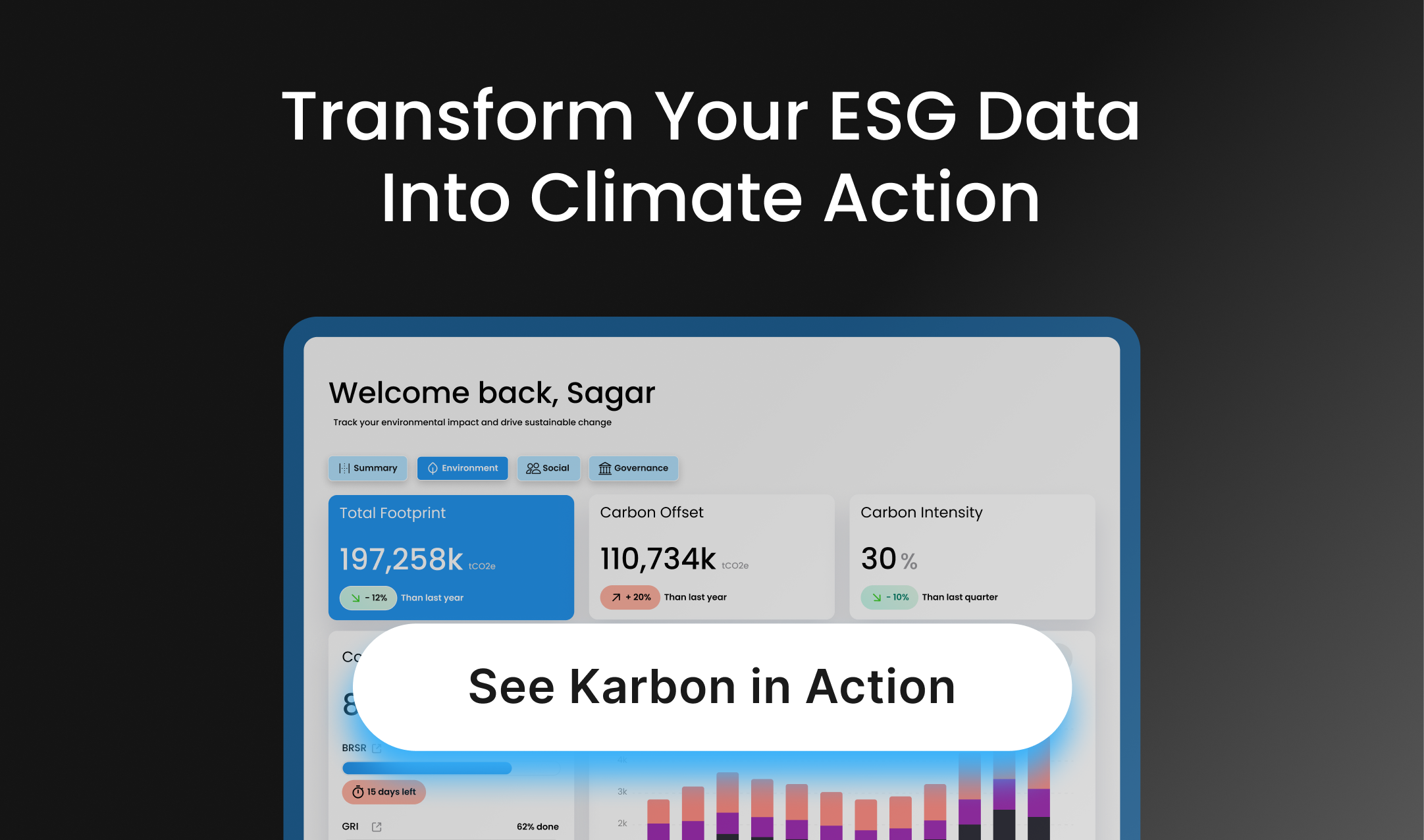
At PlanetSustech, Karbon is built to help organisations do exactly what this law's Article 6 requires: measure greenhouse gas emissions accurately, maintain organised records, and produce structured reports.
Here's how Karbon maps to the decree's requirements:
- Emissions measurement and inventory (Article 6(1)(a)): Karbon helps you capture emissions data from your operations and build a structured inventory that is audit-ready.
- Reporting data submission (Article 6(1)(b)): Karbon organises your current reduction measures, planned future measures, and expected outcomes in formats that can be submitted to the Ministry.
- Five-year record keeping (Article 6(1)(c)): Karbon maintains traceable, timestamped records of your emission quantities — meeting the five-year retention requirement the law specifies.
- Reduction tracking (Article 4): Set emission reduction targets, track progress, and document which of the Article 4 mitigation methods you are applying.
- Carbon offsetting management (Articles 4 and 10): Karbon supports carbon offsetting activities, helping you plan and document compensation for unavoidable emissions as the law permits.
Getting compliant with Decree-Law No. 11 does not have to be overwhelming. The implementing resolutions will add detail, but the core obligation — measure, record, reduce, report — is already clear. Starting now puts you ahead.
FAQ
Q: When did Decree-Law No. 11 of 2024 enter into force?
A: Nine months after its publication on 28 August 2024 — placing entry into force in May 2025 (the exact gazette date determines the precise day).
Q: Does the law apply to businesses in free zones?
A: Yes. Article 3 explicitly includes free zones within the law's scope.
Q: Does the law apply to all businesses or only certain ones?
A: Article 3 applies the law broadly to all sources of GHG emissions. However, Article 6's specific measurement and reporting obligations apply to sources determined by the Ministry and the competent authority. Watch for implementing resolutions that will formally designate which entities are covered.
Q: What emissions categories must be reported?
A: The decree uses the term "emissions" generally and does not use the Scope 1/2/3 classification in its text. The specific standards and formats for reporting will be set through Ministry resolutions.
Q: What is the compliance adjustment period?
A: Article 18 gives sources one year from entry into force to adjust their status. The Cabinet can extend this on the Minister's proposal.
Q: What are the penalties for non-compliance?
A: Fines of AED 50,000 to AED 2,000,000 under Article 15 for violations of the Article 6(1) obligations. Doubled for repeat violations within two years of conviction under Article 16. Additional administrative penalties will be specified through a Cabinet resolution under Article 17.
Q: What is the National Carbon Credit Registry?
A: Article 10(3) establishes that the Ministry will create and manage this registry, which tracks carbon emissions, carbon credits, and credit retirement. The operational rules governing trading and credit generation will come through implementing resolutions.
Not sure where your business stands under Decree-Law No. 11? Let's find out together.