What is ESG Reporting? A Complete Guide for Indian Businesses in 2026
Compliance & Regulations
PS Team
April 1, 2026
Table of Contents
Let's be honest — when someone first says "ESG reporting," your brain probably goes: "Is this another compliance headache?"
You're not wrong to wonder. But here's the thing — ESG reporting is quickly becoming one of the most powerful tools an Indian business can have in 2026. Not just to stay compliant, but to attract investors, win bigger clients, and future-proof your company.
This guide breaks it all down. No jargon. No fluff. Just what you actually need to know.
What Does ESG Even Mean?
ESG stands for Environmental, Social, and Governance. Think of it as a report card — but instead of grades in Maths and Science, it measures how responsibly your business operates.
Here's a simple breakdown:
- Environmental (E): How does your business impact the planet? Think carbon emissions, water usage, waste management, and energy consumption.
- Social (S): How do you treat people? This covers your employees, suppliers, customers, and the communities you operate in.
- Governance (G): How is your company run? This looks at leadership ethics, board diversity, executive pay, anti-corruption policies, and transparency.
Think of it like a three-legged stool. If one leg is weak, the whole thing wobbles — and investors, regulators, and customers will notice.
So What Is ESG Reporting Exactly?
ESG reporting is the process of measuring, tracking, and publicly disclosing your company's performance across those three pillars.
It's not just a document you file away. It's a structured, data-backed disclosure that tells the world — your investors, customers, employees, and regulators — exactly how your business is performing beyond just profit and loss.
If your annual financial report answers "How much money did you make?", your ESG report answers "How did you make it — and at what cost to the world around you?"
Why Is ESG Reporting Suddenly So Important for Indian Businesses?
A few years ago, ESG was mostly a Western concept. Not anymore.
India has moved fast. And in 2026, ESG reporting isn't optional for many businesses — it's a legal requirement.
Here's what's driving this shift:
1. SEBI's BRSR Framework
The Securities and Exchange Board of India (SEBI) introduced the Business Responsibility and Sustainability Report (BRSR) — India's version of ESG reporting. If your company is listed on Indian stock exchanges, BRSR disclosures are now mandatory.
The top 1,000 listed companies by market capitalisation must submit detailed BRSR reports. And SEBI keeps expanding the scope — so even if you're not on the list today, you likely will be tomorrow.
2. Global Supply Chain Pressure
Do you export goods or work with multinational clients? Then you've probably already felt it. Global companies — especially in Europe and the US — now require their Indian suppliers and vendors to meet ESG standards before signing contracts.
Your ESG performance is literally becoming a business qualification.
3. Investor Expectations Have Changed
ESG-focused funds attracted billions in investment globally in 2025 alone. Institutional investors, foreign portfolio investors (FPIs), and even domestic mutual funds are now screening companies based on ESG scores before investing.
A weak ESG profile can mean higher cost of capital — or no capital at all.
4. Consumer and Talent Expectations
India's younger workforce cares deeply about where they work. And consumers increasingly prefer brands that stand for something. ESG gives you a story — and a competitive edge.
The Key ESG Reporting Frameworks You Should Know
You've probably heard terms like "GRI" or "TCFD" thrown around. Let's decode them quickly.
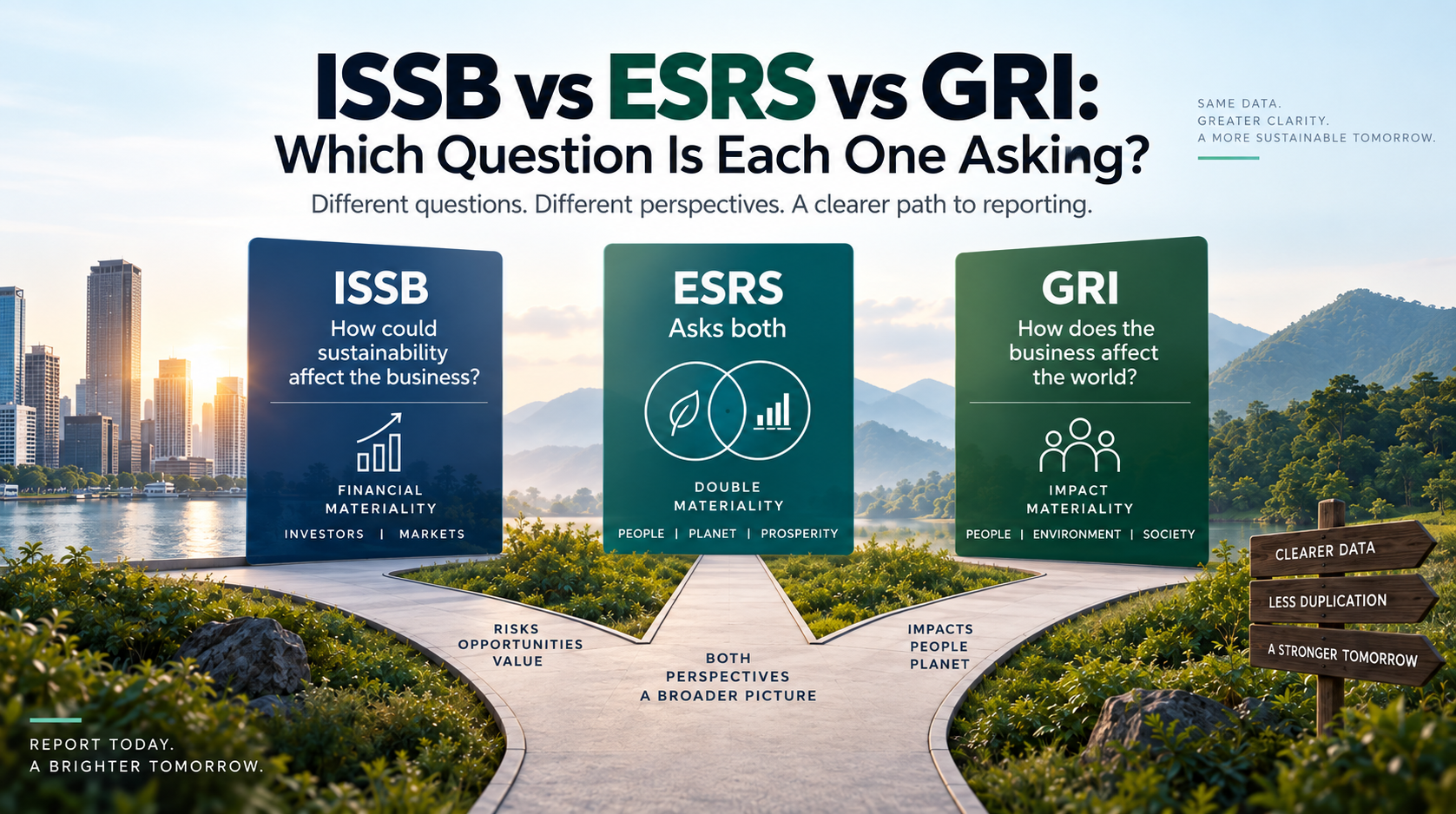
GRI (Global Reporting Initiative): The most widely used global standard for ESG disclosures. It covers everything from emissions to labour practices. Think of it as the gold standard template.
BRSR (Business Responsibility and Sustainability Report): India's own SEBI-mandated framework, aligned with GRI but tailored for Indian regulations and context. If you're a listed company, this is your primary framework.
TCFD (Task Force on Climate-related Financial Disclosures): Focuses specifically on climate risk and how it affects your business financially. Big in the banking and financial services sector.
CDP (Carbon Disclosure Project): A global platform where companies disclose environmental data. High CDP scores are increasingly demanded by global buyers and investors.
You don't necessarily need to follow all of them. But understanding which frameworks apply to your business — and your stakeholders — is the first step.
What Goes Into an ESG Report? (The Key Metrics)
Here's where most businesses get overwhelmed. What data do we actually need to collect?
Let's simplify it by category:
Environmental Metrics
- Total greenhouse gas (GHG) emissions (Scope 1, 2, and 3)
- Energy consumption and % from renewable sources
- Water withdrawal and consumption
- Waste generated and disposal methods
- Carbon reduction targets and progress
Social Metrics
- Total employee count, attrition rate, diversity ratio
- Employee health, safety incidents, and training hours
- Supply chain labour practices
- Community development spending (CSR in India)
- Customer data privacy and product safety
Governance Metrics
- Board composition and diversity
- Anti-corruption and ethics policies
- Executive remuneration disclosures
- Whistleblower mechanisms
- Regulatory compliance record
Does this feel like a lot? It is. That's exactly why having the right system — and the right partner — makes all the difference.
Common ESG Reporting Mistakes Indian Companies Make
Knowing what not to do can save you months of rework.
Mistake #1: Treating ESG as a one-time exercise. ESG reporting is ongoing. Data collection, analysis, and reporting need to be embedded into your operations — not scrambled together at year-end.
Mistake #2: Greenwashing — intentional or not. Making vague claims like "We are committed to sustainability" without backing them up with data is a liability. Regulators and investors are getting better at spotting it.
Mistake #3: Ignoring Scope 3 emissions. Scope 1 is what you emit directly. Scope 2 is from the energy you buy. Scope 3 is everything else — your supply chain, business travel, product use. It's often the largest chunk, and the hardest to measure.
Mistake #4: Data silos. ESG data comes from HR, operations, finance, procurement, and legal. If these teams aren't talking to each other, your report will have gaps and inconsistencies.
Mistake #5: Starting too late. BRSR and ESG reporting requires historical data. You can't build a credible report in 30 days. Companies that start early have a massive advantage.
How to Get Started with ESG Reporting: A Practical Roadmap
You don't need to boil the ocean on day one. Here's a phased approach that works for Indian businesses:
Phase 1: Assess & Gap Analysis (Month 1–2)
Understand where you currently stand. What data do you already have? What frameworks apply to you? Where are your biggest ESG risks and opportunities?
Phase 2: Data Collection & Systems Setup (Month 2–4)
Build internal processes to collect ESG data consistently. This often means integrating ESG data collection into your existing ERP, HR, and operations tools.
Phase 3: Measure & Baseline (Month 3–5)
Establish your baseline metrics. You can't improve what you haven't measured. Your baseline year becomes the reference point for all future progress.
Phase 4: Disclosure & Reporting (Month 5–6)
Draft your BRSR or ESG report using the relevant framework. Ensure it's reviewed by leadership, audited if required, and disclosed on your website and stock exchange portal.
Phase 5: Continuous Improvement
Set targets. Track progress quarterly. Engage stakeholders. Improve your score year over year.
How Does ESG Reporting Actually Benefit Your Business?
Let's put the regulatory talk aside for a moment and talk about real business value.
- Lower cost of capital: Banks and financial institutions are offering better loan terms to companies with strong ESG performance. Green bonds and sustainability-linked loans are growing fast in India.
- Access to global markets: Want to supply to Unilever, Apple, H&M, or any major global brand? ESG compliance is increasingly a prerequisite — not a nice-to-have.
- Risk management: ESG helps you identify risks before they become crises — climate risk, supply chain vulnerabilities, governance failures. It's proactive business intelligence.
- Talent attraction and retention: Top talent wants to work for companies with purpose. A strong ESG story helps you hire and keep the best people.
- Brand reputation: In a world where one viral news story can destroy a brand, ESG reporting signals that your company is managed with integrity.
ESG Reporting in 2026: What's Changed?
India's ESG landscape has evolved rapidly. Here's what's new in 2026:
- BRSR Core disclosures are now mandatory for the top 500 listed companies, with third-party assurance requirements.
- Value chain disclosures — SEBI now expects large companies to report ESG data for their key suppliers and customers too.
- Digital reporting formats — Structured digital submissions are being piloted on stock exchange portals.
- ESG credit ratings — Indian credit rating agencies like CRISIL, ICRA, and CARE now offer ESG ratings that increasingly influence lending decisions.
- RBI's climate risk guidelines — Banks are being asked to incorporate climate risk into lending and investment frameworks, directly impacting how they evaluate your business.
If you thought ESG was slow-moving — 2026 changed that.
Final Thought: ESG Is a Business Strategy, Not a Compliance Box
The companies that treat ESG as just another regulation to tick off will always be on the back foot.
The companies that treat it as a genuine business strategy — investing in the right processes, data, and disclosures — are the ones winning contracts, attracting capital, and building brands that last.
The question isn't whether your business needs ESG reporting in 2026. It does.
The real question is: Are you building the capability to do it well?