Why BRSR Core KPIs Matter More Than Ever in FY 2025-26
Compliance & Regulations
PS Team
March 19, 2026
Table of Contents
Let's be direct. Most listed companies treated BRSR as a checkbox exercise for the first two years. Report what you can, estimate what you can't, and hope no one looks too closely.
SEBI has shifted that calculus — deliberately and methodically.
SEBI's latest circular confirms that ESG disclosures for Value Chain Partners are now applicable on a voluntary basis for the top 250 listed entities from FY 2025-26. Third-party assurance for VCP disclosures follows voluntarily from FY 2026-27. And for first-year VCP reporting, prior-year comparatives are also voluntary — giving companies some breathing room, but no excuse to delay.
Why does this matter beyond regulatory compliance?
- Investor pressure: Global institutional investors screen Indian listed companies on ESG scores. Weak BRSR disclosures directly impact your ESG ratings — and your cost of capital.
- Supply chain resilience: Mapping your value chain's ESG footprint forces visibility that most organisations don't have. Companies that do it well are discovering supply chain risks they didn't know existed.
- First-mover advantage: Companies building robust BRSR compliance infrastructure now will define best practice. Those scrambling to retrofit will pay a premium — in time, money, and credibility.
What BRSR Value Chain Disclosure Actually Requires
SEBI isn't asking you to simply acknowledge that your suppliers have an environmental footprint. It's asking you to measure it — with the same rigour you apply to your own operations — and have a qualified third party sign off on it.
The BRSR Core framework covers nine ESG attributes, each with specific parameters, measurement units, and data assurance requirements. Here's what each one demands
01 · GHG Footprint
This covers your organisation's total greenhouse gas emissions, measured in CO₂ equivalent, across two scopes.
Key parameters to report:
- Scope 1 emissions — direct emissions from owned or controlled sources, broken down by CO₂, CH₄, N₂O, HFCs, and PFCs
- Scope 2 emissions — indirect emissions from purchased electricity, steam, heating, and cooling
GHG emission intensity per rupee of revenue (PPP adjusted) and per unit of product or service output
02 · Water Footprint
This goes beyond simply reporting how much water your operations use — it requires disclosure of intensity and what happens to water after use.
Key parameters to report:
- Total water consumption in million litres or kilolitres
- Water consumption intensity per rupee of revenue and per unit of product/service
- Water discharge broken down by destination and level of treatment applied
03 · Energy Footprint
Both the quantum and the quality of your energy mix matter here — SEBI wants to see how much of your energy comes from clean sources.
Key parameters to report:
- Total energy consumed, combining renewable and non-renewable sources
- Percentage of total energy sourced from renewable sources
- Energy intensity per rupee of revenue and per unit of product or service output
04 · Embracing Circularity (Waste Management)
This is the most granular of the nine attributes — SEBI requires waste reporting broken down by type, not just in aggregate.
Key parameters to report:
- Waste generated by category: plastic waste, e-waste, bio-medical waste, construction and demolition waste, battery waste, radioactive waste, other hazardous waste, and non-hazardous waste
- Total waste intensity per rupee of revenue and per unit of output
- Total waste recovered through recycling, reuse, or other recovery operations
- Waste disposed by method — incineration, landfill, or other
05 · Employee Wellbeing & Safety
This attribute connects your people investment to measurable outcomes — both in spend and in safety performance.
Key parameters to report:
- Wellbeing spend on employees and workers as a percentage of total company revenue
- Lost Time Injury Frequency Rate (LTIFR) for both employees and contract workers
- Number of permanent disabilities and fatalities
06 · Enabling Gender Diversity
Two focused disclosures that cut through broad diversity statements to measurable indicators.
Key parameters to report:
- Gross wages paid to female employees as a percentage of total wages paid
- Total POSH complaints reported, complaints upheld, and complaints as a percentage of total female employees and workers
07 · Enabling Inclusive Development
This attribute reflects SEBI's focus on economic inclusion — tracking whether listed companies' procurement and employment practices support smaller businesses and underserved communities.
Key parameters to report:
- Input material sourced directly from MSMEs, small producers, and from within India — as a percentage of total purchases by value
- Wages paid to persons employed in smaller towns as a percentage of total wage cost
08 · Fairness with Customers & Suppliers
Two financial and governance indicators that signal how responsibly a company manages its data and its payment obligations.
Key parameters to report:
- Instances of data loss or cyber security breaches involving customer data — as a percentage of total data breaches or cyber security events
- Number of days of accounts payable outstanding
09 · Open-ness of Business
This attribute looks at the concentration and transparency of a company's business relationships — particularly with trading intermediaries and related parties.
Key parameters to report:
- Purchases from trading houses, dealers, and related parties as a percentage of total purchases; purchases from top 10 trading houses as a percentage of total purchases from trading houses
- Sales to dealers and distributors as a percentage of total sales; sales to top 10 dealers as a percentage of total dealer/distributor sales
- Share of Related Party Transactions (RPTs) in purchases, sales, loans and advances, and investments
Common Challenges: Where Indian Companies Are Getting It Wrong
Across manufacturing, IT, financial services, and pharma, we see the same four failure patterns repeated.
Mistake 1: Treating It as a Procurement Problem
Many companies hand value chain ESG data collection entirely to the procurement team. The problem? Procurement teams aren't trained to define emission boundaries, validate reported data, or distinguish between estimated and measured values. The data looks complete — but it won't hold up to an auditor.
Mistake 2: Relying on Annual Supplier Self-Declarations
A supplier filling out a sustainability questionnaire once a year is not robust value chain data. SEBI's assurance requirements demand traceability — the ability to show how a number was derived, what methodology was applied, and whether it aligns with GHG Protocol or ISO 14064. A PDF form from your supplier won't satisfy a reasonable assurance auditor.
Mistake 3: Underestimating Scope 3 Complexity
Value chain emissions typically represent 70–90% of a company's total carbon footprint. Yet most Indian listed companies still report Scope 3 using spend-based estimates or industry averages. SEBI's framework is actively moving toward activity-based and supplier-specific methodologies. FY 2025-26 is the year to make this shift.
Mistake 4: Building on Spreadsheets That Break
When you're collecting ESG data from dozens or hundreds of value chain partners, manual consolidation isn't just inefficient — it's a liability. A formula error in Excel doesn't just create inaccurate numbers. It creates an audit failure.
How Karbon Solves This: Built for BRSR Core Complexity
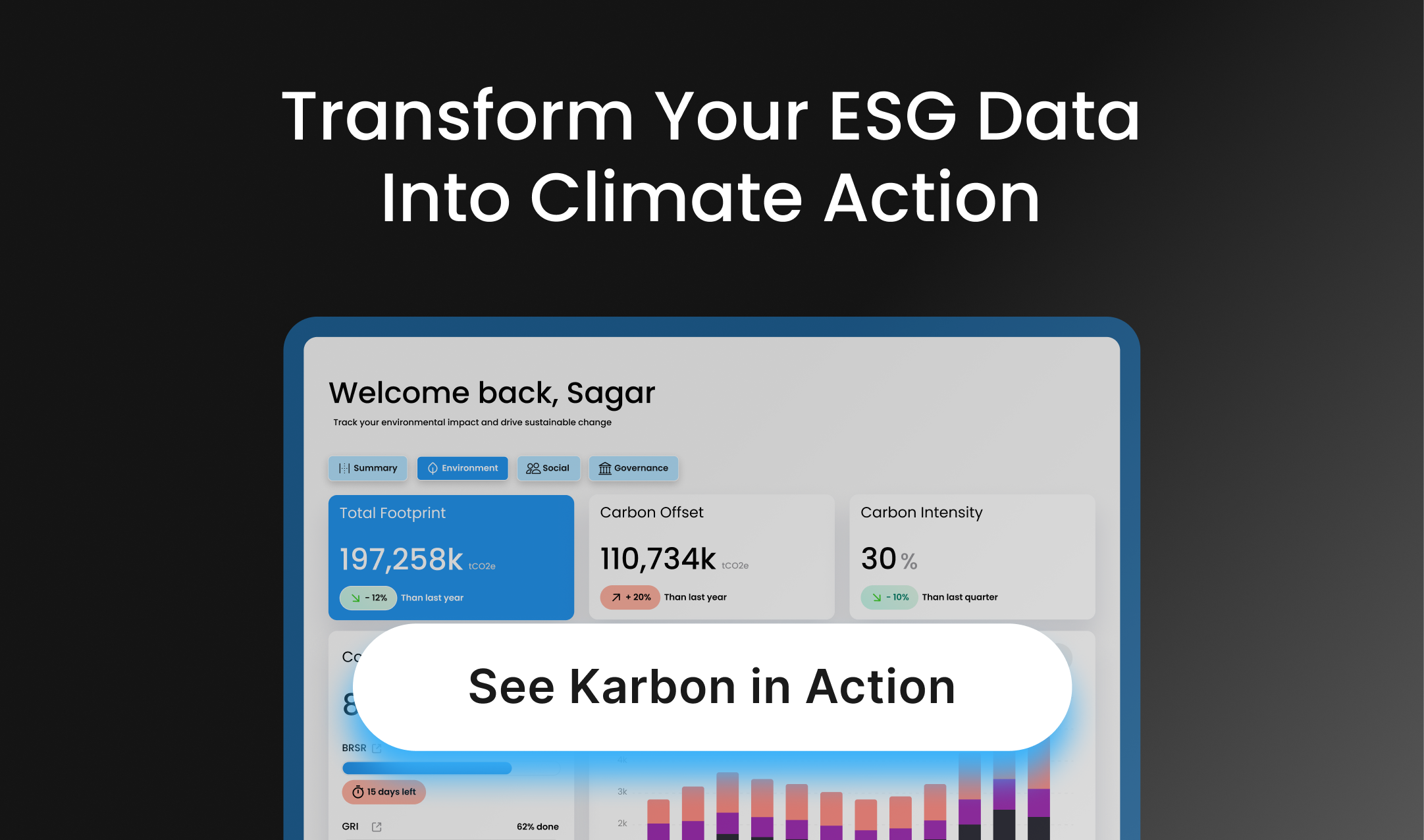
Karbon, built by Planet Sustech, is not a dashboard where you manually enter numbers and get a chart. It's a system of record — the calculation engine, data collection layer, and audit trail architecture that connects your value chain to your disclosure obligations.
🔄 Automated Scope 1, 2 & 3 Calculations Karbon's calculation engines handle GHG Protocol-aligned emissions accounting — including all 15 Scope 3 categories — using activity-based methodologies that SEBI's evolving framework demands.
🔗 ERP Integration with SAP & More Pull operational data directly from your existing systems. No duplicate data entry, no manual exports. Karbon connects to ERP and SAP so your source data flows in automatically.
📥 Structured Supplier Data Collection Replace email questionnaires with standardised digital data templates. Every supplier submission is timestamped, version-controlled, and tagged with methodology metadata — ready for auditor review.
✅ Third-Party Assurance Support Karbon's audit trail architecture is built specifically for reasonable assurance. Every reported number traces back to its source, with documented methodology, assumptions, and internal review records.
📄 BRSR Core-Aligned Reporting Generate disclosure-ready reports mapped to SEBI's BRSR Core KPI framework — with the structure, terminology, and data requirements that SEBI and assurance providers expect.
The Regulatory Timeline: Where You Stand
SEBI has been deliberate about this expansion. Here's the glide path:
FY 2023-24 — Top 150 listed entities · BRSR Core · Limited assurance (mandatory)
FY 2024-25 — Top 250 listed entities · BRSR Core · Limited assurance (mandatory)
FY 2025-26 — Top 500 listed entities · BRSR Core · Reasonable assurance expanding | Top 250 entities · VCP ESG disclosure (voluntary) 🔴 Now
FY 2026-27 — Top 1,000 listed entities · BRSR Core | Top 250 entities · VCP third-party assurance (voluntary)
Companies that build their BRSR compliance infrastructure now — rather than scrambling to retrofit — will have a measurable advantage in investor confidence, ESG ratings, and supply chain resilience.
Frequently Asked Questions About BRSR Core KPIs
Which companies must comply with BRSR Core and VCP disclosures for FY 2025-26?
For BRSR Core, the top 500 listed entities are in scope for FY 2025-26 with expanding assurance requirements. For Value Chain Partner (VCP) ESG disclosures, the top 250 listed entities may report on a voluntary basis from FY 2025-26. Third-party assurance for VCP becomes voluntary from FY 2026-27.
What is the difference between BRSR and BRSR Core?
BRSR is the broader disclosure framework applicable to the top 1,000 listed companies. BRSR Core is the subset of nine Key Performance Indicators that require third-party assurance and extend ESG reporting into the value chain. BRSR Core is the more demanding and higher-scrutiny component.
What does 'reasonable assurance' mean for BRSR disclosures?
Reasonable assurance is a higher standard than limited assurance. It means a qualified auditor must be able to trace every reported BRSR Core KPI back to its source — including methodology, source data, assumptions, and internal review evidence. Spreadsheet-based data collection systems typically cannot support this level of audit scrutiny.
How does Karbon handle Scope 3 emissions for Indian companies?
Karbon's Scope 3 module covers all 15 GHG Protocol categories with activity-based calculation methodologies, by supporting internationally recognised factors for global supply chains.
Can Karbon integrate with our existing SAP systems?
Yes. Karbon integrates directly with SAP and other ERP systems to pull operational data automatically — eliminating duplicate entry, reducing manual errors, and ensuring your ESG calculations are based on the same source data your financial systems use.
How long does it take to implement Karbon for BRSR Core compliance?
For most listed companies, the initial implementation — including ERP integration, supplier onboarding templates, and baseline data collection — can be completed within 8–12 weeks. Given the compliance trajectory, starting now rather than in Q4 makes a significant difference.
What happens if our BRSR value chain data doesn't pass reasonable assurance?
Failed or qualified assurance reports create significant regulatory and reputational risk. Beyond regulatory exposure, a failed assurance audit can trigger ESG rating downgrades — directly impacting your cost of capital.
The Bottom Line
BRSR Core KPIs have moved from a sustainability aspiration to a legal obligation with audit consequences. For India's listed companies, FY 2025-26 is the year that separates organisations that took this seriously from those that didn't.
The companies winning at value chain disclosure aren't doing more work — they're doing it smarter. They've replaced email questionnaires with structured data collection. They've replaced spreadsheets with calculation engines. And they've replaced hope with audit trails.
Karbon by Planet Sustech exists to give your organisation exactly that infrastructure — built for India's BRSR Core KPI framework, ready for the reasonable assurance standard, and scalable across your entire value chain.
The window for incremental fixes is closing. The time to build this right is now.
Ready to Simplify Your BRSR Value Chain Disclosure?
Join India's leading listed companies already using Karbon to turn their most complex SEBI reporting obligation into their most defensible one.